Top Three Mistakes in Solo 401(k) Plans

Photo of an old statue with its palm over its face.Solo 401(k) plans have grown significantly and are often used by self-directed investors. Solo 401(k)s are an excellent tool for self employed persons to maximize contributions in their own business or self-employment just like large companies who offer plans for their employees. The basic rules for solo 401(k)s are that you must be self-employed and that you must have no other employees other than the business owner and the owner’s spouse. As happens with many good things, this is starting to get over-sold and we are seeing common problems arise with persons who create them on-line or with the assistance of someone who has no credentials or experience outside of creating a catchy website. Here are a few things to watch out for.
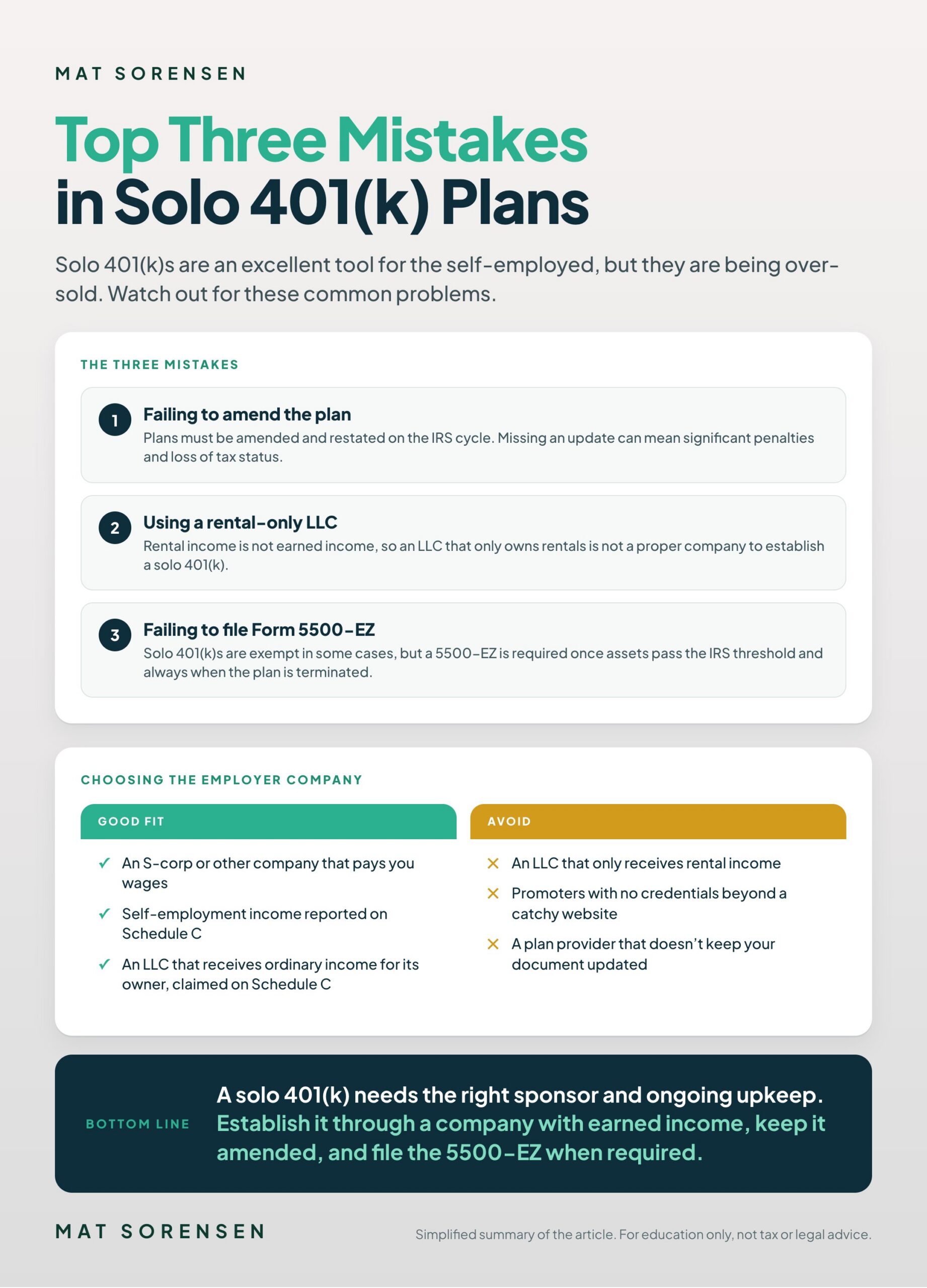
Infographic: three common solo 401(k) mistakes and which company should establish the plan

Top Three Mistakes in Solo 401(k) Plans

1. Failure to Update/Amend

Pursuant to Revenue Procedure 2007-44, 401(k) plans shall be amended and restated every six years to conform with current law. The company who provided your plan document, usually what is called a pre-approved plan document for solo 401(k)’s, should be providing you with these updates so that your plan stays in compliance with the amendment cycles established by the IRS. Failure to properly update the plan can result in significant penalties and revocation of tax status.

2. Using an LLC With Rental Income as The Employer/Company

Solo 401(k)s must be established by an employer company. Unlike IRAs, where any individual may establish an account, a 401(k) may only be established by a company and is a benefit for its employees. For example, a solo 401(k) for a self-employed real estate agent with no other employees is created for the real estate agent who is the sole employee/owner. For many self-employed persons who have no other employees, this type of 401(k) is an excellent retirement plan too.

Unfortunately, the solo 401(k) is being oversold and over promoted to real estate investors who only own rentals. We have seen many promoters (operating out of a basement somewhere) who state that you can establish a solo 401(k) with your LLC that owns rental real estate. After all, they say, the LLC is a company and you are the only owner. Therefore this company can establish a solo 401(k). This is only partly true. The LLC that owns rental properties is not a proper entity in which to establish a solo 401(k) since the LLC receives “rental income” and since the owners of the LLC are not considered “employees” receiving wages or earned income that may be contributed to a retirement account. Rental income cannot be contributed to a retirement account and as a result the owner of the LLC is not an employee or person receiving earned income that qualifies to have a solo 401(k) account. All 401(k)s, solo 401(k)s included, must be established by a company for the benefit of its employees with wages or earned income. See IRS Publication 560. As a result, we recommend that clients use companies where there is wage income (e.g. s-corps) or self-employment income that creates earned income on schedule C  be used to establish a solo 401(k). While an LLC may be used to adopt a solo 401(k), that would only be the case if the LLC receives ordinary income for its owner that is then claimed on schedule C of the owner’s tax return.

3. Failing to File Form 5500-EZ

In general, 401(k)s are required to file a return called form 5500. Solo 401(k)s, however, have some exemptions to the 5500 filing requirement but there are many situations where a solo 401(k) is still required to file an annual form 5500-EZ return. The first instance where a 5500-EZ tax return is required is when the solo 401(k) has over $250,000 in assets. The second instance is when the plan is terminated. Regardless of assets, a form 5500 must still be filed at termination.

Our law firm has experience in creating solo 401(k)s that can be self-trustee’d and self-directed and we also assist our clients with annual maintenance, plan amendments, and required annual 5500-EZ filings. Contact us at the law firm to learn more information about our services.

FREE SOLO 401(K) GUIDE

Self-employed? Learn how a self-directed Solo 401(k) works and how much you can contribute.

Get the Free Solo 401(k) Guide

Prefer to talk it through? Book a call with a Directed IRA specialist
Maxed Out Your 401(k), What’s Next?

Photo of graffiti on the ground reading as "What's Next?"For most American workers and business owners, the first vehicle to save and invest in is your 401(k). The tax benefits and the typical company matching that offers free company money make a 401(k) a great place to save and invest for the long-haul. But what if you’ve maxed out your 401(k) contributions? What else can you do?

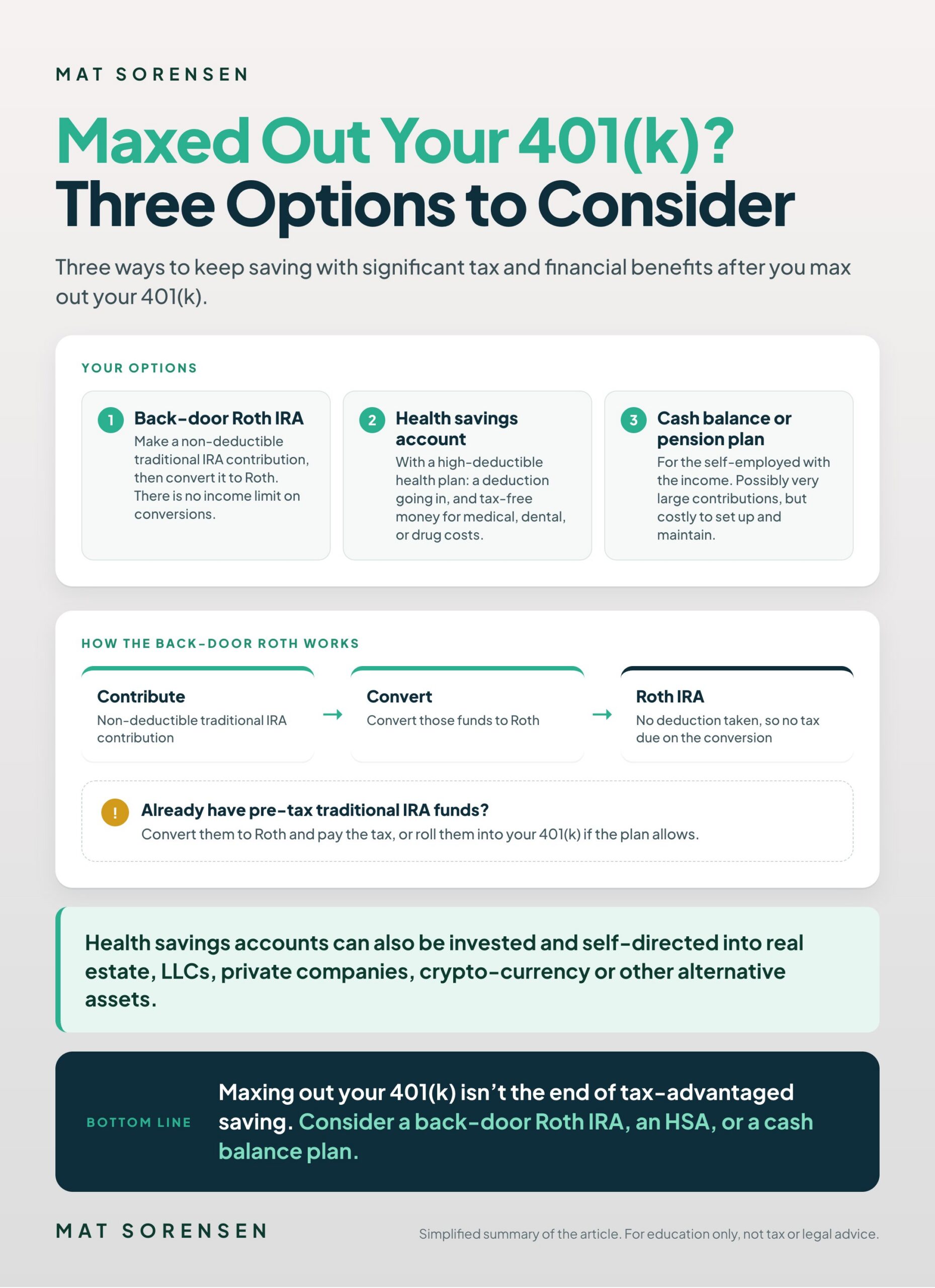
Here are the three options you should consider that provide significant tax and financial benefits:

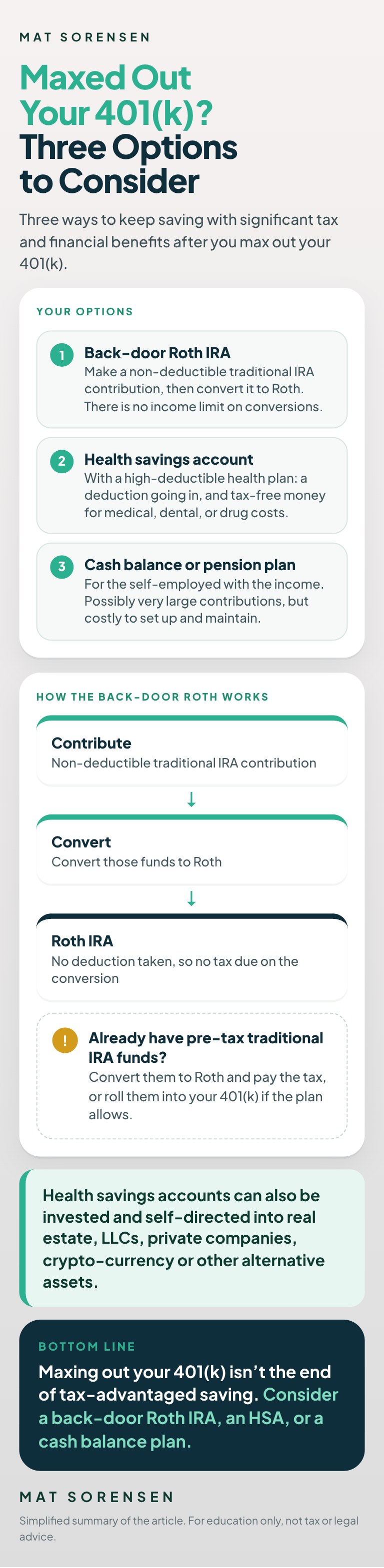
Infographic: three options after maxing out your 401(k), the back-door Roth IRA, a health savings account, and a cash balance or defined benefit plan

1. Back-Door Roth IRA

This is a really cool option that many clients utilize every year. (I do too.) First, you may be thinking that you can’t do a Roth IRA because your income is too high or because you already maxed out your 401(k). WRONG: It is still possible to do a Roth IRA, but you just have to know the back-door route. The reason it’s called a back-door Roth IRA is because you make a non-deductible traditional IRA contribution (up to $5,500 annual limit, $6,500 if 50 or older). Then, after the non-deductible traditional IRA contribution is made, you then convert the funds to Roth. There is no income limit on Roth conversions, and since you didn’t take a deduction on the non-deductible traditional IRA contribution, there is no tax due on the conversion to Roth. And now, voila, you have $5,500 in your Roth IRA. That’s the back-door route.

UPDATE (NOV 2026)

This section uses the IRA limits from when this article was written. For 2026, the IRA contribution limit is $7,500 ($8,600 if you’re 50 or older). (Source: IRS)

There is a road block though for some who already have funds already in traditional IRAs. The Roth conversion pro-rata rule states that you can’t convert only your non-deductible traditional IRA funds. Each conversion is treated as coming proportionally from all of your traditional IRA funds, including your pre-tax traditional IRA funds, which you got a deduction for and now pay tax on when you convert (this is figured on Form 8606 using the year-end value of all your traditional IRAs). So, if you have pre-tax traditional IRA funds and you want to do the back-door Roth IRA, you have two options:

  1. 1First, convert those pre-tax traditional IRA dollars to Roth and pay the taxes on the conversion.
  2. 2Second, if your 401(k) allows, you can roll those pre-tax traditional IRA dollars into your 401(k).

If you don’t have a traditional IRA, you’re on easy street and only need to do the two-step process of making the non-deductible traditional IRA contribution and then convert it to Roth.

You have until April 15th of each year to do this for the prior tax year. Additionally, while the GOP tax-reform restricted Roth re-characterizations, Roth conversions and the back-door Roth IRA route were unaffected. For more detail on the back-door Roth IRA, check out my prior article here.

2. Health Savings Account (HSA)

If you have a high-deductible health insurance plan, you can make contributions to your HSA up until April 15th of each year for the prior tax year. Why make an HSA contribution? Because you get a tax deduction for doing it, and because that money comes out of your HSA tax-free for your medical, dental, or drug costs. You can contribute and get a deduction, above the line, of up to $4,400 if you’re single or for up to $8,750 for family (2026). We all have these out-of-pocket costs, and this is the most efficient way to spend those dollars (from an account you got a tax deduction for putting money into). If you didn’t have a high deductible HSA-qualifying plan by December 1st of the prior year, then the HSA won’t work.

Any amounts you don’t spend on medical can be invested in the account and grow tax-free for your future medical or long-term care. Health savings accounts can also be invested and self-directed into real estate, LLCs, private companies, crypto-currency or other alternative assets. We’ve helped many clients invest these tax-favored funds using a self-directed HSA.

For more details on health savings accounts, check out my partner Mark’s article here.

3. Cash Balance Plan or Defined Benefit Plan

If you’re self-employed you may consider establishing a cash balance plan or a defined benefit plan (aka “pension”), where you can possibly contribute hundreds of thousands of dollars each year. The amount of your contribution depends on your income, age, and the age and number of employees you may have. A cash balance plan or defined benefit plan/pension will cost you ten thousand dollars or more in fees to establish, and is far more expensive to maintain and administer. But, if you have the income, it’s a valuable option to consider. For more details on cash balance plans, check out Randy Luebke’s article here.

FREE SELF-DIRECTED IRA GUIDE

Learn how a self-directed Roth IRA can invest in real estate, private companies, notes, and more, and keep the growth tax-free.

Get the Free Self-Directed IRA Guide

Prefer to talk it through? Book a call with a Directed IRA specialist

Fact and Fiction for IRA RMDs

If you are age 70 1/2 or older and if you have a traditional IRA (or SEP or SIMPLE IRA or 401k), you must take your 2015 required minimum distributions (“RMD”) by December 31, 2015. In short, the RMD rules require you to distribute a portion of funds from your retirement account to yourself personally. These distributed funds are subject to tax and need to be included on your personal tax return.

UPDATE (NOV 2026)

This article was written for the 2015 tax year. Required minimum distributions now start at age 73 (rising to 75 in 2033) under the SECURE 2.0 Act, and the penalty for a missed RMD is now 25% of the amount not taken (10% if corrected within two years). When this article was written, RMDs started at 70½ and the penalty was 50%. (Source: IRS)

EXAMPLE

Let’s take an example to illustrate how the rule works. Sally is 72 and is required to take RMD each year. She has an IRA with $250,000 in it. According to the distribution rules, see IRS Publication 590-B, she will need to distribute $9,765 by the end of the year. This equates to about 4% of her account value. Next year, she will re-calculate this annual distribution amount based on the account’s value and her age.

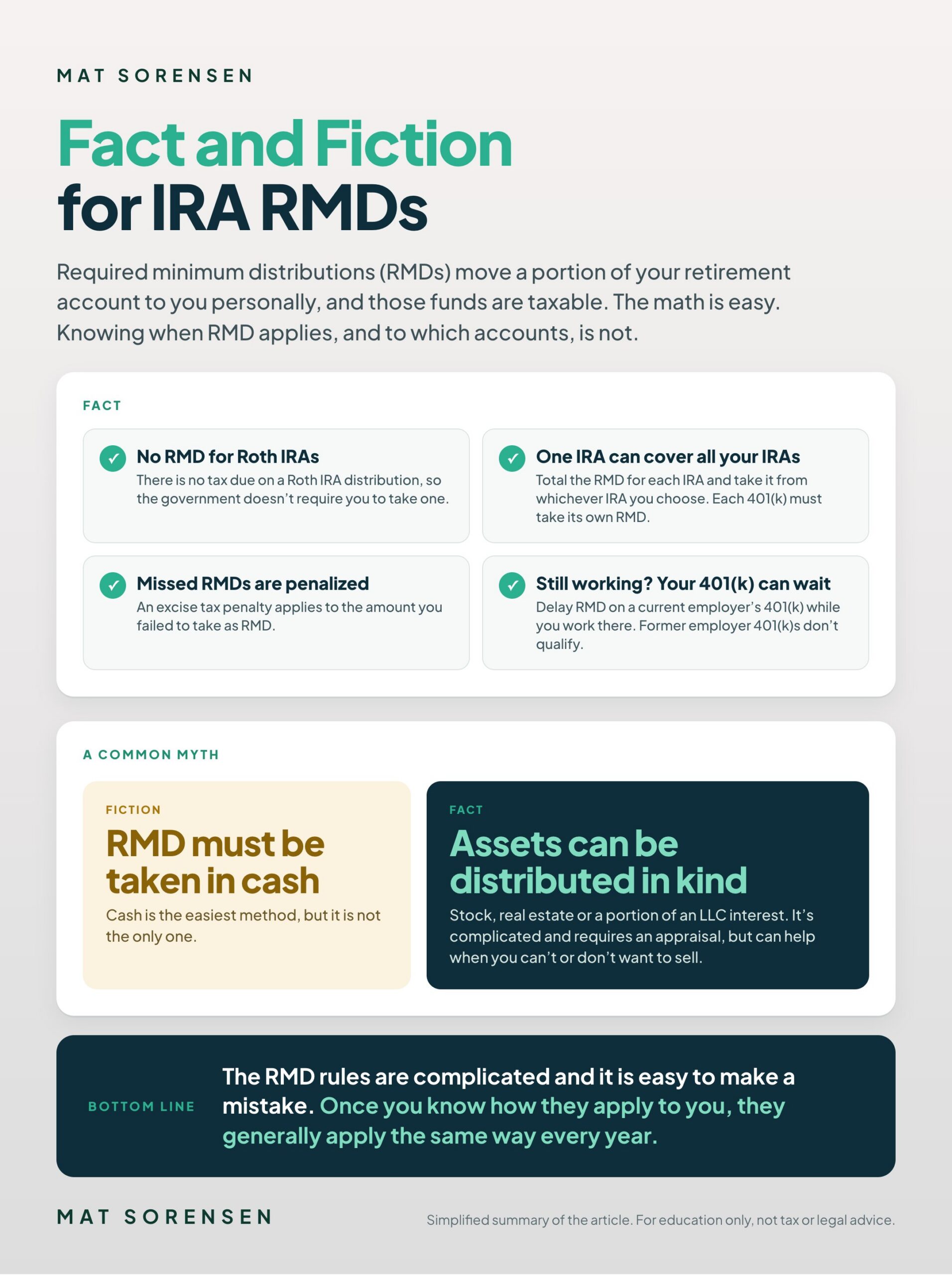
Once you know how to calculate the RMD, determining the distribution amount is relatively easy. However, the rules of when RMD applies and to what accounts can be confusing. To help sort out the confusion, I have outlined some facts and fiction that every retirement account owner should know about RMDs. First, let’s cover the facts. Then, we’ll tackle the fiction.

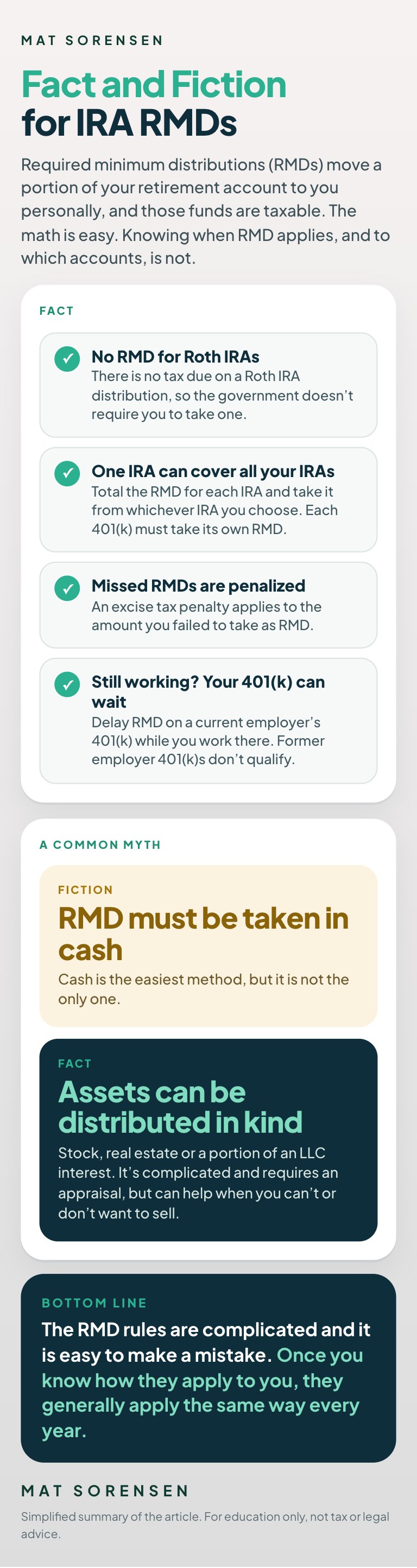
Infographic: facts about IRA required minimum distributions and the myth that RMD must be taken in cash

Fact

  1. 1No RMD for Roth IRAs: Roth IRAs are exempt from RMDs. Even if you are 73 or older, you’re not required to take distributions from your Roth IRA. Why is that? Because there is no tax due when you take a distribution from your Roth IRA. As a result, the government doesn’t really care whether you distribute the funds or not as they don’t receive any tax revenue.
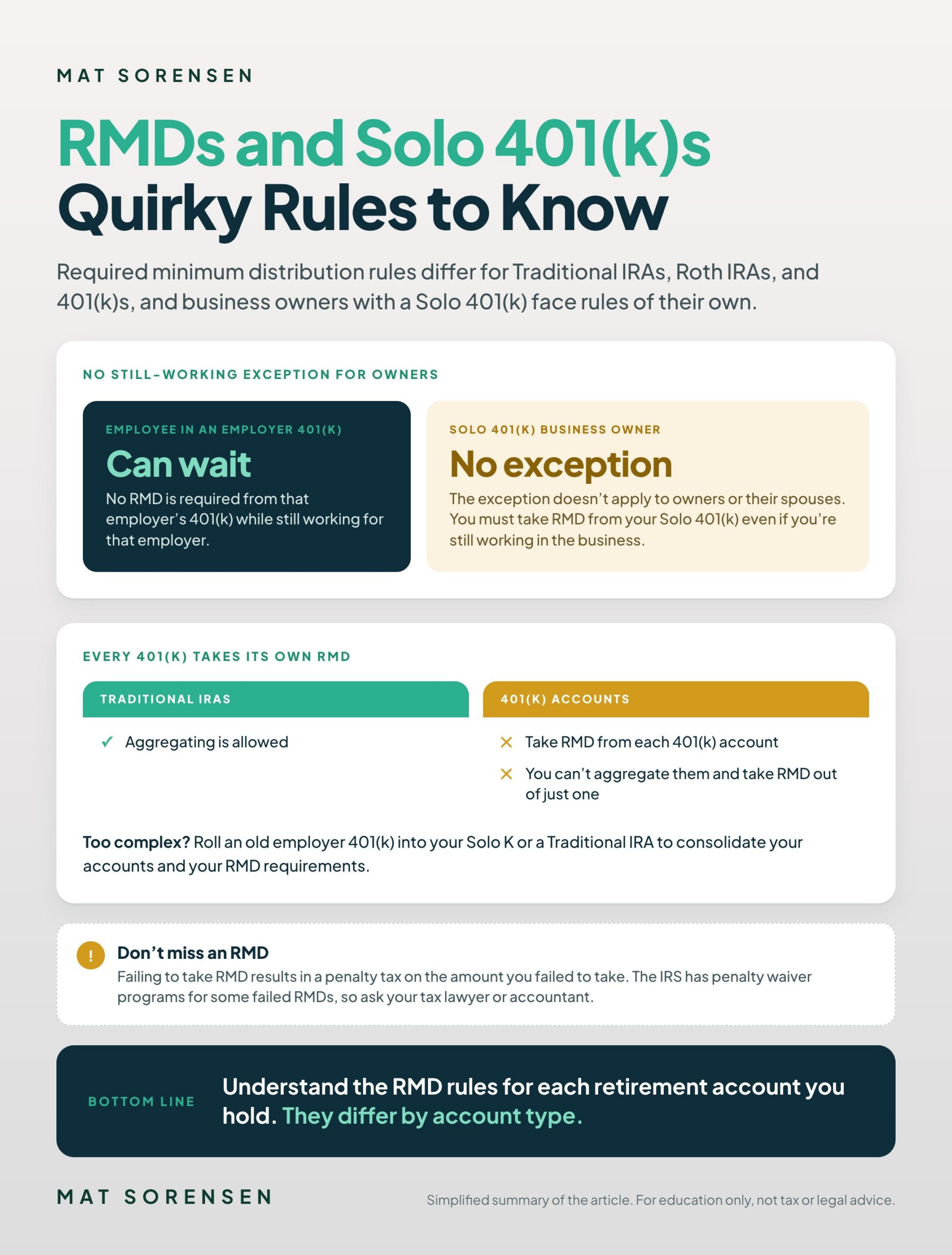
  2. 2RMD Can Be Taken From One IRA to Satisfy RMD for All IRAs: While each account will have an RMD amount to be distributed, you can total those amounts and can satisfy that total amount from one IRA. It is up to you. So, for example, if you have a self directed IRA with a property you don’t want to sell to pay RMD and a brokerage IRA with stock you want to sell to pay RMD, then you can sell the stock in the brokerage IRA and use those funds to satisfy the RMD for both IRAs. You can’t combine RMD though for 401(k) and IRA accounts. Only IRA to IRA. Each 401(k) must take its own RMD.
  3. 350% Excise Tax Penalty: There is a 50% excise tax penalty on the amount you failed to take as RMD. So, for example, if you should’ve taken $10,000 as RMD, but failed to do so, you will be subject to a $5,000 excise tax penalty. Check back next month where I will summarize some measures and relief procedures you can take if you failed to take required RMD.
  4. 4401(k) Account Holder Still Working for 401(k) Employer: If you have a 401(k) with a current employer and if you are still working for that employer, you can delay RMD for as long as you are still working at that employer. This exception doesn’t apply to former employer 401(k) accounts even if you are otherwise employed.

Fiction

UPDATE (NOV 2026)

Since 2024, Roth 401(k) and Roth 403(b) accounts no longer require RMDs during the owner’s lifetime (SECURE 2.0 Act). Item 2 below describes the rules before that change. (Source: IRS)

  1. 1RMD Due by End of Year: You can make 2015 RMD payments until the tax return deadline of April 15, 2016. Wrong! While you can make 2015 IRA contributions up until the tax return deadline of April 15, 2016, RMD distributions must be done by December 31, 2015.
  2. 2Roth 401(k)s are Subject to RMDs: While Roth IRAs and Roth 401(k)s are both tax-free accounts, the RMD rules apply differently. As I stated above, Roth IRAs are exempt from RMD rules. However, Roth 401(k) owners are required to take RMD. The distributions will not be subject to tax but they will start the slow process of removing funds from the tax-free account.
  3. 3RMD Must Be Taken In Cash: False. Required Minimum distributions may be satisfied by taking cash distributions or by taking a distribution of assets in kind. While a cash distribution is the easiest method to take RMD, you may also satisfy RMD by distributing assets in kind. This may be stock or real estate or other assets that you don’t want to sell or that you cannot sell. This doesn’t occur often but some self directed IRA owners will end up holding an asset they don’t want to sell because of current market conditions (e.g. real estate) and they decide to take distributions of portions of the real estate in-kind in order to satisfy RMD. This process is complicated and requires an appraisal of the asset(s) being distributed and partial deed transfers (or partial LLC membership interest transfers, if the IRA owns an LLC and the LLC owns the real estate) from the IRA to the IRA owner. While this isn’t the recommended course to satisfy RMD, it is a potential solution to IRA owners who are holding an asset, who have no other IRA funds to distribute for RMD, and who wish to only take a portion of the asset to satisfy their annual RMD.

The RMD rules are complicated and it is easy to make a mistake. Keep in mind that once you know how the RMD rules apply in your situation it is generally going to apply in the same manner every year thereafter with only some new calculations based on your age and account balances each year thereafter.

Click here for a nice summary of the RMD rules from the IRS.

FREE SELF-DIRECTED IRA GUIDE

Learn how to invest your IRA in real estate, private companies, notes, precious metals, and more.

Get the Free Self-Directed IRA Guide

Prefer to talk it through? Book a call with a Directed IRA specialist

Avoiding the 20% Withholding Tax on 401(k) Distributions

Distributions from a 401(k) to its owner are subject to a 20% withholding tax whereas distributions from an IRA are not subject to a withholding tax. As a result, any amounts distributed from a 401(k) to its owner will be reduced by 20% and that 20% will be sent to the IRS in expectation of the taxes that will be due from the account owner for the distribution. Any amounts distributed from an IRA, however, are not subject to the 20% withholding as the IRA owner can elect out of withholding. The discrepancy in the rules is one advantage of using an IRA in retirement as opposed to a 401(k) since the amounts distributed from the IRA can be received in their entirety.

Keep in mind, the tax owed on a distribution from an IRA or 401(k) is the exact same. The difference is when you are required to pay it. In both instances you will receive a 1099-R from your custodian/administrator but in the 401(k) distribution you are required to set aside and effectively pre-pay the taxes owed.

Infographic: how rolling 401(k) funds to an IRA before taking a distribution avoids mandatory 401(k) withholding

The 401(k) Withholding Rule in Practice

EXAMPLE

Let’s walk through a common situation that outlines the issue. Sarah is 64 and has a 401(k). She would like to distribute $100,000 from the 401(k). She contacts her 401(k) administrator and is told that on a $100,000 distribution they will send her $80,000 and that $20,000 will be sent to the IRS for her to cover the 20% withholding requirement.

Since this 20% withholding requirement does not apply to IRAs, Sarah decides to roll/transfer the $100,000 from her 401(k) directly to an IRA. Once the funds arrive at the IRA, Sarah takes the $100,000 distribution from the IRA and there is no mandatory 20% withholding so she actually receives $100,000 in total.

Keep in mind, Sarah will still owe taxes on the $100,000 distribution from the IRA and she will receive a 1099-R to include on her tax return. That being said, Sarah has given herself the ability to access all of the amounts distributed for her retirement account without the need for sending withholding to the IRS at the time of distribution.

$80,000

What Sarah would receive from the 401(k)

$100,000

What she receives from the IRA

It’s that simple. Don’t take distributions from a 401(k) and subject yourself to the 20% withholding tax when you can roll/transfer those 401(k) funds to an IRA and receive the entire distribution desired without a 20% withholding.

FREE ROLLOVER GUIDE

Learn how to move an old 401(k) or IRA into a self-directed IRA, tax-free.

Get the Free Transfers & Rollovers Guide

Prefer to talk it through? Book a call with a Directed IRA specialist