Inherited an IRA? Don’t Miss This 10-Year Rule

Inheriting an IRA or 401(k) can create a costly deadline many beneficiaries do not see coming. If you miss a required distribution, the IRS can impose a 25% excise tax on the amount you should have withdrawn—on top of the ordinary income tax that generally applies to distributions from inherited traditional IRAs and 401(k)s.

The IRS temporarily waived the excise tax for certain missed inherited-account required minimum distributions (RMDs) from 2021 through 2024 because the post-SECURE Act rules caused widespread confusion. That broad relief has ended. For 2025 and later tax years, beneficiaries who miss an applicable inherited-account RMD may again be exposed to the penalty.

The 10-year rule is not always just a 10-year deadline. Depending on the original account owner’s RMD status at death, a beneficiary may have to take annual distributions during the 10-year period—not simply wait and empty the account at the end.
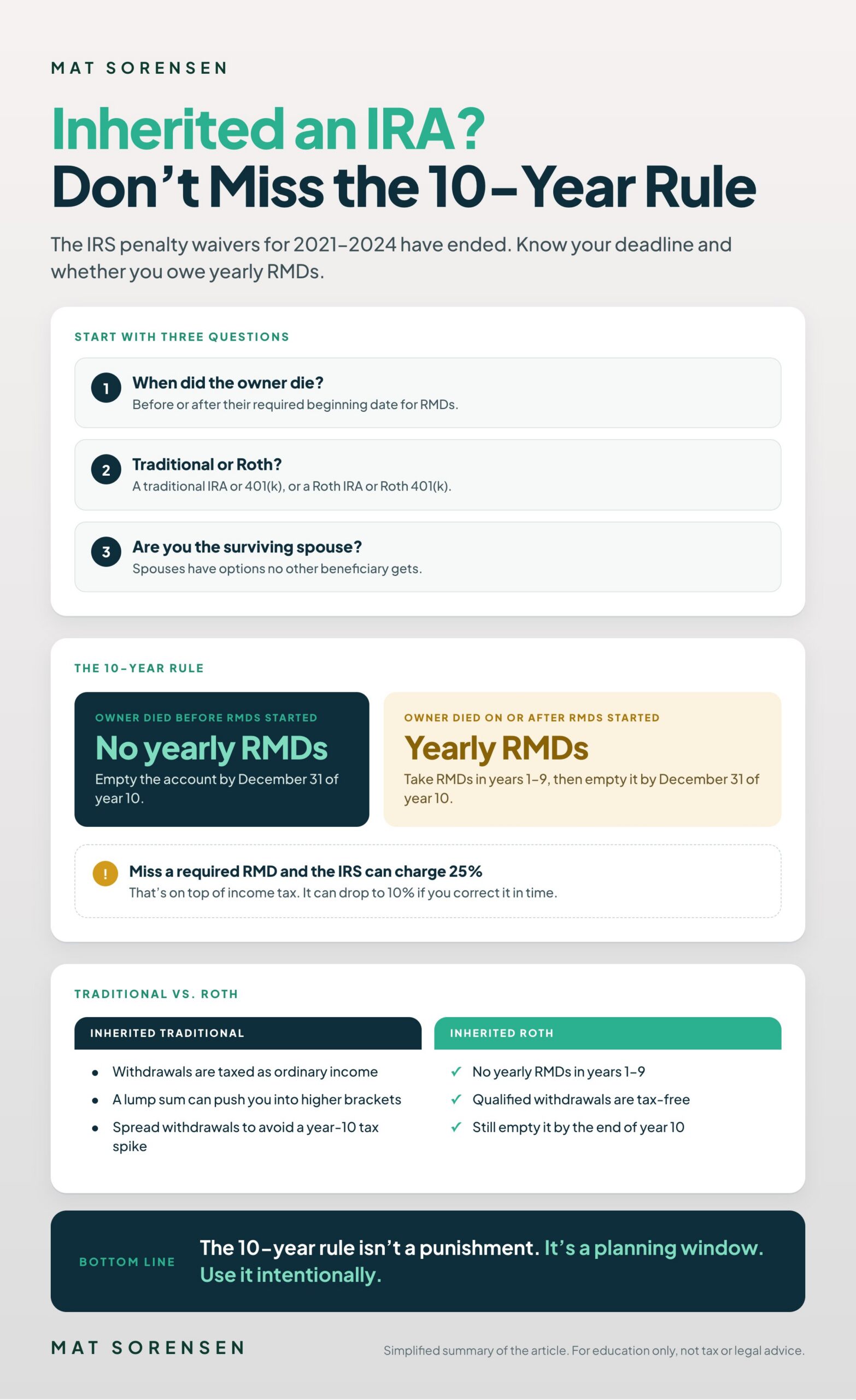
Infographic: the inherited IRA 10-year rule. Three questions to start with, when yearly RMDs are required, the 25% penalty for a missed RMD, and how inherited traditional and Roth accounts differ

Start with These Questions

Before taking—or postponing—an inherited-retirement-account distribution, confirm three facts:

  1. 1Did the original owner die before or after their required beginning date for RMDs?
  2. 2Is the account a traditional IRA or 401(k), or a Roth IRA or Roth 401(k)?
  3. 3Are you a surviving spouse?

These answers determine the applicable deadline, whether annual RMDs are required, and how to structure distributions for tax purposes.

This article focuses on the current rules that apply in many common situations. If the original owner died before 2020, different “stretch IRA” rules may apply. Confirm the owner’s date of death before assuming the 10-year rule governs your account.

The 10-Year Rule

For most non-spouse designated beneficiaries, an inherited IRA or retirement-plan account must be fully distributed by December 31 of the 10th calendar year following the year of the original owner’s death.

For example, if the original owner died in 2026, the inherited account generally must be fully distributed by December 31, 2036. The deadline is not simply 10 years from the date of death.

For beneficiaries subject to the 10-year rule, the central question is whether the original owner died before or after their required beginning date for RMDs.

For many current retirees, the applicable RMD age is 73. For younger account owners, it can be age 75. The required beginning date for a first RMD is generally April 1 of the year after the owner reaches the applicable RMD age.

Original owner’s status at death Annual beneficiary RMDs in years 1–9 Final deadline
Died before their RMD beginning date Generally no December 31 of year 10
Died on or after their RMD beginning date Generally yes December 31 of year 10

EXAMPLE

Consider two beneficiaries with identical $300,000 inherited traditional IRAs:

Your uncle dies at age 78 while already taking RMDs. You inherit his traditional IRA. You must take annual RMDs during the 10-year period and empty the account by the end of year 10.

Your mother dies at age 68. You inherit her traditional IRA. You still face the 10-year deadline, but you are not required to take annual distributions during years one through nine.

KEY POINT

Same account type. Same account balance. Completely different distribution obligations—solely because of the original owner’s age and RMD status at death.

Traditional Accounts: Annual RMDs and Taxes

If you inherit a traditional IRA or traditional 401(k) from an owner who died on or after their required beginning date, you generally must take annual RMDs in years one through nine. You must also fully distribute the remaining balance by the end of year 10.

This is where many beneficiaries make an expensive mistake. They understand the year-10 deadline but do not realize that annual RMDs may be required along the way.

WATCH OUT

If an annual inherited-account RMD is required and you miss it, the IRS can impose a 25% excise tax on the amount that should have been withdrawn. For example, if your RMD was $10,000 and you withdrew nothing, the excise tax could be $2,500. The excise tax may be reduced to 10% if you correct the mistake within the IRS correction window. That penalty is separate from the ordinary income tax generally due when the $10,000 is eventually withdrawn.

Annual inherited-IRA RMDs are not calculated by simply dividing the account by 10. The calculation uses the beneficiary’s age-based life-expectancy factor and the prior December 31 account balance.

EXAMPLE

Assume you inherit a $300,000 traditional IRA from your father, who died at age 78 while already taking RMDs. You are 40 in the year after his death, which is the year your first annual RMD is due. Under the IRS Single Life Expectancy Table, a 40-year-old beneficiary has an initial life-expectancy factor of 45.7.

Your first annual RMD, using this simplified illustration, would be: $300,000 ÷ 45.7 = $6,565

For the following year, reduce the initial factor by one, from 45.7 to 44.7. Assume that, after the first distribution and investment performance, the prior December 31 account balance is $304,000. Your second-year RMD would be: $304,000 ÷ 44.7 = $6,801

You would continue reducing the initial factor by one each year—43.7, 42.7, 41.7, and so on—while using the account’s prior December 31 balance to calculate each year’s RMD.

$6,565

First annual RMD

$6,801

Second-year RMD

This example illustrates the life-expectancy method. The applicable first-year calculation can depend on the year of death, the beneficiary’s age, and whether the owner had already begun taking RMDs. Confirm the calculation with the custodian or a qualified tax professional before relying on it.

These annual amounts are minimums, not a schedule designed to evenly empty the account over 10 years. A large balance may still remain in year 10, when the entire remainder must be distributed.

That is why inherited traditional retirement accounts require two separate decisions:

  1. 1Determine whether annual RMDs are mandatory.
  2. 2Determine how much additional income to recognize each year before the year-10 deadline.

The required minimum may be relatively small, but the optimal distribution may be larger if it helps prevent a major tax spike in the final year.

Lump Sums and Tax Planning

When you inherit an IRA or 401(k), one of the first decisions is whether to take the money immediately or preserve it in an inherited IRA. A lump-sum distribution is generally available at any age and, unlike an early withdrawal from your own retirement account, it typically does not trigger the 10% early-withdrawal penalty.

But penalty-free does not mean tax-free.

With a traditional IRA or traditional 401(k), the distribution is generally taxable as ordinary income in the year you take it. Imagine inheriting a $300,000 traditional IRA and withdrawing the entire balance at once. That adds $300,000 to your taxable income in a single year and may push a substantial part of the distribution into higher marginal tax brackets.

If you need the money immediately, a lump sum may be necessary. Otherwise, it is often worth considering whether distributions can be coordinated over several tax years. Keeping the assets invested in an inherited IRA may preserve growth potential while giving you more control over when taxable income appears on your return.

EXAMPLE

Consider a $300,000 inherited traditional IRA from a parent who died at age 68. No annual RMDs may be required in years one through nine, which gives the beneficiary flexibility—but can create a year-10 tax trap.

If the account grows to $600,000 and the beneficiary withdraws the full balance in year 10, the entire $600,000 is generally added to taxable income for that year. A more intentional approach may be to allow the account to compound during the first several years, assuming the beneficiary does not need the money, then begin taking planned distributions in later years.

KEY TAKEAWAY

The objective is not always to avoid every increase in marginal tax rate. It is to avoid unnecessarily concentrating a large amount of ordinary income into one tax year when distributions could have been spread more efficiently across several years.

Roth Accounts: A Different Strategy

Inherited Roth retirement accounts generally offer a simpler planning framework. For most non-spouse beneficiaries subject to the 10-year rule, an inherited Roth IRA or Roth 401(k) must be fully distributed by December 31 of year 10. However, annual RMDs are generally not required during years one through nine because the original Roth owner was not subject to lifetime RMDs.

That allows the beneficiary to leave the account invested for the full 10-year period, if appropriate, and distribute the balance at the end of year 10.

Unlike an inherited traditional retirement account, waiting until year 10 generally does not create a large ordinary-income-tax issue. Qualified Roth distributions are tax-free, so continued compounding can increase the eventual tax-free inheritance without pushing the beneficiary into a higher tax bracket.

EXAMPLE

For example, assume you inherit a $300,000 Roth IRA and leave it invested for 10 years. At a hypothetical 8% annual return—not a guarantee—the account could grow to approximately $648,000. If the distribution is qualified, the full amount could be distributed tax-free at the end of year 10.

$300,000

Inherited Roth IRA

~$648,000

After 10 years at a hypothetical 8%

CAVEAT

One important caveat: the original Roth IRA owner’s five-year holding period matters. If the original owner had not met the Roth IRA five-year requirement, the earnings portion of distributions may be taxable.

You also cannot convert an inherited traditional IRA into an inherited Roth IRA. If you inherit pre-tax traditional IRA assets, they must remain in an inherited traditional IRA. If you inherit Roth assets, they remain in an inherited Roth IRA.

Spousal Rollover Options

A surviving spouse has options no other beneficiary receives. If you inherit an IRA or employer retirement plan from a deceased spouse, you may be able to move the assets into an IRA in your own name or, in certain cases, elect to treat the inherited IRA as your own.

Traditional assets may be moved into the surviving spouse’s own traditional IRA. Roth assets may be moved into the surviving spouse’s own Roth IRA. Once the account is treated as the surviving spouse’s own, the inherited-account 10-year deadline does not apply.

EXAMPLE

A spousal rollover is powerful, but it is not automatically the best choice. Consider a 53-year-old widow who needs to use inherited traditional IRA assets for living expenses. If she rolls the account into her own IRA, distributions before age 59½ may generally be subject to the 10% additional tax, in addition to ordinary income tax.

If she instead retains the funds in an inherited IRA, distributions attributable to the deceased spouse may generally be available without the 10% additional tax. She could use the inherited IRA for penalty-free withdrawals if needed, then consider a rollover into her own IRA later.

The right choice depends on age, cash-flow needs, investment goals, tax circumstances, and the plan’s available options.

Common Tax Questions

Do you owe inheritance tax or estate tax simply because you inherited an IRA?

Generally, no. Receiving an inherited IRA is not itself a federal income-tax event. With traditional retirement accounts, income tax is generally due when distributions are taken—not when you become the beneficiary.

Federal estate tax affects only very large estates. For deaths in 2026, the federal estate-tax basic exclusion amount is $15 million per person. With appropriate planning, a married couple may be able to protect up to $30 million.

State law is different. Some states impose estate taxes, inheritance taxes, or both, and their exemption amounts can be much lower than the federal exclusion, such as Oregon and Massachusetts. The deceased person’s state of domicile, the property involved, and state-specific rules can all matter.

Does an inherited traditional IRA receive a step-up in basis?

No. Inherited stock, real estate, and other taxable assets may receive a step-up in basis to fair market value at death. Traditional IRAs and 401(k)s are different.

Traditional retirement assets are generally treated as income in respect of a decedent. There is no step-up in basis for the pre-tax portion of a traditional IRA or 401(k), and distributions are generally taxed as ordinary income at the beneficiary’s tax rates.

Can I self-direct an inherited retirement account?

Yes—an inherited IRA can generally be self-directed. Instead of limiting the account to brokerage investments, you may be able to invest in assets such as real estate, private funds, private lending, certain private businesses, or cryptocurrency. But the 10-year deadline and any annual RMDs still apply, so illiquid investments must leave enough cash available for required distributions.

For more information on self-directing, download my free guide and learn how an inherited IRA can invest in real estate, private funds, small businesses, and crypto here.

If you are considering self-directing an inherited IRA—or need help evaluating liquidity, RMD deadlines, alternative investments, or prohibited-transaction risk—schedule a free consultation call with my firm, Directed IRA. We can help you understand your options and structure the account thoughtfully before you invest or take a distribution.

The Bottom Line

What this ultimately comes down to is stewardship. Someone spent a lifetime building this retirement account and chose to leave it to you. The 10-year rule is not a punishment—it is a planning window, and often the final planning opportunity the original owner could not complete on your behalf.

The beneficiaries who lose five or six figures unnecessarily to taxes are not usually careless. They are often careful in the wrong direction. Some leave the account untouched for nearly a decade, assuming that continued tax-deferred growth is always the best answer, only to face a large taxable distribution in year 10. Others do the opposite: they withdraw the entire account immediately and push themselves into higher tax brackets.

The goal is not simply to take distributions—or to avoid taking them. It is to use the 10-year window intentionally: preserve growth where it makes sense, meet any annual RMD requirements, and distribute traditional retirement assets on a schedule that manages taxable income. That is how more of the account stays with the beneficiary and less is unnecessarily lost to taxes.

INHERITED IRA

Inherited an IRA? Talk with a Directed IRA specialist about your options for self-directing it.

Book a Call with Directed IRA

Mat Sorensen

Mat has been at the forefront of the self-directed IRA industry since 2006. He is the CEO of Directed IRA & Directed Trust Company where they handle all types of self-directed accounts (IRAs, Roth IRAs, HSAs, Coverdell ESA, Solo Ks, and Custodial Accounts) which are typically invested into real estate, private company/private equity, IRA/LLCs, notes, precious metals, and cryptocurrency. Mat is also a partner at KKOS Lawyers and serves clients nationwide from its Phoenix, AZ office.

He is published regularly on retirement, tax, and business topics, and is a VIP Contributor at Entrepreneur.com. Mat is the best-selling author of the most widely used book in the self-directed IRA industry, The Self-Directed IRA Handbook: An Authoritative Guide for Self-Directed Retirement Plan Investors and Their Advisors.

Roth Conversion Mistakes That Could Wreck Your Retirement Plan

Roth conversions are one of the most frequently recommended strategies in retirement planning, and for good reason. I appreciate their benefits for a variety of reasons, but they’re not suitable for everyone.

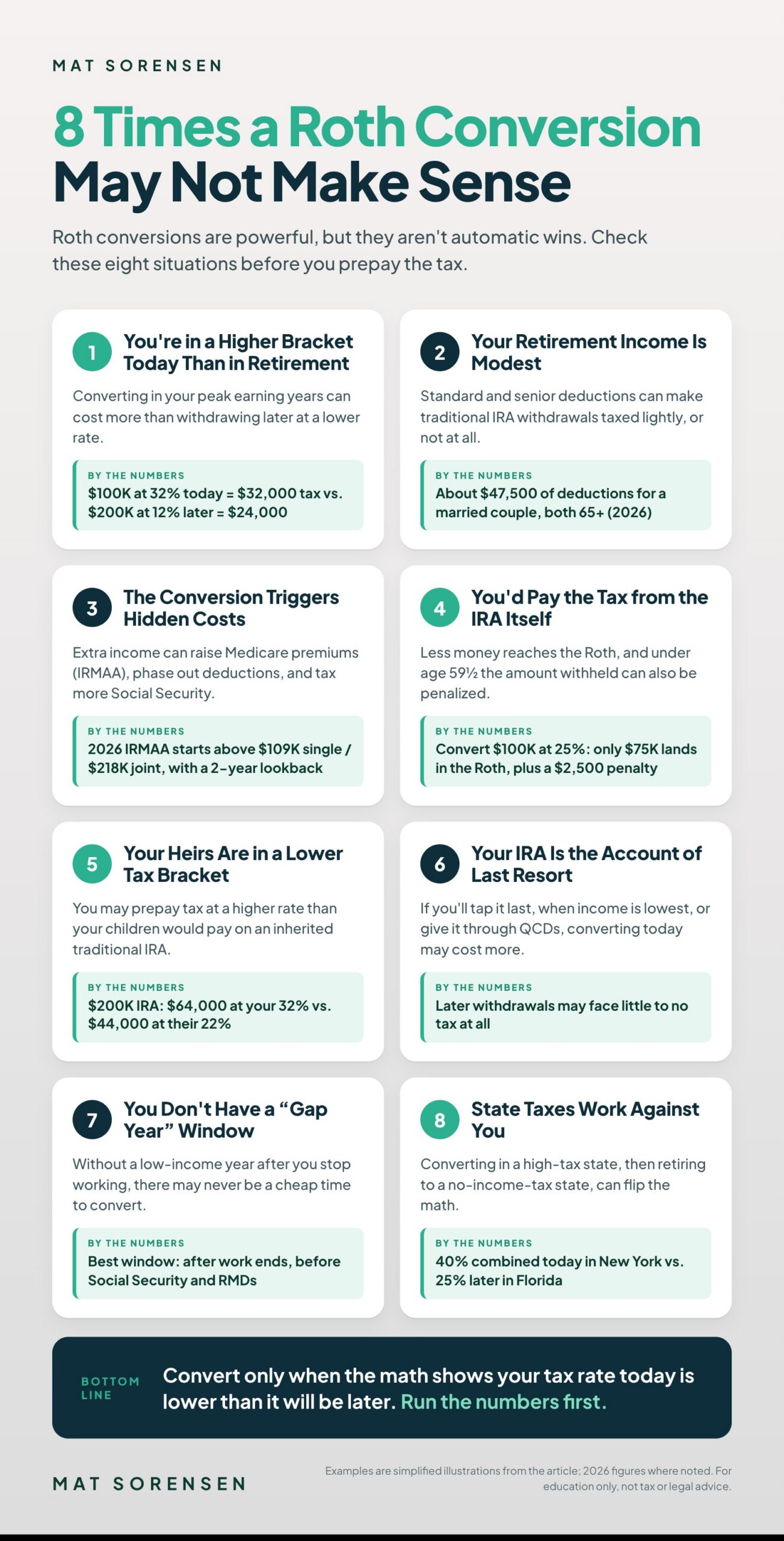
In this article, I’ll cover eight common scenarios where a Roth conversion may actually not make sense. These are not obscure or unusual situations; they’re real-world examples I see regularly in practice.

The challenge is that Roth conversions have been oversimplified into the idea that you should always convert. In reality, this approach ignores important factors such as current and future tax rates, timing, retirement income planning, and even your age. Getting a conversion right can create tens or even hundreds of thousands of dollars in long-term savings. Doing it wrong can have the opposite effect.

Infographic: 8 times a Roth conversion may not make sense

The Core Principle: It’s a Tax Rate Arbitrage Decision

Before diving into specific scenarios, it’s important to understand the core principle behind a Roth conversion. When you convert traditional IRA funds to a Roth, you pay taxes today so that future withdrawals are tax-free.

At first glance, it may seem straightforward: convert now if your current tax rate is lower than what you expect to pay later. For example, imagine you’re 50 years old with a $100,000 traditional IRA and currently fall into the 10% tax bracket. Converting that balance today would trigger a $10,000 tax bill.

Now picture that same IRA ten years later—worth $200,000 when you’re 60 years old and in a 20% tax bracket. If you withdraw in retirement instead of converting earlier, you’d owe $40,000 in taxes. In this example, converting at the lower rate would clearly have been the smarter move.

When Converting Wins: Lower Rate Today
Convert at 50 Withdraw at 60
IRA value $100,000 $200,000
Tax bracket 10% 20%
Tax owed $10,000 $40,000
Simplified illustration. Converting early saves $30,000 in this example.

However, the reality for many investors is the opposite. Most people are in a higher tax bracket during their working years than they will be in retirement. Because of this, Roth conversions can easily become more expensive than beneficial. That’s why it’s essential to evaluate your current versus future tax brackets before deciding if a conversion truly makes sense.

Scenario #1: You’re in a Higher Tax Bracket Today Than You Will Be Later

Let’s look at a common scenario where a Roth conversion can actually backfire. This happens when you’re in a higher tax bracket today than you’ll be later in retirement.

Imagine you’re 55 years old, earning $250,000 per year, and in the 32% tax bracket. If you convert a $100,000 traditional IRA to a Roth right now, you’ll owe $32,000 in taxes immediately.

Now suppose you don’t convert. You let the account grow for 10 years, and by age 65, it has doubled to $200,000. At that point, your retirement income is around $100,000, placing you in a 12% tax bracket. When you begin taking withdrawals, you’ll pay $24,000 in taxes (12% of $200,000), which is far less than the $32,000 you would have paid in your high-earning years.

Convert at 55 vs. Withdraw at 65
Convert now (age 55) Wait and withdraw (age 65)
IRA value $100,000 $200,000
Tax bracket 32% 12%
Tax owed $32,000 $24,000
Waiting saves $8,000 in tax here, even though the account is twice as large.

This is a very typical scenario for people in their peak earning years who consider converting while their tax bracket is highest. Ten years later, when they’re retired and earning less, their tax rate is lower, making the earlier conversion costlier than necessary.

Key takeaway: A Roth conversion typically isn’t advisable when your expected retirement tax rate will be lower than what you pay today. There are exceptions, such as when you expect only a modest drop, for example 32% to 22%. If the difference is substantial, like 32% down to 12%, converting could be a mistake. Always run the numbers and compare what your tax burden would be today versus in retirement before making the decision.

Scenario #2: You Don’t Have Enough Income or Assets for It to Matter

This scenario doesn’t get discussed nearly enough, but for many middle-income households, a Roth conversion often doesn’t move the needle at all.

Consider this example: you retire with a $150,000 traditional IRA and have about $40,000–$60,000 in annual retirement income. In this situation, you may owe little to no income tax when taking IRA distributions. In effect, your traditional IRA can behave much like a Roth, thanks to the deductions available to seniors.

For instance, once you’re 65 or older, you can claim the standard deduction of $32,200, the additional senior deduction of $3,300, and potentially the new senior deduction from the One Big Beautiful Bill of $12,000 (for married couples filing jointly). That’s roughly $47,500 in total deductions. This means your first $47,500 of retirement income is tax-free, and income above that is taxed at only about 10–12%.

2026 Deductions: Married Couple, Both 65+, Filing Jointly
Deduction Amount
Standard deduction $32,200
Additional standard deduction for age 65+ ($1,650 × 2) $3,300
New senior deduction (One Big Beautiful Bill, 2025–2028)* $12,000
Total deductions $47,500
*The $6,000-per-person senior deduction phases out once modified adjusted gross income exceeds $150,000 for joint filers.

For someone with $150,000 in income, after deductions you’d be taxed on roughly $102,500, resulting in no more than about $12,000 in federal tax. With taxes this low in retirement, converting to a Roth doesn’t provide much benefit because your traditional IRA withdrawals are already taxed lightly.

When your projected retirement income keeps you in a relatively low tax bracket and when generous standard and senior deductions apply, the traditional IRA can already deliver near tax-free outcomes. In these situations, pre-paying taxes through a Roth conversion offers little advantage. Doing nothing, leaving funds in your traditional IRA and taking distributions strategically, often proves the more tax-efficient and financially prudent approach.

Scenario #3: The Conversion Triggers Hidden Costs (IRMAA, Phaseouts)

Another situation where a Roth conversion can work against you is when you are in your 60s and the conversion triggers hidden costs that you might not be considering. Roth conversions do not only affect your tax bill, although that is often the main focus. They can also influence several other parts of your financial picture.

When you convert to a Roth IRA, the amount converted is treated as taxable income. For individuals in their 60s, that income increase can have several ripple effects. One of the biggest concerns is the Medicare Income-Related Monthly Adjustment Amount, or IRMAA. IRMAA is an additional charge added to your Medicare Part B and Part D premiums if your income exceeds certain thresholds. For 2026, this applies when income is above roughly $109,000 for single filers or $218,000 for married couples filing jointly.

Crossing those limits can raise your Medicare premiums by roughly $96 to $578 per month per person, depending on how far over the line you go—that’s anywhere from about $1,100 to nearly $7,000 per year for each spouse on Medicare. A higher reported income can also cause you to lose certain deductions or credits that phase out at higher income levels, and it can increase the taxable portion of your Social Security benefits.

2026 Medicare IRMAA Surcharges (Based on 2024 Income)
Single filer income Joint filer income Added cost per person / month
$109,000 or less $218,000 or less $0
$109,001 – $137,000 $218,001 – $274,000 $95.70
$137,001 – $171,000 $274,001 – $342,000 $240.40
$171,001 – $205,000 $342,001 – $410,000 $385.00
$205,001 – $499,999 $410,001 – $749,999 $529.60
$500,000 or more $750,000 or more $578.00
Combined Part B and Part D surcharge on top of standard premiums; income is modified adjusted gross income. Source: SSA/CMS 2026 figures.

This issue is especially important for people around age 63 and older. Medicare uses a two-year lookback when determining IRMAA surcharges. That means conversions done at age 63 could affect your Medicare costs when you turn 65.

Key takeaway: If you are approaching Medicare eligibility, consider the potential IRMAA surcharges and their long-term impact as part of your Roth conversion analysis.

Scenario #4: You’re Paying the Taxes from the IRA Itself

The next scenario where a Roth conversion does not make sense is when you plan to pay the taxes for the conversion using money from the IRA itself. This is a major mistake and, in my view, a dealbreaker in every situation.

When doing a Roth conversion, you should always pay the taxes with money from outside the IRA. That way, the full amount of the conversion ends up in the Roth as after-tax dollars that can grow and eventually come out tax-free.

If you do not have outside cash to cover the tax bill, some people make the costly mistake of taking a distribution from their traditional IRA to pay the taxes. This approach creates two problems. First, you will owe income tax on the withdrawal. Second, if you are under age 59½, you will also face a 10% early withdrawal penalty. Both of these reduce the amount that stays invested and growing in the Roth IRA.

For example, say you convert $100,000 while in the 25% tax bracket. You take out $25,000 from the IRA to pay the tax. You will owe another 10% penalty on that $25,000, bringing your total cost to $27,500 in taxes and penalties. That leaves only $75,000 invested in the Roth—and you still have to cover the $2,500 penalty on top of that—which greatly reduces the long-term benefit of the conversion.

Paying the Conversion Tax: Outside Cash vs. the IRA
$100,000 conversion, 25% rate, under 59½ Pay with outside cash Pay from the IRA
Amount that reaches the Roth $100,000 $75,000
Income tax $25,000 $25,000
10% early withdrawal penalty $0 $2,500
Total tax and penalty $25,000 $27,500

If you are in a situation where paying the taxes requires taking money from the IRA itself, it is usually best to pause and reconsider. In nearly every case, a conversion under these circumstances will hurt more than it helps.

Scenario #5: You Plan to Leave the Account to Lower-Tax-Bracket Heirs

A Roth conversion may not make sense when you plan to leave the account to heirs who are in a lower tax bracket. This is where estate planning starts to overlap with your tax and retirement strategy.

If you are in a 24%, 32%, or higher tax bracket, but your children or heirs are only in a 12% or 22% bracket, you may be prepaying taxes at a higher rate than they would pay later. For example, if you convert a $200,000 traditional IRA to a Roth IRA and you are in the 32% bracket, that conversion would cost $64,000 in taxes. If your child later inherits a traditional IRA and withdraws the money while in the 22% bracket, they would pay $44,000 in taxes instead. That is a $20,000 difference, which means the conversion may not be the most efficient move.

Who Pays the Tax on a $200,000 IRA?
You convert now Your heir withdraws later
Tax bracket 32% 22%
Tax owed $64,000 $44,000
Leaving the account as a traditional IRA saves $20,000 in this example.

In some cases, it can actually be better to leave the account as a traditional IRA.

The analysis changes, though, if you are in lower income years in retirement and plan to leave the account to children who are still in their peak earning years. If you are paying 10% to 20% today while your heirs are paying 30% or more, converting to a Roth IRA may make more sense. In that case, you are paying the tax upfront at a lower rate so your heirs can inherit a tax-free asset that can continue to grow.

The facts matter here. Whether it makes sense to convert now or leave the account as-is depends on your tax rate, your heirs’ tax rate, and how the IRA fits into your broader estate plan.

Scenario #6: Your Traditional IRA Is Your Account of Last Resort

The next scenario where a Roth conversion does not make sense is when your traditional IRA is really your account of last resort. In other words, you do not expect to rely on it for retirement income in your 60s or 70s, and you may eventually use it for qualified charitable distributions to causes you care about.

For many people, the traditional IRA is simply the last bucket of money they expect to spend. If that is your situation, and you have other assets or income sources to live on first, converting to Roth may not provide much benefit. By the time you reach your later retirement years, your taxable income may be low enough that withdrawals from the traditional IRA result in little to no tax anyway.

That is why this scenario often comes down to timing and intent. If your plan is to leave the IRA untouched for years and then use it later when your income is lowest, the tax cost of converting today may be higher than the tax cost of leaving it alone. In many cases, the traditional IRA can remain the more efficient choice.

Scenario #7: You Don’t Have a “Gap Year” Window

Another reason a Roth conversion may not make sense is if you do not have a gap year window. One of the best times to convert is during a year when your income is temporarily lower, such as after you stop working but before Social Security or RMDs begin. Those years can create a valuable opportunity to convert at a lower tax rate, sometimes with little or no tax at all.

However, not everyone has that window. You may keep working into your 70s and stay in a high tax bracket, or you may simply never have a year where your income drops enough to make a conversion attractive. In those cases, the clear-cut opportunity to convert at a low tax cost may never appear.

That is why timing matters so much. If you do not have a gap year or another low-income year to work with, a Roth conversion may not deliver the same benefit it would for someone who does.

Scenario #8: State Taxes Work Against You

Finally, the last scenario where a Roth conversion may not make sense is when state taxes work against you. For example, if you live in New York when you do the conversion but plan to retire in Florida and take withdrawals there, state taxes can change the entire equation.

If you are in a high-tax state today, say 8% to 10%, a Roth conversion may look much more expensive than it will later in retirement. For instance, if you are paying 30% in federal taxes and 10% in state taxes today, your total tax cost is 40%. But if you retire in Florida and your future withdrawals are taxed at only 25% federally with no state income tax, then leaving the money in a traditional IRA could actually be the better move.

Convert in New York vs. Withdraw in Florida
Convert today (New York) Withdraw later (Florida)
Federal tax rate 30% 25%
State tax rate 10% 0%
Total tax rate 40% 25%

In that case, you would be paying 40% today to convert to Roth instead of paying 25% later on traditional withdrawals. That is a much bigger tax bill upfront, so the conversion does not make sense. Always factor in where you live now versus where you expect to live in retirement, because state taxes can significantly change the outcome.

The Big Picture: Why It Always Depends

Now that we have covered the 8 scenarios where a Roth conversion may not make sense, it is worth stepping back to look at the bigger picture. Whether a Roth conversion is the right move is always situational.

It depends on your current income, your expected future income, the amount you want to convert, your tax bracket today versus later in retirement, the state you live in now versus the state you may live in later, and your long-term legacy goals. Are you planning to spend down this account in retirement, or are you trying to preserve it for children or other heirs?

One of the biggest mistakes people make is converting without running the numbers first. Roth accounts are powerful, but they are not always the right tool. A traditional IRA to Roth IRA conversion only makes sense when the math supports it. Do not leave your decision to guesswork; crunch the numbers specific to your situation first.

If you would like help determining whether a Roth conversion makes sense in your situation or building a more tax-efficient retirement strategy, my team at KKOS Lawyers works with investors and business owners across the country. You can book a free call using the link below, and we will help you map out the smartest approach based on your numbers.

FREE SELF-DIRECTED IRA GUIDE

Learn how a self-directed Roth IRA can invest in real estate, private companies, notes, and more, and keep the growth tax-free.

Get the Free Self-Directed IRA Guide

Want help running the numbers? Book a free strategy call with KKOS Lawyers

The Roth IRA 5-Year Rule Everyone Gets Wrong (It’s Actually Two Clocks)

Your Roth IRA is only tax-free if you satisfy two separate five-year rules—each running on its own clock. Get either one wrong, and what you thought was a tax-free withdrawal can land on your 1040 as ordinary income, plus potential penalties.

These rules affect more investors than you might expect: anyone with multiple Roth IRAs, anyone who has changed custodians, backdoor Roth contributors, savers executing gap-year conversion strategies before retirement, and those who opened their first Roth IRA later in life and assumed age 59½ made everything automatically tax-free.

The key question is simple but critical: which clock applies to which dollars? Every Roth IRA can hold three types of money: contributions, conversions, and earnings. The two five-year rules treat each type differently. Some funds are immediately accessible, some unlock on a schedule, and some remain conditional until a specific date.

The short version:

RULE 1

The Account Clock

You must have a Roth IRA open for five years before earnings can be withdrawn tax-free. This clock starts on January 1 of the tax year of your first Roth contribution (or conversion, if earlier) and applies collectively to all your Roth IRAs. It never resets when you switch custodians or open additional Roth accounts.

RULE 2

The Conversion Clock

Each Roth conversion has its own five-year clock. This rule does not affect whether the conversion itself is taxed—you already paid that—but it can shield you from the 10% early-withdrawal penalty if you take converted funds out before age 59½.

The costly mistake: Most costly mistakes come from applying the right rule to the wrong dollars. Misstep on $50,000 of earnings, and you could hand the IRS $12,000 in taxes on growth that should have been yours, tax-free, forever.

Clock #1 — The Account Clock (This One Applies to Everyone)

For your Roth IRA earnings to come out completely tax-free, you must satisfy two conditions:

  • 1Be at least age 59½ (or meet another qualifying exception), and
  • 2Have satisfied the Roth IRA five-year rule

The five-year clock starts on January 1 of the tax year in which you made your first Roth IRA contribution—whether that contribution was to a traditional Roth IRA or a Roth conversion IRA. Once that clock starts, it applies to all your Roth IRAs and never resets.

If you make a Roth contribution in April 2027 but designate it for the 2026 tax year, the five-year clock is treated as starting on January 1, 2026. In that case, you reach the five-year mark in under four calendar years.

A common misconception is that each Roth IRA has its own five-year timer. It doesn’t. You get one lifetime clock tied to your first Roth contribution. Switching custodians, rolling assets, or opening additional Roth IRAs does not restart the five-year period; the clock follows you.

EXAMPLE: SWITCHING CUSTODIANS

You opened a Roth IRA at Fidelity, held it for three years, then transferred everything to Directed IRA and bought real estate inside the Roth IRA. Your clock kept running. You now have six years on the same clock.

EXAMPLE: OPENING YOUR FIRST ROTH IRA LATE IN LIFE

You open your first Roth IRA at 58 and want to withdraw at 60. At 60, you’re past the 59½ threshold, so the 10% early-withdrawal penalty no longer applies—but earnings remain taxable until the five-year rule is satisfied. In this scenario, contributions can be withdrawn tax- and penalty-free at 60, but any earnings taken before age 63 are taxable. Once the five-year clock is met at 63, qualified distributions—including earnings—become entirely tax-free.

Age 58

First Roth IRA opened. The account clock starts.

Age 59½

The 10% penalty no longer applies, but earnings are still taxable.

Age 63

Five-year clock met. Earnings come out tax-free.

Age 59½ eliminates the penalty, not the tax on earnings. Tax-free treatment on earnings requires both (1) being at least 59½ (or meeting another qualifying condition) and (2) satisfying the five-year account clock. Once any Roth IRA has been open for five years—counting transfers and custodian changes—earnings can be withdrawn tax-free as soon as the age or other qualifying condition is met.

FREE SELF-DIRECTED IRA GUIDE

Learn how a self-directed Roth IRA can invest in real estate, private funds, and other alternative assets you actually understand.

Get the Free Self-Directed IRA Guide

Clock #2 — The Conversion Clock (Situational, and the One People Mess Up)

Every Roth conversion carries its own five-year clock, starting January 1 of the conversion year. This rule exists to prevent investors from using conversions as a loophole to sidestep the 10% early-withdrawal penalty. You pay income tax on the conversion in the year it occurs, but that does not automatically make the converted funds penalty-free if withdrawn immediately.

The rule is narrow but important: if you withdraw converted Roth dollars within five years and you’re under 59½, the IRS imposes a 10% early-withdrawal penalty on the amount taken. Wait out the full five years, and those converted dollars behave like regular Roth contributions which are withdrawable at any age, tax- and penalty-free. Earnings, however, remain subject to Rule 1 (the account clock) and the age 59½ requirement.

EXAMPLE: EARLY ACCESS AFTER CONVERSION

At 45, you have $100,000 in a Roth IRA and $100,000 in a traditional IRA. You convert the entire traditional IRA to Roth, pay the tax in 2026, and let the account grow. By age 51, the five-year conversion clock has run its course, and the converted funds have grown to $150,000. You can withdraw the $100,000 of converted principal tax- and penalty-free at 51. The $50,000 of earnings, however, remains off-limits without tax and penalty until you satisfy Rule 1 and reach 59½. Withdrawing earnings early could trigger both income tax and a 10% penalty—potentially costing $17,000 on a $50,000 distribution.

$100,000

Converted principal: tax- and penalty-free at 51

$50,000

Earnings: taking them early could cost about $17,000 in tax and penalty

EXAMPLE: BACKDOOR ROTH AND MULTIPLE CLOCKS

For backdoor Roth IRA users, each annual conversion starts its own five-year timer. If you’re 50 and contribute $7,500 annually to a non-deductible traditional IRA, then convert to Roth each year, every conversion has a separate timeline. The 2026 conversion unlocks in 2031, the 2027 conversion in 2032, and so on. After six years of this strategy, you don’t have a single locked Roth balance; you have a rolling conveyor belt of penalty-free principal, with a new tranche becoming available each January 1.

Backdoor Roth: Each Conversion Unlocks on Its Own Date
Year converted Amount Penalty-free from
2026 $7,500 Jan. 1, 2031
2027 $7,500 Jan. 1, 2032
2028 $7,500 Jan. 1, 2033
2029 $7,500 Jan. 1, 2034
2030 $7,500 Jan. 1, 2035
2031 $7,500 Jan. 1, 2036
Assumes $7,500 converted each year. The conversion clock only matters before age 59½; earnings still follow the account clock.

EXAMPLE: THE “SHUTOFF SWITCH” AT 59½

The conversion five-year rule only guards against the 10% early-withdrawal penalty, which disappears at 59½. After that age, the rule no longer matters. A 62-year-old executing a gap-year conversion strategy can convert traditional IRA funds to Roth at 62 and withdraw those converted dollars at 63 without penalty.

However, Rule 1—the account five-year clock—still applies. If this investor opened their first Roth IRA at 60 and has never held one before, earnings cannot be withdrawn tax-free until age 65, when the five-year account requirement is satisfied. Converted principal remains accessible without penalty, but growth and earnings must wait.

For anyone new to Roth IRAs after 59½, the key is to track both clocks: the conversion timers for penalty avoidance before 59½, and the single lifetime account clock for tax-free treatment of earnings.

The Two Roth Clocks at a Glance

CLOCK #1

The Account Clock

HOW MANY

One lifetime clock

STARTS

Jan. 1 of the tax year of your first Roth IRA contribution or conversion

APPLIES TO

All your Roth IRAs

DETERMINES

When earnings can become tax-free

RESETS?

Never, even when you change custodians or open another Roth IRA

THINK

Tax-free earnings

CLOCK #2

The Conversion Clock

HOW MANY

A new clock for each conversion

STARTS

Jan. 1 of the year of each conversion

APPLIES TO

Each conversion separately

DETERMINES

Whether converted dollars can be withdrawn without the 10% early-withdrawal penalty before age 59½

RESETS?

Each conversion starts another clock

THINK

Penalty-free converted principal

The Machinery That Makes This Navigable — Ordering Rules

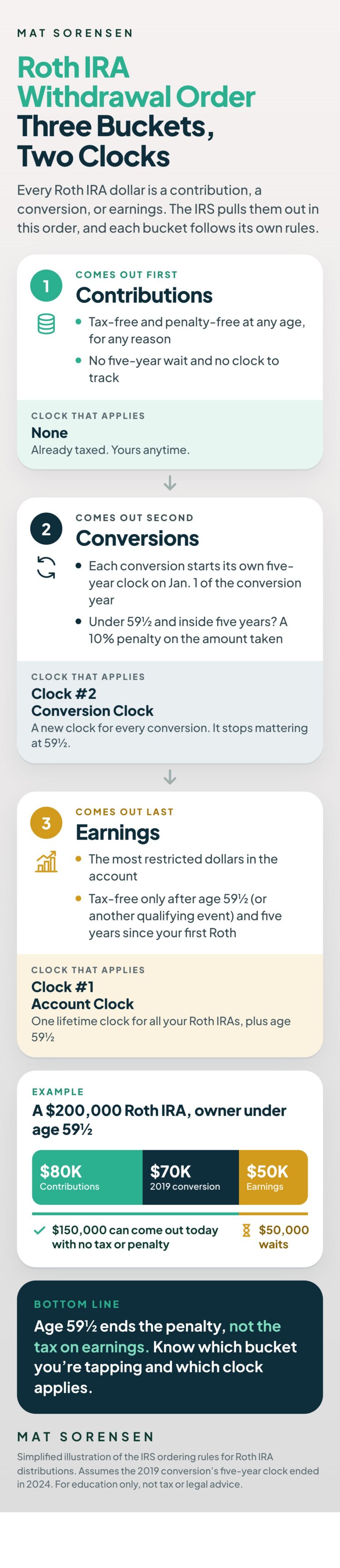
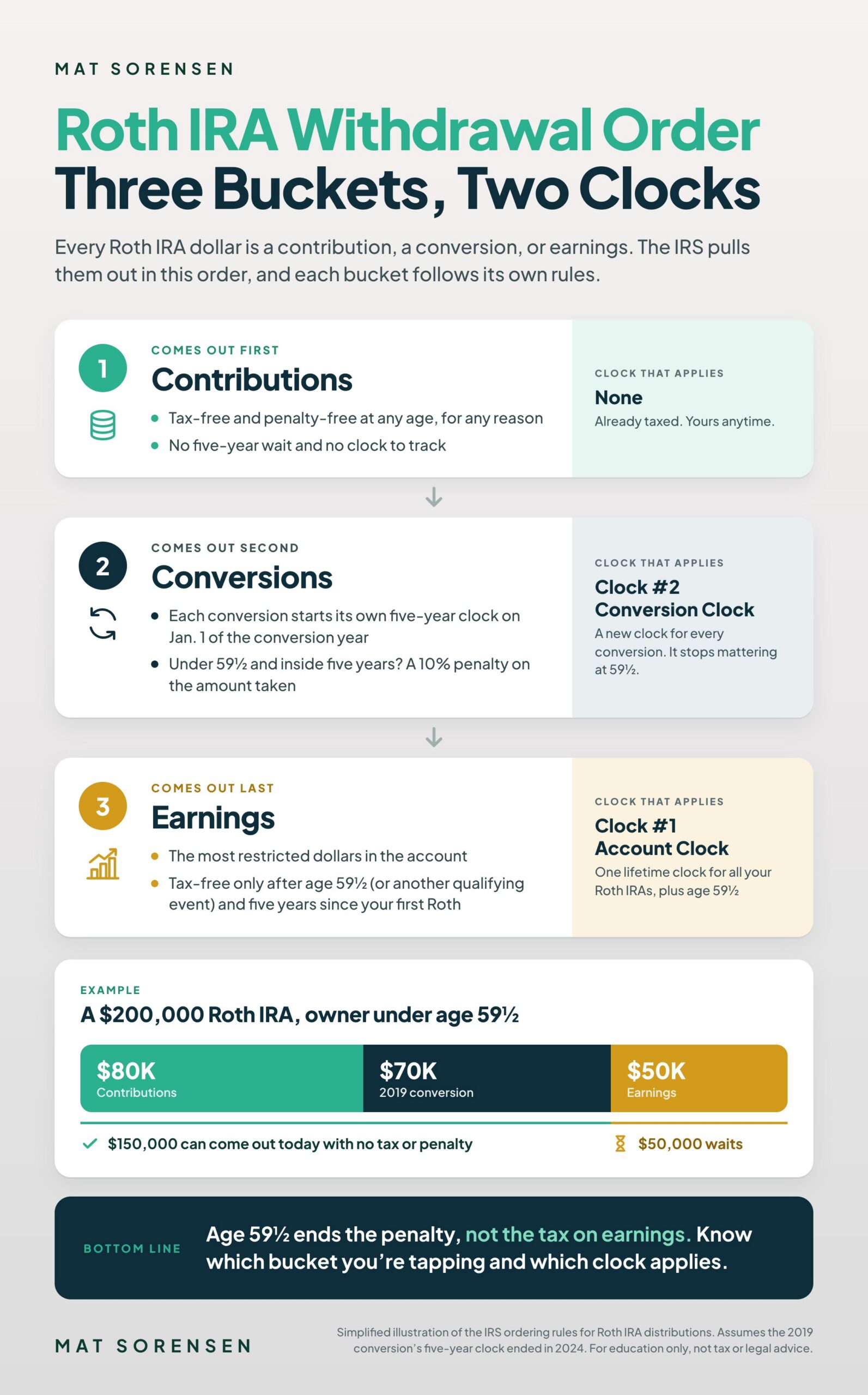
When Congress created Roth IRAs, it built in a powerful safeguard: a strict ordering rule for withdrawals. Every distribution comes out in a specific sequence—contributions first, then conversions, then earnings. This order matters because each bucket carries different tax and penalty treatment. The rules ensure you access the safest dollars first and only reach the most restricted funds last.

The Three Buckets, in Order

1

ALWAYS COME OUT FIRST

Regular Roth Contributions

These are tax- and penalty-free at any age, with no five-year waiting period. If you withdraw at 50, you’re pulling contributions first—no clocks to track, no forms to justify.

2

COME OUT SECOND

Converted Amounts

Each conversion has its own five-year clock (Clock #2). Once that period has passed, the converted principal can be withdrawn tax- and penalty-free, even before age 59½. If the clock hasn’t run, a 10% penalty may apply if you’re under 59½.

3

ALWAYS COME OUT LAST

Earnings and Growth

This is the most restricted bucket. To withdraw earnings tax- and penalty-free, you must satisfy both five-year rules and be at least 59½ (or meet another qualifying condition). The IRS won’t let you touch earnings until contributions and conversions are exhausted.

This ordering is automatic—you don’t choose which dollars come out. The IRS mandates the sequence that minimizes your tax burden. You cannot accidentally withdraw taxable earnings while untaxed contributions or seasoned conversions remain in the account.

EXAMPLE: KNOW WHICH DOLLARS YOU CAN TOUCH

Suppose your Roth IRA holds $200,000:

  • $80,000 in regular contributions
  • $70,000 from a 2019 Roth conversion
  • $50,000 in earnings and growth

You can withdraw $150,000 today with zero tax or penalty, even if you’re under 59½:

  • The $80,000 in contributions is always accessible
  • The $70,000 conversion is seasoned—its five-year clock ended in 2024
  • Only the $50,000 in earnings remains conditional. The IRS requires you to exhaust the $150,000 first before any earnings can be distributed

Your custodian’s statements show your account balance, but not the breakdown by bucket. To track contributions, conversions, and distributions, you’ll use IRS Form 8606, which reports Roth IRA activity—including conversions and distributions—on your federal tax return. This form ensures the IRS knows which dollars you’ve withdrawn and whether any portion is taxable or subject to penalty.

Understanding these three buckets—and the ordering rule that governs them—gives you clarity on what you can access today, what requires waiting, and how to avoid unnecessary taxes and penalties.

Infographic: Roth IRA withdrawal order. Contributions come out first, conversions second, earnings last, and which five-year clock applies to each

When Neither Rule Matters (So You Don’t Overthink It)

Most Roth IRA owners never need to stress over the two five-year clocks. In many common situations, the rules are already satisfied—or simply don’t apply.

You can ignore the clocks if:

  • ✓You’re withdrawing regular Roth contributions (not conversions). These come out first, tax- and penalty-free, at any age, for any reason
  • ✓You’re 59½ or older and have held a Roth IRA for at least five years. Both clocks are effectively dead: the conversion clock only guards the 10% early-withdrawal penalty (which no longer exists after 59½), and the account clock is already met, so earnings are tax-free

If you’re 45 and don’t plan to touch your Roth until 60, these rules are largely trivial. Contribute, invest, and let compounding work. By retirement, both five-year requirements will be long satisfied, and your Roth will function as the tax-free ATM it was designed to be.

Where mistakes happen:

  • !Early withdrawal of converted funds: You convert to Roth, then pull those dollars out before five years have passed while under 59½—triggering a 10% penalty on the amount taken
  • !Late starters: You open your first Roth IRA at 58, assume everything is tax-free at 59½, and withdraw earnings early. In reality, earnings remain taxable until the account itself has existed for five years—meaning tax-free treatment doesn’t begin until age 63 in this scenario

If neither situation describes you, relax. Your Roth IRA’s tax-free growth is intact. Wait until after 59½ and once the five-year account clock is met, and you’ll enjoy the full benefit: tax-free income in retirement, exactly as Congress intended.

What This All Really Comes Down To

Here’s what the 5-year Roth rule really comes down to: it isn’t one rule, and it isn’t simply about waiting five years.

The key is knowing which Roth dollars you’re dealing with. The tax code effectively treats your Roth IRA as three separate buckets: contributions, conversions, and earnings. Those buckets don’t all follow the same rules. Add in two different five-year clocks, and it’s easy to see where the confusion starts.

In fact, the people most likely to make a costly mistake aren’t necessarily those who have never heard of the five-year rule. They’re the people who know about it—but apply the wrong five-year rule to the wrong bucket of money.

That distinction becomes especially important if you have multiple Roth IRAs, have switched custodians, regularly make backdoor Roth contributions, have completed Roth conversions, or opened your first Roth later in life. Before taking money out, make sure you know which bucket the distribution is coming from and which clock—if any—actually applies.

And remember, a Roth IRA doesn’t have to be limited to publicly traded stocks and mutual funds. A self-directed Roth IRA can hold assets such as real estate, private funds, private businesses, cryptocurrency, and more. At Directed IRA, we help investors establish and administer self-directed retirement accounts. If you want to explore whether a self-directed Roth IRA fits your strategy, book a free 15-minute call with our team here.

FREE 15-MINUTE CALL

See whether a self-directed Roth IRA fits your strategy, from real estate to private funds.

Book a Call with Directed IRA

New Solo 401(k) Contribution Deadlines: Rules, Steps, and Strategies

As 2019 comes to an end, it is critical that Solo 401(k) owners understand when and how to make their 2019 contributions. There are three important deadlines you must know if you have a Solo 401(k) or if you plan to set one up still in 2019. A Solo 401(k) is a retirement plan for small business owners or self-employed persons who have no other full-time employees other than owners and spouses. It’s a great plan that can be self-directed into real estate, LLCs, or other alternative investments, and allows the owner/participants to contribute up to $56,000 per year (far more and faster than any IRA).

UPDATE (NOV 2026)

This article was written for the 2019 tax year. Since then, the deadline to set up a new Solo 401(k) has changed (see the next section), and for 2026 the total contribution limit is $72,000 (not counting catch-ups). (Source: IRS; SECURE Act §201)

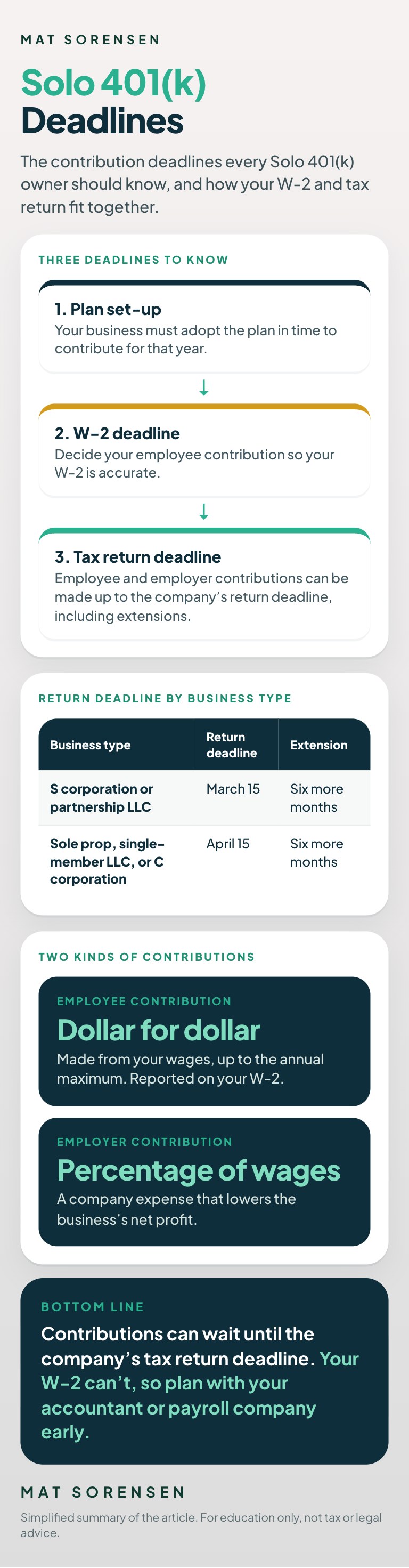
Infographic: the three Solo 401(k) deadlines to know (plan set-up, the W-2 deadline, and the company tax return deadline), return deadlines by business type, and employee vs. employer contributions

Solo 401(k) Set-Up Deadline

UPDATE (NOV 2026)

The SECURE Act and SECURE 2.0 Act changed this deadline. A new 401(k) can now be set up after year-end, by the business’s tax return due date (including extensions), and employer contributions made for that year. A one-person business owned by a sole proprietor can also make first-year employee deferrals if the plan is set up by the return due date (without extensions). (Source: SECURE Act §201; SECURE 2.0 §317)

First, in order to make 2019 contributions, the Solo 401(k) must be adopted by your business by December 31st, 2019. If you haven’t already adopted a Solo 401(k) plan, you should start now so that documents can be completed and filed in time. If the 401(k) is established on January 1st, 2020 or later, you cannot make 2019 contributions.

2019 Contributions Can Be Made in 2020

Both employee and employer contributions can be made up until the company’s tax return deadline including extensions. If you have a sole proprietorship (e.g. single member LLC or schedule C income) or C-Corporation, then the company tax return deadline is April 15th, 2020. If you have an S-Corporation or partnership LLC, the deadline for 2019 contributions is March 15th, 2020. Both of these deadlines (March 15th and April 15th) to make 2019 contributions may be extended another six months by filing an extension. This is a huge benefit for those that want to make 2019 contributions, but won’t have funds until later in the year to do so.

W-2’s Force You to Plan Now

While employee and employer contributions may be extended until the company tax return deadline, you will typically need to file a W-2 for your wages (e.g. an S-Corporation) by January 31st, 2020. The W-2 will include your wage income and any deduction for employee retirement plan contributions will be reduced on the W-2 in box 12. As a result, you should make your employee contributions (up to $19,000 for 2019) by January 31st, 2020 or you should at least determine the amount you plan to contribute so that you can file an accurate W-2 by January 31st, 2020. If you don’t have all or a portion of the funds you plan to contribute available by the time your W-2 is due, you can set the amount you plan to contribute to the 401(k) as an employee contribution, and will then need to make said contribution by the tax return deadline (including extensions).

Example

EXAMPLE

Now let’s bring this all together and look at an example outlining how this may work. Sally is 44 years old and has an S-Corporation for her online business. She is the only owner and only employee, and had a new Solo 401(k) established in 2019. She has $120,000 in net income for the year and will have taken $50,000 of that in wage income that will go on her W-2 for the year. That will leave $70,000 of profit that is taxable to her and that will come through to her personally via a K-1 from the business. Sally has not yet made any 2019 401(k) contributions, but plans to do so in order to reduce her taxable income for the year and to build a nest egg for retirement. If she decided to max-out her 2019 Solo 401(k) contributions, it would look like this:

  1. 1Employee Contributions – The 2019 maximum employee contribution is $19,000. This is dollar for dollar on wages so you can contribute $19,000 as long as you have made $19,000. Since Sally has $50,000 in wages from her S-Corp, she can easily make a $19,000 employee contribution. Let’s say that Sally doesn’t have the $19,000 to contribute, but will have it available by the tax return deadline (including extensions). What Sally will need to do is let her accountant or payroll company know what she plans to contribute as an employee contribution so that they can properly report the contributions on her payroll and W-2 reporting. By making a $19,000 employee contribution, Sally has reduced her taxable income on her W-2 from $50,000 to $31,000. At even a 20% tax bracket for federal taxes and a 5% tax bracket for state taxes that comes to a tax savings of $4,750.
  2. 2Employer Contributions – The 2019 maximum employer contribution is 25% of wage compensation not to exceed $56,000 total. Since Sally has taken a W-2 wage of $50,000, the company may make an employer contribution of $12,500 (25% of $50,000). This contribution is an expense to the company and is included as an employee benefit expense on the S-Corporation’s tax return (form 1120S). In the stated example, Sally would’ve had $70,000 in net profit/income from the company before making the Solo 401(k) contribution. After making the employer profit-sharing contribution of $12,500 in this example, Sally would then only receive a K-1 and net income/profit from the S-Corporation of $57,500. Again, if she were in a 20% federal and a 5% state tax bracket, that would create a tax savings of $3,125. This employer contribution would need to be made by March 15th, 2020 (the company return deadline) or by September 15th, 2020 if the company were to file an extension.

In the end, Sally would have contributed and saved $31,500 for retirement ($19,000 employee contribution, $12,500 employer contribution). And she would have saved approximately $7,875 in federal and state taxes. That’s a win-win.

UPDATE (NOV 2026)

This example uses 2019 limits. For 2026, the employee deferral limit is $24,500 ($32,500 at age 50+) and the total limit is $72,000. (Source: IRS)

Keep in mind, you need to start making plans now, and begin coordinating with your accountant or payroll company as your yearly wage information on your W-2 (self-employment income for sole props) is critical in determining what you can contribute to your Solo 401(k). Also, make certain you have the plan set-up in 2019 if you plan to make 2019 contributions. While IRAs can be established until April 15th, 2020 for 2019 contributions, a Solo K must be established by December 31st, 2019 if you want to make 2019 contributions. Don’t get the two confused, and make sure you’ve got a plan for your specific business.

Note: If you’ve got a single member LLC taxed as a sole proprietorship, or just an old-fashioned sole prop, or even an LLC taxed as a partnership (where you don’t have a W-2), then please refer to our prior article here on how to calculate your Solo K contributions as they differ slightly from the s-corp example above.

We can help in establishing your solo(k) at KKOS Lawyers using our IRS pre-approved solo(k) plan documents where you can self-direct the solo(k) and have checkbook control right out of the plan. We also assist with the plan quarterly statements and IRS required plan document updates at Directed Trust Company.

FREE SOLO 401(K) GUIDE

Self-employed? Learn how a self-directed Solo 401(k) works and how much you can contribute.

Get the Free Solo 401(k) Guide

Prefer to talk it through? Book a call with a Directed IRA specialist

Mat Sorensen

Mat has been at the forefront of the self-directed IRA industry since 2006. He is the CEO of Directed IRA & Directed Trust Company where they handle all types of self-directed accounts (IRAs, Roth IRAs, HSAs, Coverdell ESA, Solo Ks, and Custodial Accounts) which are typically invested into real estate, private company/private equity, IRA/LLCs, notes, precious metals, and cryptocurrency. Mat is also a partner at KKOS Lawyers and serves clients nationwide from its Phoenix, AZ office.

He is published regularly on retirement, tax, and business topics, and is a VIP Contributor at Entrepreneur.com. Mat is the best-selling author of the most widely used book in the self-directed IRA industry, The Self-Directed IRA Handbook: An Authoritative Guide for Self-Directed Retirement Plan Investors and Their Advisors.
Self-Directed IRAs, Real Estate Crowdfunding, and UBIT Tax Explained

The most common asset class for self-directed IRA accounts is real estate. Real estate investments for self-directed IRAs come in various forms from simple single-family rentals owned 100% by the IRA to LLC or LP investment partnerships with multiple investors in larger commercial or multi-family properties.

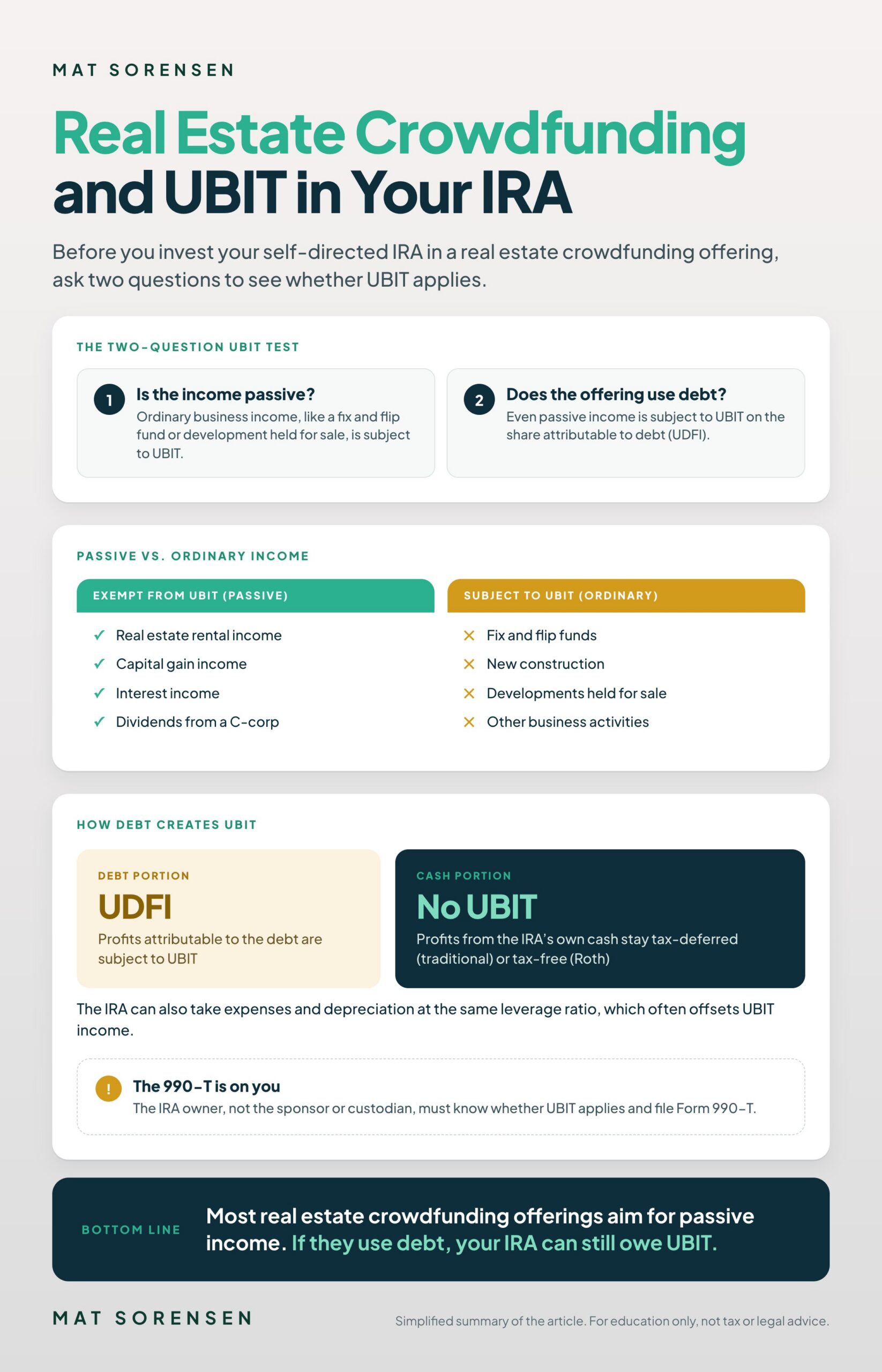
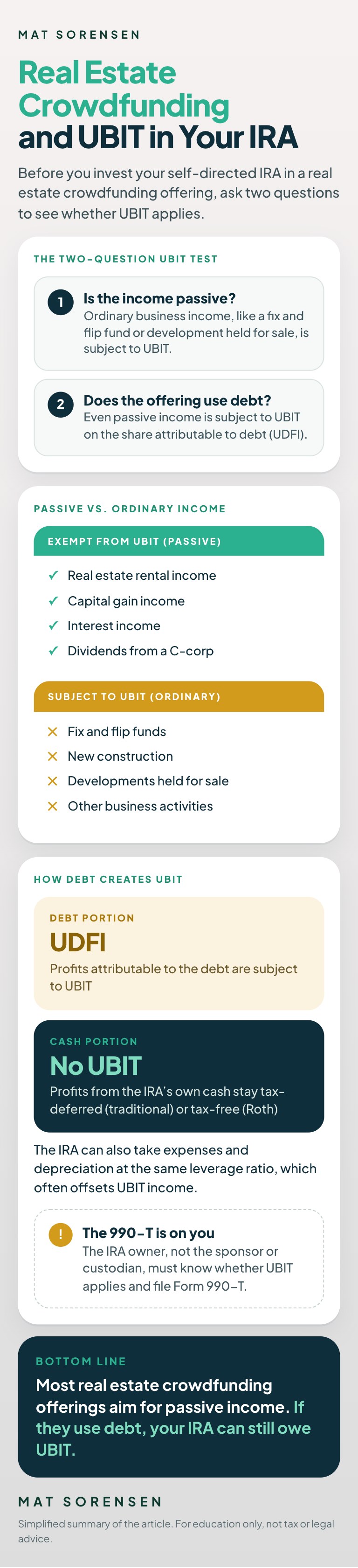
Infographic: the two-question test for whether UBIT applies to a self-directed IRA real estate crowdfunding investment, passive versus ordinary income, and how debt financing creates UDFI

Real Estate Crowdfunding and Your IRA

Given the changes in federal securities laws that now allow investment sponsors and real estate syndicators to raise capital more easily, many self directed IRA investors have considered investing their IRAs into these offerings. Crowdfunding sites such as Realcrowd are already offering Crowdfunding type investment opportunities for investors under SEC Rule 506(c). This rule and those investments are currently only available to accredited investors and have no restriction on the investment amount that may come from the accredited investor. These offerings have traditionally been known as private placements or “PPMs” but can now be marketed and there is no requirement that they be “private” so long as the offering company only accepts accredited investors.

For those who are not accredited investors, “true” Crowdfunding under Title III of the JOBS Act goes into effect in May of 2016. Under these Crowdfunding offerings everyone will be able to invest into Crowdfunding opportunities and the investment amount will be based on the investor’s income and assets. These new Crowdfunding rules were enacted in Title III of the JOBS Act and were put into final regulations by the SEC in late 2015.

Before investing your self-directed IRA into a real estate Crowdfunding offering, you must first learn and understand one very important tax called UBIT tax that may apply to your self-directed IRA’s income.

Will My IRA Be Subject to UBIT Tax?

Unrelated Business Income Tax (“UBIT”) applies to an IRA that receives non-passive income. UBIT is a hefty tax and has a maximum rate of 39.6%. IRC § 511. The tax table is copied below.

2016 UBIT Tax Rates

 If taxable income is: The tax is:
Not over $2550 15% of the taxable income
Over $2550 but not over $5950 $375 plus 25% of the excess over $2550
Over $5950 but not over $9050 $1225 plus 28% of the excess over $5950
Over $9050 but not over $12300 $2107 plus 33% of the excess over $9050
Over $12400 $3179 plus 39.6% of the excess over $12400

UPDATE (NOV 2026)

This table shows 2016 rates. For 2026, the top rate for UBIT (trust tax rates) is 37%, on taxable income above $16,000; it was 39.6% when this article was written. The $1,000 specific deduction still applies. (Source: AAII; IRC 511(b), 512(b)(12))

Although not shown on the table, the first $1,000 in UBIT gross income is exempt and you receive an automatic $1,000 deduction.

UBIT will apply to your self-directed IRA’s real estate investment in two scenarios. First, it will apply if the income to the IRA is ordinary. And second, it will apply if the offering company uses debt to acquire its properties.

Step One: Is the income passive?

First, UBIT will apply if the investment is an ordinary income producing business. An ordinary income business in real estate investing would include investing into an LLC or LP that conducts new construction, real estate developments held for sale, or other activities that are deemed business activities. Passive income investments, on the other hand, are specifically exempt from UBIT and include real estate rental income, capital gain income, interest income, and dividend income from a c-corp. IRC § 512(b). The vast majority of real estate Crowdfunding offerings are structured to obtain passive income such as rental income while the property is held and capital gain income when the property is sold. Typical real estate offerings where UBIT can be due include offerings to fix and flip properties or offerings for new construction or real estate development where the investment strategy is to buy properties to then immediately sell.

If you have an investment offering that is ordinary income (e.g. a fix and flip fund), then the income to the IRA from the fund will be subject to UBIT tax and the IRA will be required to file and pay the tax each year by using IRS Form 990-T. This responsibility to file the return each year is on the IRA account owner and not the investment sponsor or the IRA custodian so IRA owners need to know for themselves whether the IRA is subject to UBIT or not. So for example, let’s say that a self-directed IRA invested into a Crowdfunding offering that was a real estate development with properties held immediately for sale and that the income was ordinary income. Let’s further assume that the self-directed IRA received a K-1 for profits to the IRA for the year of $10,000. Based on the UBIT tax table, and after the $1,000 deduction, the IRA would owe UBIT tax in the amount of $2,079. This amount is due from the IRA to the IRS and is reported and payable using form 990-T.

If you’ve determined that the Crowdfunding offering income is passive (e.g. rental, capital gain), then you may still be subject to UBIT if the LLC or LP offering company is using debt to leverage and acquire its properties.

Step Two: Will the investment be leveraged with debt?

EXAMPLE

Second, UBIT will apply to profits returned to your IRA from a Crowdfunding real estate offering (and really any real estate owned by your IRA) if the offering company uses debt to leverage its acquisition of properties. For example, let’s say the offering company raises $1M in cash to buy a $4M multi-family property. There will be $1M of cash invested into the property and $3M of debt. The property will therefore be leveraged 75% with debt.

Whenever an IRA’s investment is leveraged with debt, the tax code requires the IRA owner to determine what profits are attributable to the IRA’s cash and what profits are attributable to the debt. The profits attributable to the cash invested is still treated as tax deferred (traditional IRA) or tax free (roth IRA) and is not subject to UBIT. The profits and income attributable to the debt, however, is called unrelated debt financed income (“UDFI”) and is subject to UBIT. IRC § 514. So, in the multi-family property example above where the property is leveraged 75% with debt, the self-directed IRA will be subject to UBIT tax on 75% of the income.

In order to calculate UBIT tax based on debt, you must first determine the leverage ratio. Once we know the leverage ratio, we can then begin to calculate how UBIT will apply. The good news is that the IRA is also allowed to take expenses against the property using the same leverage ratio and is able to take depreciation expenses which help to offset UBIT. In many situations, even where a property is cash-flowing the IRA will not be subject to UBIT because the property expenses and depreciation will offset UBIT income.

Let’s continue through this example to illustrate how this works.

Example

EXAMPLE

Property Purchase Price = $4M

Debt/Leverage = $3M

Leverage Ratio = 75%

Income = $1.3M

Income at Leverage Ratio (75%) = $975,000

Operating Expenses= $1,000,000

Operating Expenses at Leverage Ratio (75%) = $750,000

Net Leveraged Income = $225,000

Depreciation Expense ($4M / 27.5) = $145,500

Depreciation Expense at Leverage Ratio = $109,125

Net UDFI/UBIT Income = $115,875

SDIRA Investor Invested $20K and received 1.5% of Company Profit/Loss

SDIRA Investor 1.5% of Net UDFI/UBIT = $1,738.

Automatic IRS $1,000 deduction = $738 subject to UBIT/UDFI

UBIT Table Rate of 15% of $738 = $110 in UBIT is Due

As the example demonstrates, given the low-level of investment from the IRA it isn’t subject to much UBIT as the net UBIT income (after expenses and depreciation) keeps the tax rate on the low end of the tax table. That being said, 990-T tax returns must be filed by the IRA investor for the IRA and the IRA will be responsible for the tax due. Factors that will cause more UBIT are higher returns and income, larger investment amounts and ownership, and more leverage.

While self-directed IRA’s are subject to UDFI and UBIT on leveraged real estate investments, it is worth noting that self-directed 401(k) and other employer based plans are exempt from UDFI on leveraged real estate investments. IRC § 514(c)(9). Unfortunately, self-directed IRAs do not receive this exemption.

So, in short, the quick list to determine whether UBIT will be due a self-directed IRA Crowdfunding real estate investment requires analysis of two issues. First, is the offering company’s income passive or is it ordinary. If it is ordinary then it is subject to UBIT. If it is passive, then it is only subject to UBIT if the company uses debt to leverage its investments. Once you can answer these questions you know whether UBIT will apply to your investment and whether your IRA will need to report and pay tax on its income.

FREE REAL ESTATE IRA GUIDE

Learn how to buy rental property and other real estate with your IRA, and how to avoid prohibited transactions.

Get the Free Real Estate IRA Guide

Prefer to talk it through? Book a call with a Directed IRA specialist