Pay the IRS or Lose Your Passport

The IRS recently announced that the State Department will be denying passports, and may revoke yours if you have a “seriously delinquent tax debt.” A seriously delinquent tax debt is where you owe more than $52,000 (including interest and penalties). While this law has been on the books for some time, the IRS recently started sending certifications of seriously delinquent taxpayers to the State Department last year.

UPDATE (NOV 2026)

The “seriously delinquent tax debt” threshold is indexed each year. It was $52,000 when this article was written and is $66,000 for 2026. (Source: IRS)
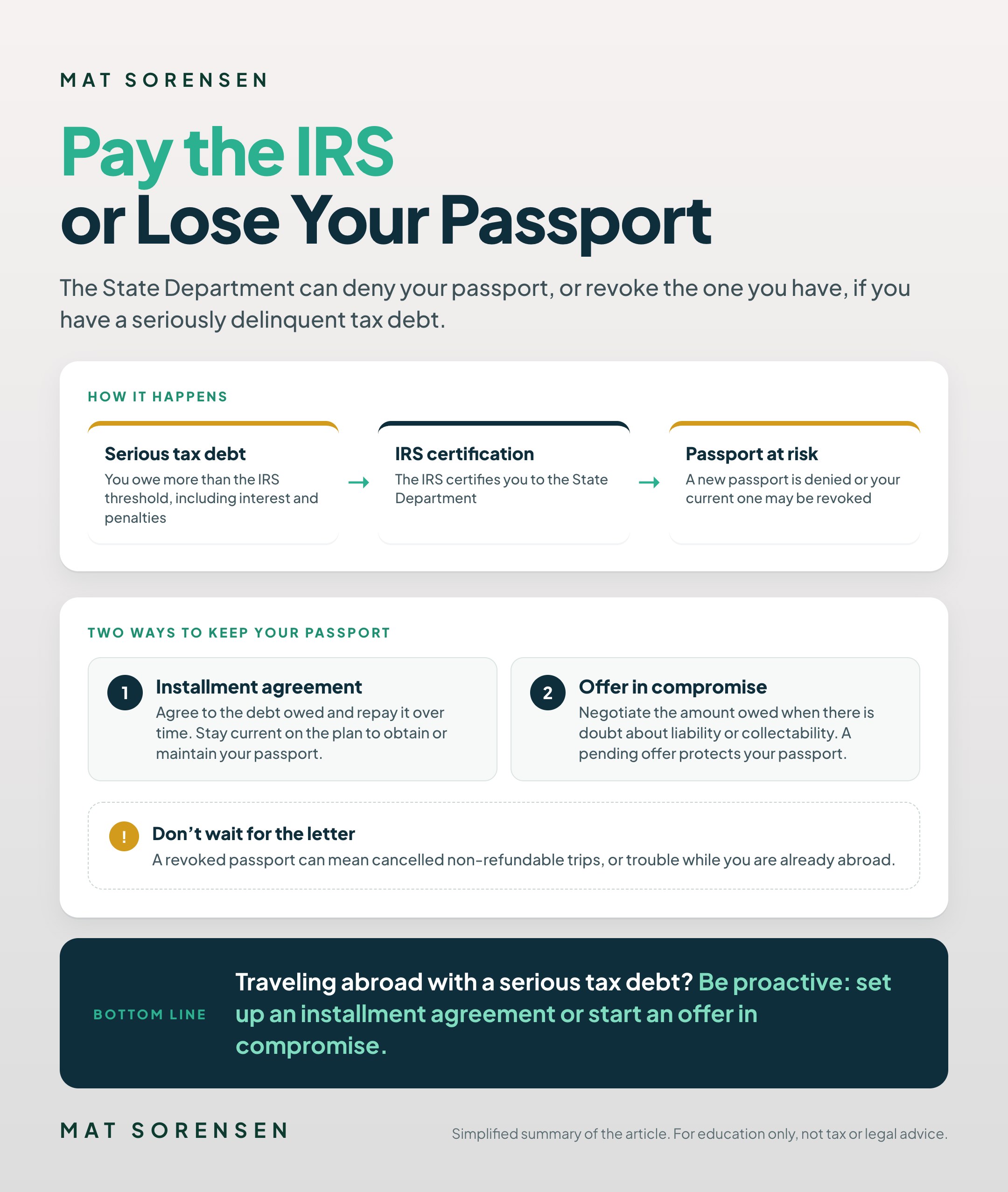
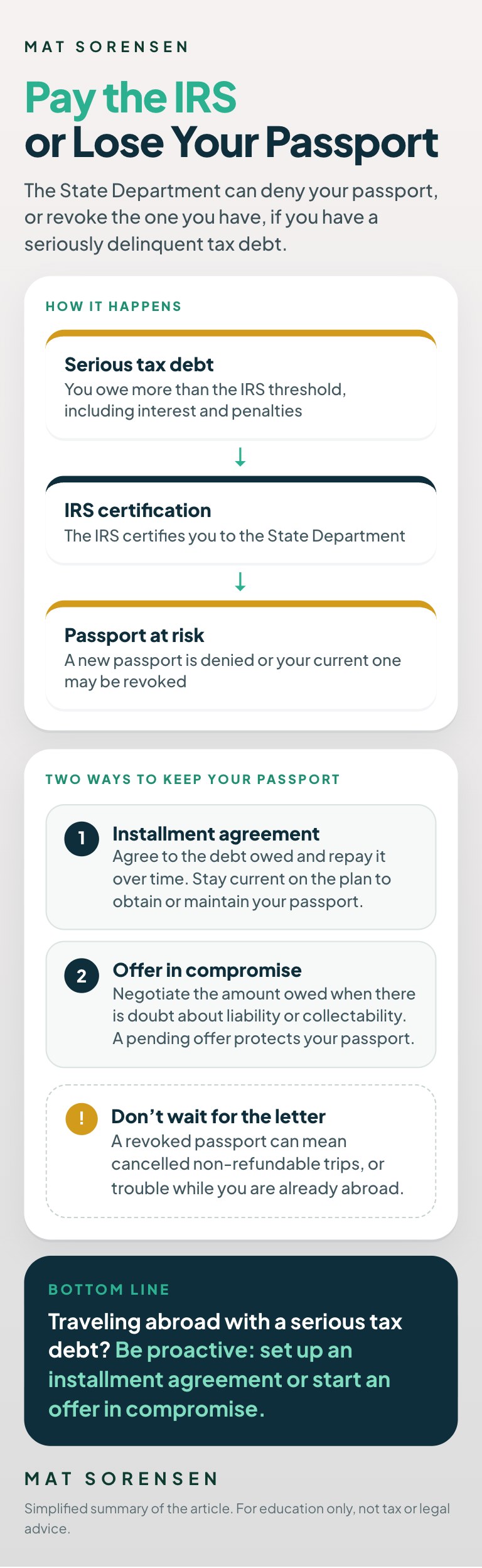
Infographic: how a seriously delinquent tax debt can lead to a denied or revoked passport, and two ways to keep your passport

If you owe the IRS money and have plans to travel abroad, there are a couple of options you can use to maintain or obtain a passport even though you may be a “seriously delinquent taxpayer.” Here are the most common options:

1. Installment Agreement

Enter into an installment agreement with the IRS to repay the debt (i.e. A payment plan). So long as you are current on your installment agreement, you can obtain or maintain your passport. An installment agreement is essentially an agreement whereby you agree to the debt owed and set-up a payment plan to have it paid back over time. The IRS usually requires financial disclosures in order to determine the payment amount and schedule. You can learn more here.

2. Offer in Compromise

Have a pending offer in compromise with the IRS, or be paying timely on an agreed upon offer in compromise. An offer in compromise is a method of negotiating a compromise on the amount owed to the IRS. The IRS only accepts an offer in compromise if there is a doubt as to the liability (i.e. There is a legitimate tax question over your position and that of the IRS), or there is a doubt as to collect-ability (i.e. “Can you really pay it back?”).  You can learn more about an offer in compromise here. Keep in mind, so long as the offer in compromise request is pending, you can still obtain or maintain your passport. So, start here if you still have issues to work out with the IRS before you agree to the amount owed in an installment agreement. Though, if you don’t have a legitimate reason for an offer in compromise, you should consider the installment agreement.

If you’ve got plans to travel abroad AND you’ve got a serious tax debt, be proactive about paying it back with an installment agreement or start the process of making an offer in compromise. You don’t want to be surprised by a letter in the mail from the state department that your passport has been revoked. Or even worse, have non-refundable travel plans that have to be cancelled because your passport is revoked. And, last but not least, be abroad and have your passport revoked and your travel status in jeopardy. You may just end up spending your foreign trip at the local U.S. Embassy.
Roth IRA Distributions Before Age 59 ½

Every Roth IRA account owner knows that the main benefit of the Roth IRA is that withdrawals are tax-free after the account owner is 59 ½, as long as the Roth IRA has been open for at least five years. However, what taxes or penalties apply to distributions taken before the Roth IRA owner reaches 59 ½?

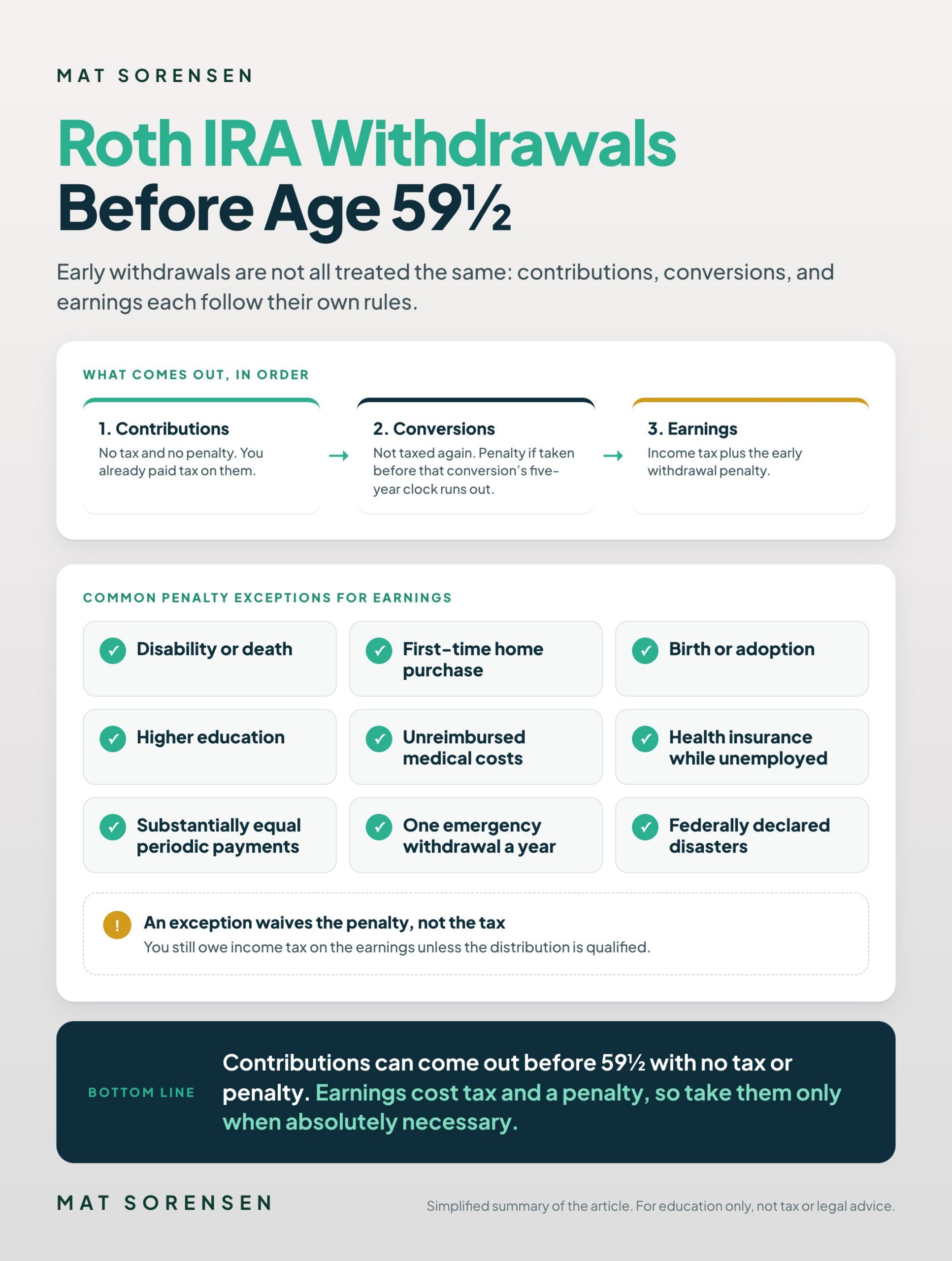
Roth IRA distributions before age 59 ½ are broken into two categories, contributions and earnings. 

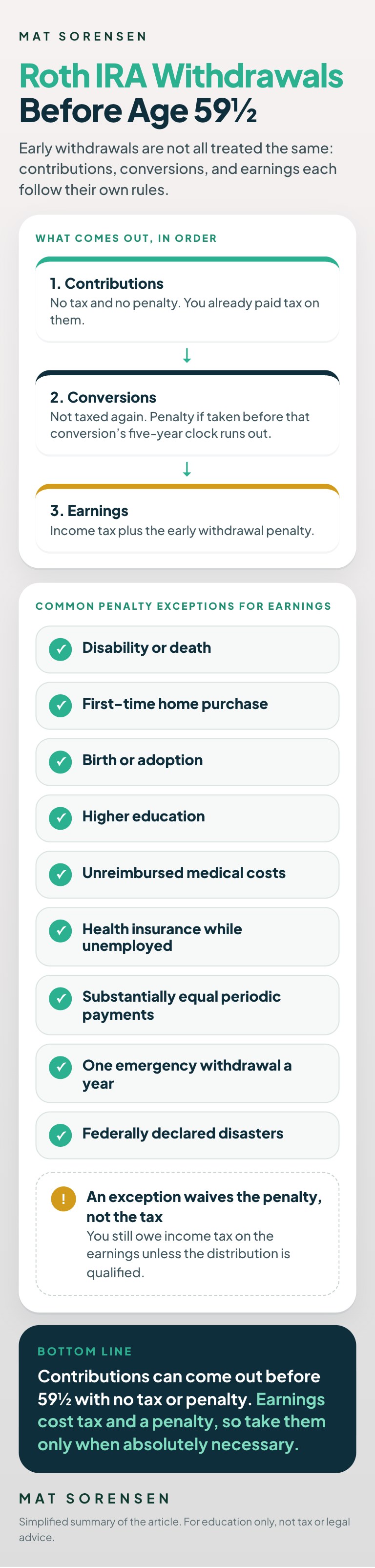
Infographic: how Roth IRA withdrawals before age 59½ work. Contributions come out first with no tax or penalty, then conversions, then earnings, which face income tax and the early withdrawal penalty, plus common penalty exceptions

Contributions Can Be Withdrawn Before 59 ½ Without Tax or Penalty

The first category is Roth IRA contributions. This category is distinct because these amounts have been subject to tax before the funds were included in the Roth IRA. The amounts withdrawn from a Roth IRA that do not exceed the amounts of Roth IRA contributions are not subject to taxes or penalties upon early distribution from the Roth IRA. However, any amounts distributed in excess of the Roth IRA contributions, which would typically be the investment returns, are subject to taxes and the early withdrawal penalty of 10%. 

KEY TAKEAWAY

This is an excellent perk as it allows Roth IRA owners to take money back that they contributed to the Roth IRA without worrying about penalties or taxes. 

What About Amounts You Converted?

If your Roth IRA holds money you converted from a traditional IRA or 401(k), those dollars come out after your contributions and before your earnings. You already paid tax on them when you converted, so they aren’t taxed again. But if you’re under 59 ½, each conversion has its own five-year clock for the 10% penalty, starting January 1 of the year you converted. Take out a conversion before its clock runs out and you’ll owe the 10% penalty on the part that was taxable when you converted.

Earnings Are Subject to Tax and the 10% Early Withdrawal Penalty

Amounts withdrawn before 59 ½ that comprise the Roth IRA’s earnings are subject to tax and a 10% early withdrawal penalty. IRC § 408A(d)(2)(A) & Treasury Reg. §1.408A-6, Q&A-1(b). “Earnings” is the amount over the sums you have contributed to the Roth IRA, and is essentially your investment returns and gains. 

WATCH OUT

Since there are taxes AND penalties on the earnings, you should only take distributions when absolutely necessary. 

Example of Roth IRA Distribution Before 59 ½

EXAMPLE

For example, let’s say a Roth IRA owner is 45 and has a Roth IRA with $65,000. This balance consists of $35,000 in Roth IRA contributions and $30,000 in earnings or investment returns. If the Roth IRA owner took a distribution of the entire account then $35,000 would NOT be subject to early withdrawal penalties as this amount comprised Roth IRA contributions where taxes have been paid already. However, the remaining $30,000 distributed represents investment returns/gains made in the Roth IRA and would be subject to early withdrawal penalties of 10% and must also be included in the taxable income of the Roth IRA owner. As a result, Roth IRA owners under age 59 ½ should avoid distributions of their Roth IRA in excess of their contributions. 

$35,000

Contributions: no tax or early withdrawal penalty

$30,000

Earnings: taxable income plus the 10% penalty

Exceptions to the 10% Penalty

Even when you withdraw earnings before 59 ½, the 10% penalty doesn’t apply in certain cases. You’ll still owe income tax on the earnings unless the distribution is qualified. Common exceptions include:

  • ✓Disability or death
  • ✓Up to $10,000 (lifetime) for a first-time home purchase
  • ✓Up to $5,000 per child for birth or adoption expenses
  • ✓Qualified higher education expenses
  • ✓Unreimbursed medical expenses above 7.5% of your AGI
  • ✓Health insurance premiums while unemployed
  • ✓Substantially equal periodic payments
  • ✓One emergency withdrawal of up to $1,000 per year
  • ✓Victims of domestic abuse, up to the lesser of $10,000 (indexed for inflation) or 50% of the account
  • ✓Up to $22,000 for qualified federally declared disasters

FREE SELF-DIRECTED IRA GUIDE

Learn how a self-directed Roth IRA can invest in real estate, private companies, notes, and more, and keep the growth tax-free.

Get the Free Self-Directed IRA Guide

Prefer to talk it through? Book a call with a Directed IRA specialist

The IRS Says That You Can Contribute More to Your IRA and 401(k) in 2019

Late last week, the IRS announced increased contribution limits for IRAs, 401(k)s and other retirement plans. IRAs have been stuck at $5,500 since 2013, but are finally moving up to $6,000 starting in 2019. If you save in a 401(k), including a Solo K, the good news is that your contribution limits were increased too, with employee contributions increasing from $18,500 to $19,000 and total 401(k) contributions (employee and employer) reaching $56,000. The IRS announcement and additional details can be found here.

Health savings account (HSA) owners also won a small victory with individual contribution maximums increasing by $50 to $3,500, and family contribution amounts increasing by $100 to $7,000.

Breakdown

Here’s a quick breakdown on the changes:

  • IRA contribution limitations (Roth and Traditional) increased from $5,500 to $6,000, and there is still the $1,000 catch-up amount for those 50 and older.
  • 401(k) contributions also increased for employees and employers: Employee contribution limitations increased from $18,500 to $19,000 for 2019. The additional catch-up contribution for those 50 and older stays the same at $6,000. The annual maximum 401(k) (defined contribution) total contribution amount increased from $55,000 to $56,000 ($62,000 for those 50 and older).
  • HSA contribution limits increased from $3,450 for individuals and $6,900 for families to $3,500 for individuals and $7,000 for families.

These accounts provide advantageous ways for an individual to either save for retirement or to pay for their medical expenses. If you’re looking for tax deductions, tax deferred growth, or tax-free income, you should be using one or all of these account types. Keep in mind there are qualifications and phase out rules that apply, so make sure you’re getting competent advice about which accounts should be set up in your specific situation. Lastly, remember, all of these accounts can be self-directed and invested into assets you know best.