Solo K 5500-EZ Requirement and Failure to File Penalty Relief

Up close photo of an egg-shaped egg timer.Do you have a Solo 401(k)? Have you been filing form 5500-EZ each year for the Solo 401(k)? Are you aware that there is a penalty up to $150,000 per year for failure to file? While some Solo 401(k)s are exempt from the 5500-EZ filing requirement, we have run across many Solo 401(k) owners who should have filed, but have failed to do so.

The return a Solo 401(k) files is called a 5500-EZ, and it is due annually on July 31st for the prior year. If you have a Solo 401(k) and you have no idea what I’m talking about, stay calm, but read on.
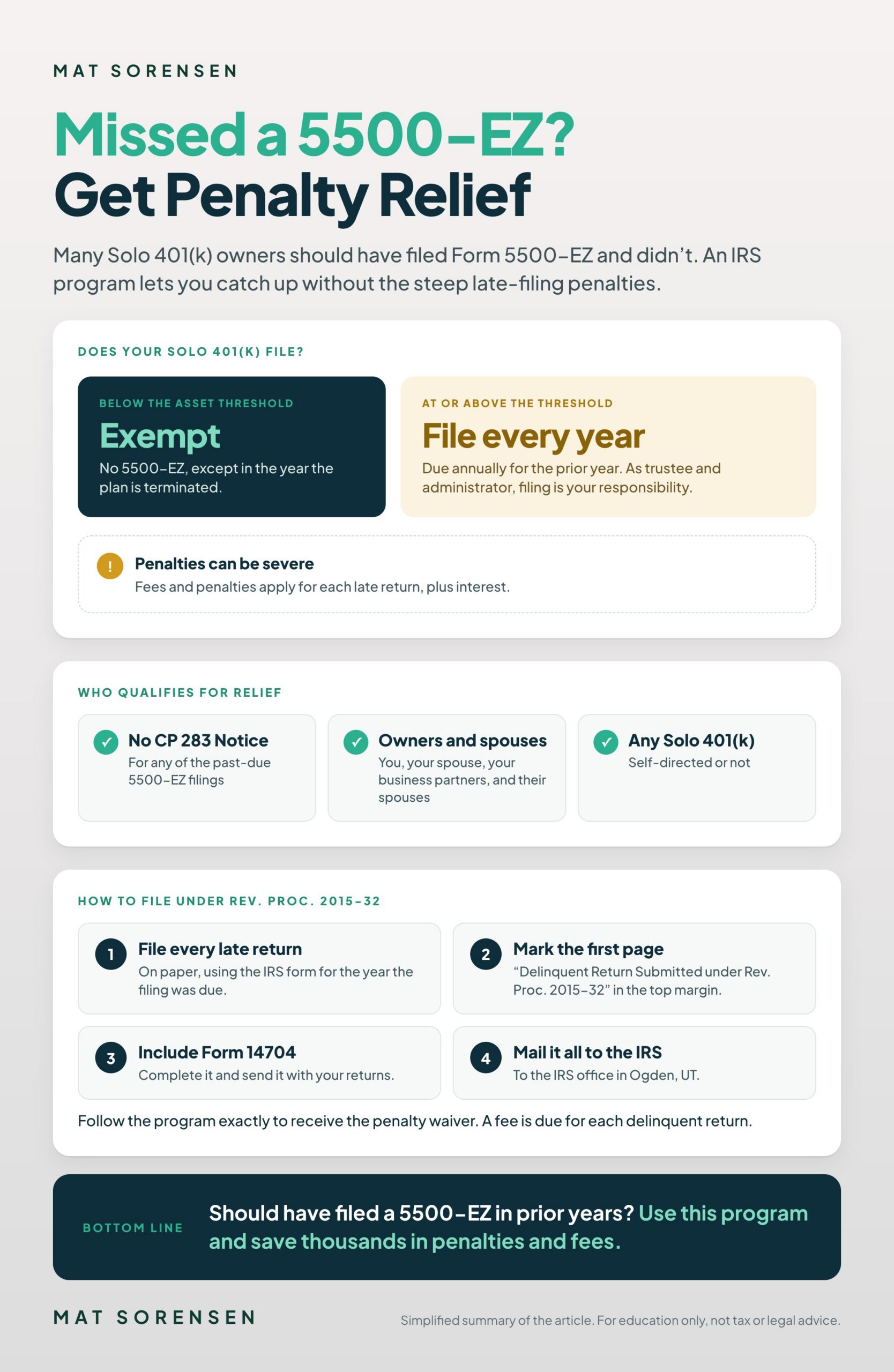
Infographic: when a Solo 401(k) must file Form 5500-EZ, who qualifies for the IRS late-filing penalty relief program, and the four steps to file under Rev. Proc. 2015-32

Benefits of Solo 401(k)s

One of the benefits of a Solo 401(k) is the ease of administration and control, because you can be the 401(k) trustee and administrator. However, as the 401(k) administrator and trustee, it is your own responsibility to make the appropriate tax filings. This would include filing any required tax returns for the 401(k).  Solo 401(k)s with less than $250,000 in assets are exempt and do not need to file a 5500-EZ. All plans with assets valued at $250,000 or greater must file a form 5500-EZ annually. A tax return is also required for a Solo 401(k) when the plan is terminated, even if the plan assets are below $250,000.

Recently, more and more Solo 401(k) owners have contacted us because they set up their Solo 401(k) online or with some other company, and were never made aware that they are supposed to file a 5500-EZ when their plan assets exceed $250,000.  Some of these individuals have multiple years in which they should have filed the 5500-EZ, but failed to do so. The penalties for failing to file a 5500-EZ when it is required can be quite severe, with fees and penalties as high as $150,000 for each late return plus interest.

Failure to File Relief

Fortunately, the IRS has a temporary pilot program that provides automatic relief from IRS Late filing penalties on past due 5500-EZ filings.  The penalty relief began as a temporary program in 2014 and was made permanent via Rev Proc 2015-32.

In order to qualify for this program, your Solo 401(k) plan must not have received a CP 283 Notice for any past due 5500-EZ filings, and the only participants of your Solo 401(k) plan can be you and your spouse, and your business partner(s) and their spouse. There is a $500 fee due for each delinquent return up to a total of $1,500 or three years.  This program is available to all Solo 401(k) plans, regardless of whether it is a self-directed plan.

The IRS has provided details via Rev Proc 15-32. In order to qualify and receive a waiver of penalties under the program, you must follow the program exactly.  In short, you must do all of the following:

  1. 1File all delinquent returns using the IRS form in the year the filing was due. This must be via paper form.
  2. 2Mark on the top margin of the first page, “Delinquent Return Submitted under Rev. Proc. 2015-32.”
  3. 3Complete and include IRS Form 14704.
  4. 4Mail all documents to the IRS, Ogden, UT office.

In sum, if you have a Solo 401(k) plan that should have filed a 5500-EZ for prior years, then you should take advantage of this program, which will save you thousands of dollars in penalties and fees.  If you have any questions about this program or would like assistance with submitting your late 5500-EZ filings under this program, please contact our law firm as we are assisting clients with current and past due 5500-EZ filings for their Solo 401(k)s.

FREE SOLO 401(K) GUIDE

Self-employed? Learn how a self-directed Solo 401(k) works and how much you can contribute.

Get the Free Solo 401(k) Guide

Prefer to talk it through? Book a call with a Directed IRA specialist

Where Should I Title My Real Estate: An LLC, a Trust, or Personally?

Real estate may be owned in your personal name, in a business name, or in a trust. You may have heard of revocable living trusts, corporations, LLCs, series LLCs, or limited partnerships. Here’s a quick guide to where you should own different types of properties.

Infographic: where to own a personal residence, rental property, land or second home, and where properties should not be held

1. Personal Residence

Your home should be owned in your revocable living trust. A living trust is an excellent choice to own your personal residence as the property can pass under the terms of your trust upon your death and your heirs won’t need to go to probate court to transfer ownership. If your residence is owned in your personal name it can only pass to your children/heirs after you’ve gone to probate court which requires far more legal fees and time than setting up a  trust now. For homes with significant equity you may want to consider a domestic asset protection trust which can protect the equity in the home from personal creditors.

2. Rental Property

Your rental property should be owned in an LLC. Rental properties generate income and wealth but they can also create liabilities. If a rental property is owned in your personal name everything that happens on the home creates personal liability to you and a plaintiff can go after all of your personal assets, income, and wages. On the other hand, if a rental property is owned in an LLC the plaintiff will be required to sue the LLC and can’t go after the LLC owner personally. In certain states where you have lots of properties you may want to consider a series LLC which provides liability protection in the LLC between multiple properties such that if something happens to one property in the series LLC it doesn’t affect the other properties in the series LLC.

An LLC owned by one person isn’t too difficult to manage and generally doesn’t require a separate LLC tax return. Instead, you report the property and its profit or loss on your personal return, the same way you would if you owned it in your own name. If you and your spouse own the LLC together, it generally files a partnership return unless you live in a community property state, where you may be able to treat it like a single-member LLC. In most instances, limited partnerships should not be used to hold rental properties as your tax losses and write offs are restricted when you own them in a limited partnership.

3. Land or Second Home

Your land or second home should be owned in your revocable living trust. Again, this helps keep your assets coordinated with your estate plans and outside of probate court. For land or second homes with significant equity you may want to consider a limited partnership or domestic asset protection trust which can protect the property from the owner’s personal liabilities. Generally, an LLC is not used unless the property itself creates liability.

EXAMPLE

For example, if you rent your second home or cabin you may want an LLC for liability protection but most second homes or parcels of land do not create liability  and therefore do not need an LLC.

4. Where Should Properties Never Be Held

Except for short-term real estate holds (under one year) properties should not be owned in an S corporation and should never be held in a C corporation. Additionally, we rarely recommend clients use land trusts to own property for asset protection purposes as land trusts provide little actual asset protection beyond making the owner of the property difficult to determine at the county records.

There are lots of options and many nuances to how you should own your real estate. For a more detailed and specific analysis for your properties please contact the law firm for an estate and asset protection plan that fits your needs. We can also assist with deed transfers to get your properties into the right place.

Top Three Mistakes in Solo 401(k) Plans

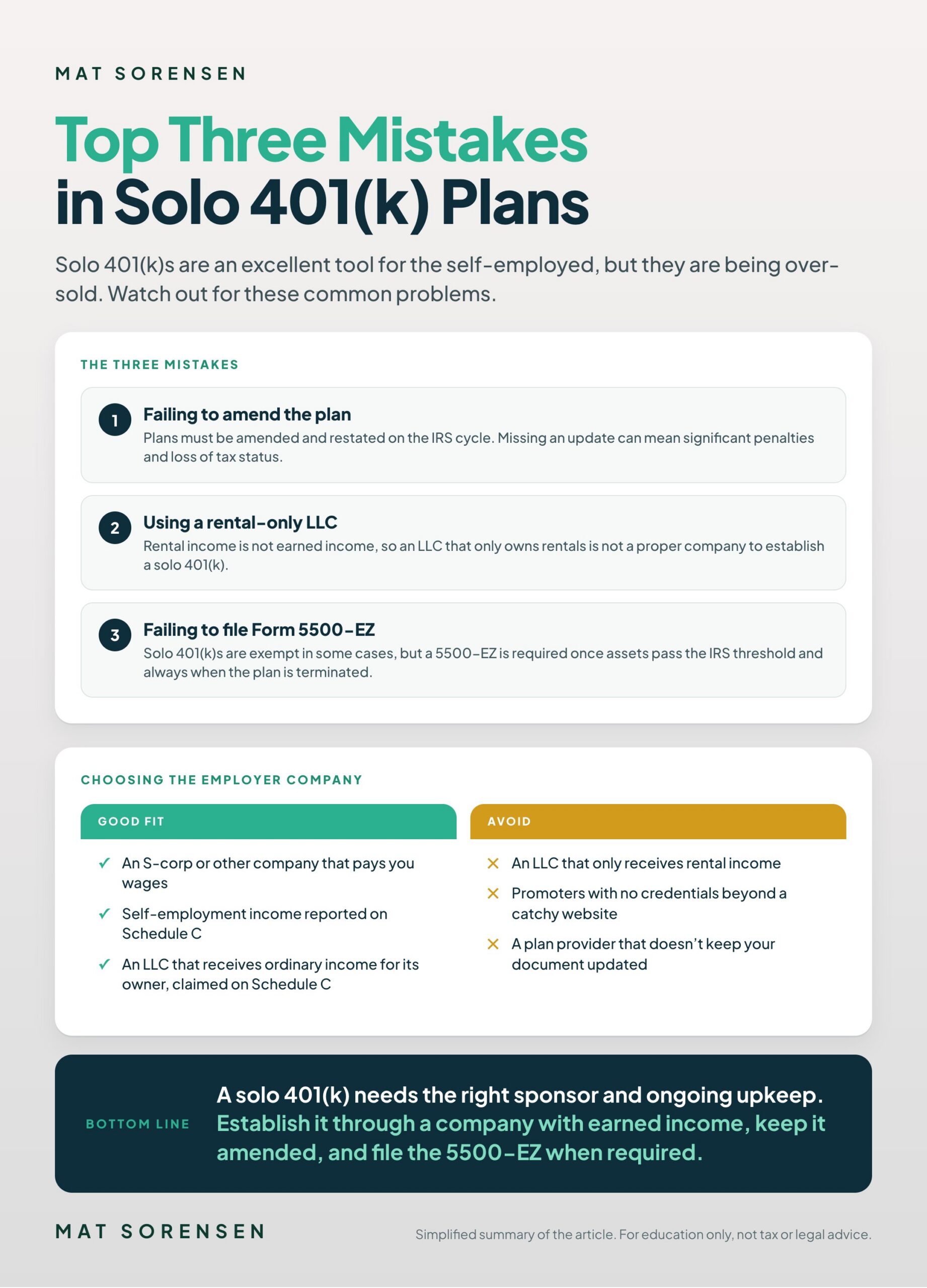
Photo of an old statue with its palm over its face.Solo 401(k) plans have grown significantly and are often used by self-directed investors. Solo 401(k)s are an excellent tool for self employed persons to maximize contributions in their own business or self-employment just like large companies who offer plans for their employees. The basic rules for solo 401(k)s are that you must be self-employed and that you must have no other employees other than the business owner and the owner’s spouse. As happens with many good things, this is starting to get over-sold and we are seeing common problems arise with persons who create them on-line or with the assistance of someone who has no credentials or experience outside of creating a catchy website. Here are a few things to watch out for.

Infographic: three common solo 401(k) mistakes and which company should establish the plan

Top Three Mistakes in Solo 401(k) Plans

1. Failure to Update/Amend

Pursuant to Revenue Procedure 2007-44, 401(k) plans shall be amended and restated every six years to conform with current law. The company who provided your plan document, usually what is called a pre-approved plan document for solo 401(k)’s, should be providing you with these updates so that your plan stays in compliance with the amendment cycles established by the IRS. Failure to properly update the plan can result in significant penalties and revocation of tax status.

2. Using an LLC With Rental Income as The Employer/Company

Solo 401(k)s must be established by an employer company. Unlike IRAs, where any individual may establish an account, a 401(k) may only be established by a company and is a benefit for its employees. For example, a solo 401(k) for a self-employed real estate agent with no other employees is created for the real estate agent who is the sole employee/owner. For many self-employed persons who have no other employees, this type of 401(k) is an excellent retirement plan too.

Unfortunately, the solo 401(k) is being oversold and over promoted to real estate investors who only own rentals. We have seen many promoters (operating out of a basement somewhere) who state that you can establish a solo 401(k) with your LLC that owns rental real estate. After all, they say, the LLC is a company and you are the only owner. Therefore this company can establish a solo 401(k). This is only partly true. The LLC that owns rental properties is not a proper entity in which to establish a solo 401(k) since the LLC receives “rental income” and since the owners of the LLC are not considered “employees” receiving wages or earned income that may be contributed to a retirement account. Rental income cannot be contributed to a retirement account and as a result the owner of the LLC is not an employee or person receiving earned income that qualifies to have a solo 401(k) account. All 401(k)s, solo 401(k)s included, must be established by a company for the benefit of its employees with wages or earned income. See IRS Publication 560. As a result, we recommend that clients use companies where there is wage income (e.g. s-corps) or self-employment income that creates earned income on schedule C  be used to establish a solo 401(k). While an LLC may be used to adopt a solo 401(k), that would only be the case if the LLC receives ordinary income for its owner that is then claimed on schedule C of the owner’s tax return.

3. Failing to File Form 5500-EZ

In general, 401(k)s are required to file a return called form 5500. Solo 401(k)s, however, have some exemptions to the 5500 filing requirement but there are many situations where a solo 401(k) is still required to file an annual form 5500-EZ return. The first instance where a 5500-EZ tax return is required is when the solo 401(k) has over $250,000 in assets. The second instance is when the plan is terminated. Regardless of assets, a form 5500 must still be filed at termination.

Our law firm has experience in creating solo 401(k)s that can be self-trustee’d and self-directed and we also assist our clients with annual maintenance, plan amendments, and required annual 5500-EZ filings. Contact us at the law firm to learn more information about our services.

FREE SOLO 401(K) GUIDE

Self-employed? Learn how a self-directed Solo 401(k) works and how much you can contribute.

Get the Free Solo 401(k) Guide

Prefer to talk it through? Book a call with a Directed IRA specialist

Maxed Out Your 401(k), What’s Next?

Photo of graffiti on the ground reading as "What's Next?"For most American workers and business owners, the first vehicle to save and invest in is your 401(k). The tax benefits and the typical company matching that offers free company money make a 401(k) a great place to save and invest for the long-haul. But what if you’ve maxed out your 401(k) contributions? What else can you do?

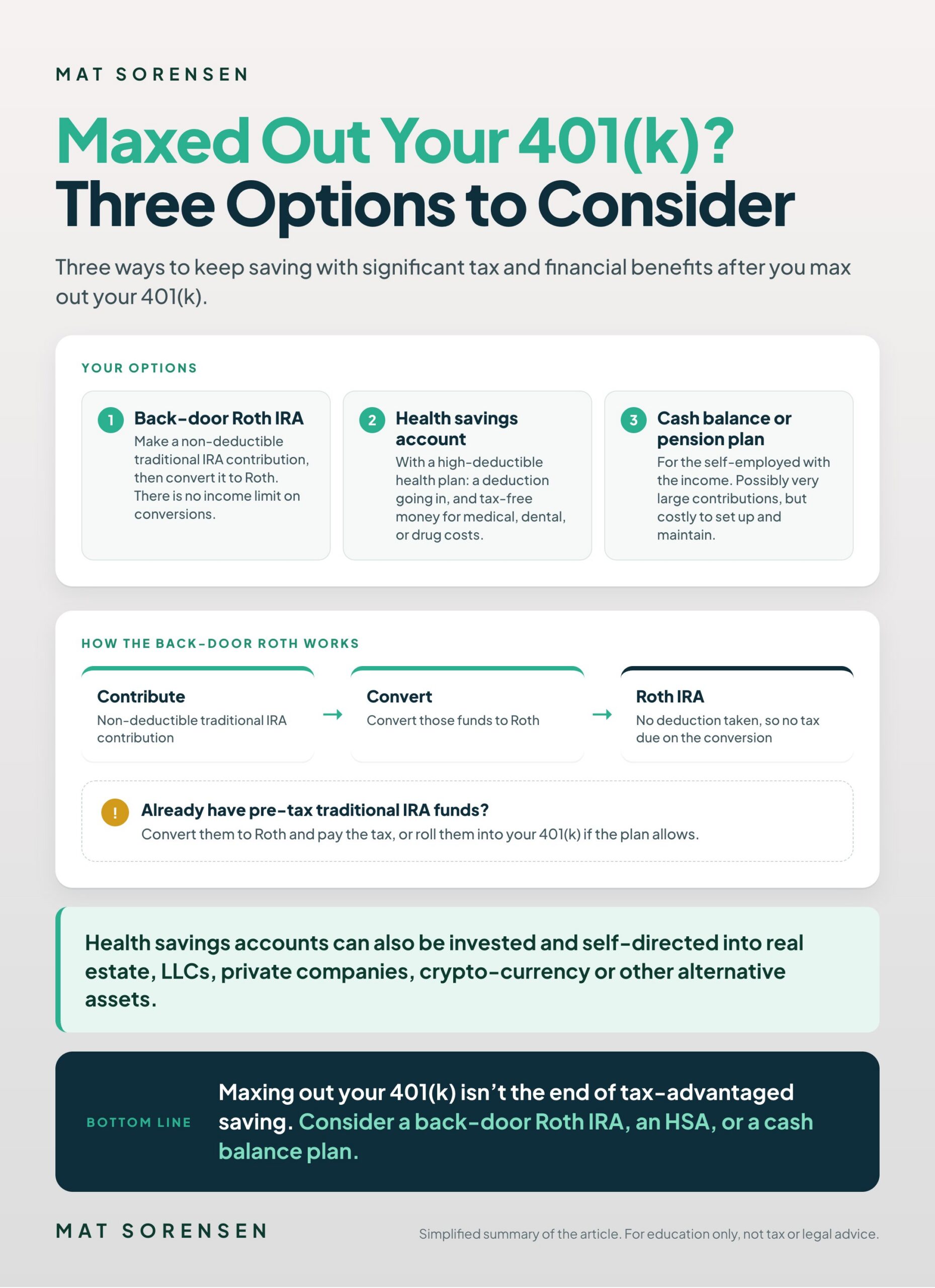
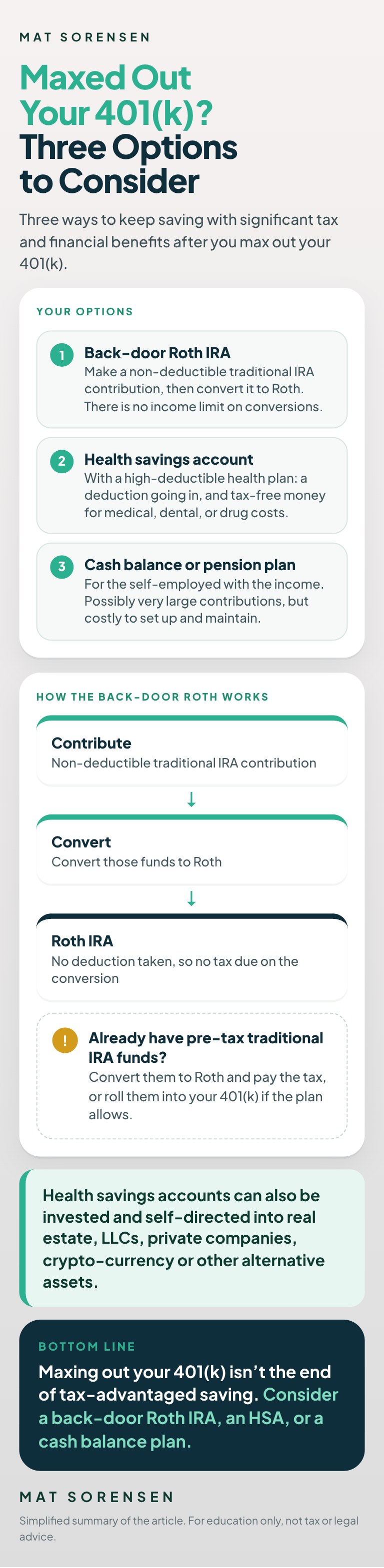
Here are the three options you should consider that provide significant tax and financial benefits:

Infographic: three options after maxing out your 401(k), the back-door Roth IRA, a health savings account, and a cash balance or defined benefit plan

1. Back-Door Roth IRA

This is a really cool option that many clients utilize every year. (I do too.) First, you may be thinking that you can’t do a Roth IRA because your income is too high or because you already maxed out your 401(k). WRONG: It is still possible to do a Roth IRA, but you just have to know the back-door route. The reason it’s called a back-door Roth IRA is because you make a non-deductible traditional IRA contribution (up to $5,500 annual limit, $6,500 if 50 or older). Then, after the non-deductible traditional IRA contribution is made, you then convert the funds to Roth. There is no income limit on Roth conversions, and since you didn’t take a deduction on the non-deductible traditional IRA contribution, there is no tax due on the conversion to Roth. And now, voila, you have $5,500 in your Roth IRA. That’s the back-door route.

UPDATE (NOV 2026)

This section uses the IRA limits from when this article was written. For 2026, the IRA contribution limit is $7,500 ($8,600 if you’re 50 or older). (Source: IRS)

There is a road block though for some who already have funds already in traditional IRAs. The Roth conversion pro-rata rule states that you can’t convert only your non-deductible traditional IRA funds. Each conversion is treated as coming proportionally from all of your traditional IRA funds, including your pre-tax traditional IRA funds, which you got a deduction for and now pay tax on when you convert (this is figured on Form 8606 using the year-end value of all your traditional IRAs). So, if you have pre-tax traditional IRA funds and you want to do the back-door Roth IRA, you have two options:

  1. 1First, convert those pre-tax traditional IRA dollars to Roth and pay the taxes on the conversion.
  2. 2Second, if your 401(k) allows, you can roll those pre-tax traditional IRA dollars into your 401(k).

If you don’t have a traditional IRA, you’re on easy street and only need to do the two-step process of making the non-deductible traditional IRA contribution and then convert it to Roth.

You have until April 15th of each year to do this for the prior tax year. Additionally, while the GOP tax-reform restricted Roth re-characterizations, Roth conversions and the back-door Roth IRA route were unaffected. For more detail on the back-door Roth IRA, check out my prior article here.

2. Health Savings Account (HSA)

If you have a high-deductible health insurance plan, you can make contributions to your HSA up until April 15th of each year for the prior tax year. Why make an HSA contribution? Because you get a tax deduction for doing it, and because that money comes out of your HSA tax-free for your medical, dental, or drug costs. You can contribute and get a deduction, above the line, of up to $4,400 if you’re single or for up to $8,750 for family (2026). We all have these out-of-pocket costs, and this is the most efficient way to spend those dollars (from an account you got a tax deduction for putting money into). If you didn’t have a high deductible HSA-qualifying plan by December 1st of the prior year, then the HSA won’t work.

Any amounts you don’t spend on medical can be invested in the account and grow tax-free for your future medical or long-term care. Health savings accounts can also be invested and self-directed into real estate, LLCs, private companies, crypto-currency or other alternative assets. We’ve helped many clients invest these tax-favored funds using a self-directed HSA.

For more details on health savings accounts, check out my partner Mark’s article here.

3. Cash Balance Plan or Defined Benefit Plan

If you’re self-employed you may consider establishing a cash balance plan or a defined benefit plan (aka “pension”), where you can possibly contribute hundreds of thousands of dollars each year. The amount of your contribution depends on your income, age, and the age and number of employees you may have. A cash balance plan or defined benefit plan/pension will cost you ten thousand dollars or more in fees to establish, and is far more expensive to maintain and administer. But, if you have the income, it’s a valuable option to consider. For more details on cash balance plans, check out Randy Luebke’s article here.

FREE SELF-DIRECTED IRA GUIDE

Learn how a self-directed Roth IRA can invest in real estate, private companies, notes, and more, and keep the growth tax-free.

Get the Free Self-Directed IRA Guide

Prefer to talk it through? Book a call with a Directed IRA specialist

Penalty-Free Early IRA Distributions for College Education Expenses

Do you have tuition or other college expenses due for yourself, your spouse, or your child? Would you like to use your IRA to pay for these expenses? Would you like to avoid the 10% early withdrawal penalty for accessing your IRA funds before you are age 59 ½? This article outlines how you can avoid the 10% early withdrawal penalty when using your IRA to pay for higher education expenses.

Whether you should actually take a distribution from your IRA to pay for the higher education expenses of your child is another topic. Sadly, too many parents have raided their own retirement savings to pay for their children’s college education expenses. They then reach retirement age with a sliver of what savings or retirement accounts they could’ve otherwise relied on. Everyone’s situation and goals are unique but if you have decided to use IRA funds to help pay for educational expenses here’s how you can avoid the 10% penalty for accessing your own money.

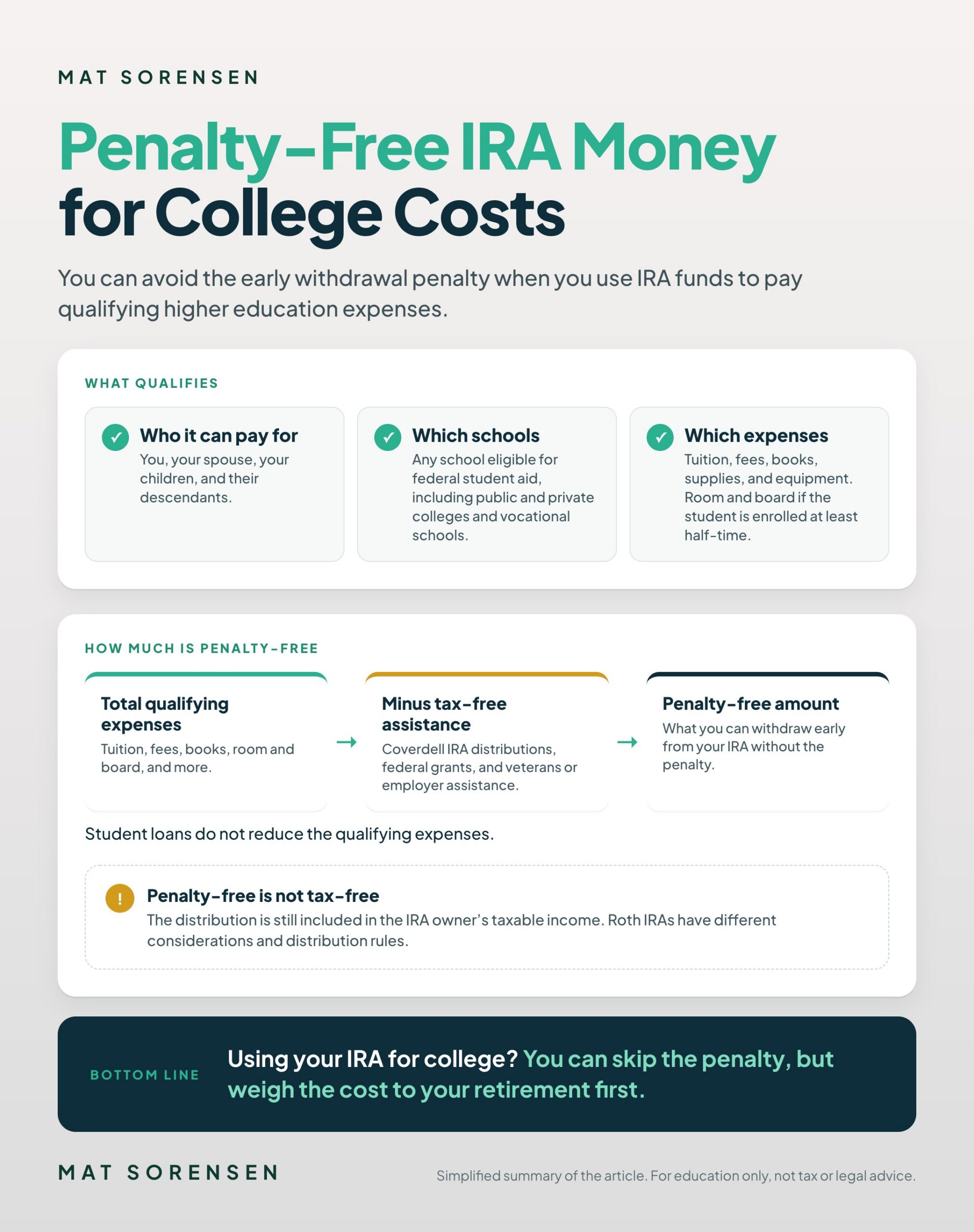
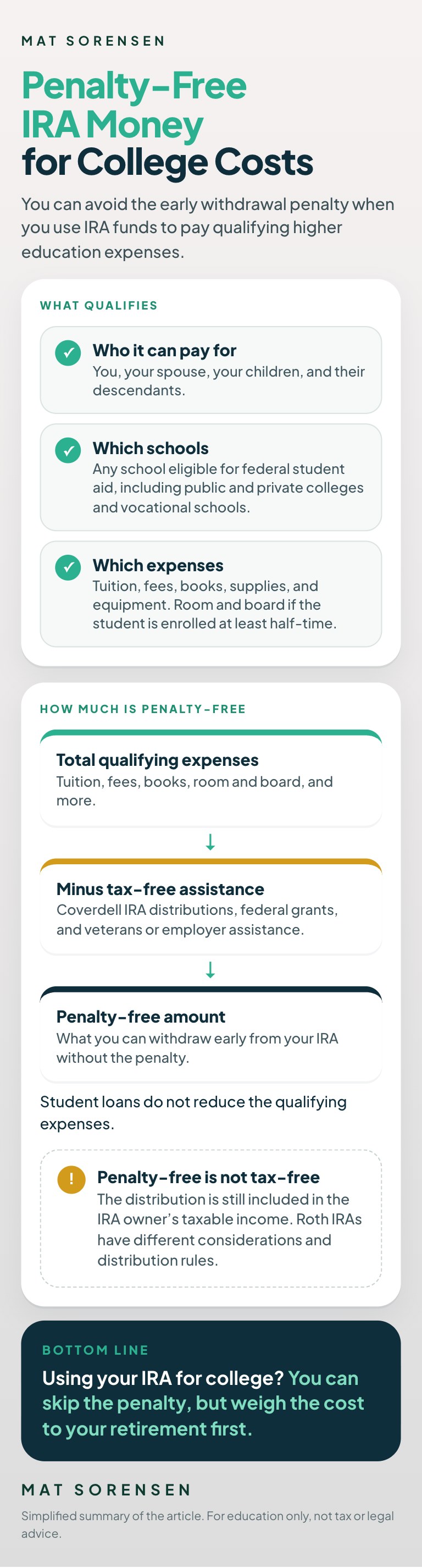
Infographic: who, which schools, and which expenses qualify for penalty-free early IRA distributions for college, and how to figure the penalty-free amount

10% Penalty Exception Rules for Higher Education Expenses

Here’s a quick breakdown on how the 10% withdrawal penalty can be avoided when you use IRA funds to pay for qualifying higher education expenses.

1. Who can the IRA money be used for?

 Your IRA funds may be used for qualifying higher education expenses of the IRA owner, their spouse, children, and their descendants.

2. What schools qualify?

Any school eligible to participate in federal student aid programs qualifies. This would include public and private colleges as well as vocational schools. Any school where you, your spouse, or your child completed a FAFSA application will qualify.

3. What expenses qualify?

There is a broad list of qualifying expenses. These include tuition, fees, books, supplies, and equipment. Also, room and board is included if the student is enrolled at least halftime.

4. How much is exempt?

The amount of your distribution that is exempt from tax is computed in three steps. First, determine the total qualifying expenses (tuition, fees, books, room and board, etc.) Second, reduce the qualifying expenses by any tax-free education expenses. These include Coverdell IRA distributions, federal grants (e.g. Pell grants), and any veterans or employer assistance received. Third, subtract any tax-free education assistance from the total qualifying expenses incurred and this gives you the total qualifying amount that you may take an early withdrawal from your IRA and avoid the 10% penalty.

Example

Here’s a quick example to illustrate these rules: You’re age 53 and have an IRA you’d like to access to help cover your daughter’s education expenses. Your daughter Jane is attending Harrison University, a private college that participates in federal student aid programs.

EXAMPLE

Her expenses for the year are as follows:

Tuition: $22,000
Room and Board: $13,000
Books: $1,000
Supplies: $500
Equipment: $500
Total Qualifying Expenses: $37,000

Jane received the following aid:

Federal Grant: $2,400
Coverdell IRA Payment: $5,000
Federal Student Loan: $10,500 (loans do not reduce the qualifying expenses)
Total Tax-Free Assistance: $7,400
Total Amount Eligible for a Penalty-Free 10% Early Withdrawal: $29,600

You decide to take a $10,000 withdrawal from your IRA. Since the total amount eligible is $29,600, the entire distribution will be penalty-free. Keep in mind that while the $10,000 distribution is penalty-free it is still included into the taxable income of the IRA owner.

$37,000

Total qualifying expenses

$7,400

Total tax-free assistance

$29,600

Eligible for a penalty-free early withdrawal

For more details on the 10% early withdrawal exception for higher education expenses, refer to IRS Publication 970. Also, the above example presumes the IRA owner has a traditional IRA. If the IRA owner has a Roth IRA, there are different considerations and distribution rules.

FREE SELF-DIRECTED IRA GUIDE

Learn how to invest your IRA in real estate, private companies, notes, precious metals, and more.

Get the Free Self-Directed IRA Guide

Prefer to talk it through? Book a call with a Directed IRA specialist