You have a number of options and decisions to make when moving funds from a retirement account (401(k), 403(b), IRA) to an IRA. And you’ve got to be careful because sometimes checking the wrong box on your transfer, rollover, and withdrawal forms can have drastic tax consequences. For example, should you move funds from one retirement account to your IRA using a Direct Rollover, a 60-Day Rollover, or a Trustee-to-Trustee transfer? Which box do you check on your form and does a 1099-R get issued and reported to the IRS? Will I have to report anything on my tax return? Let’s go over the options and the consequences as well as the tax reporting for each one.

1. Direct Rollover from 401(k) to IRA – When Moving from an Employer Plan
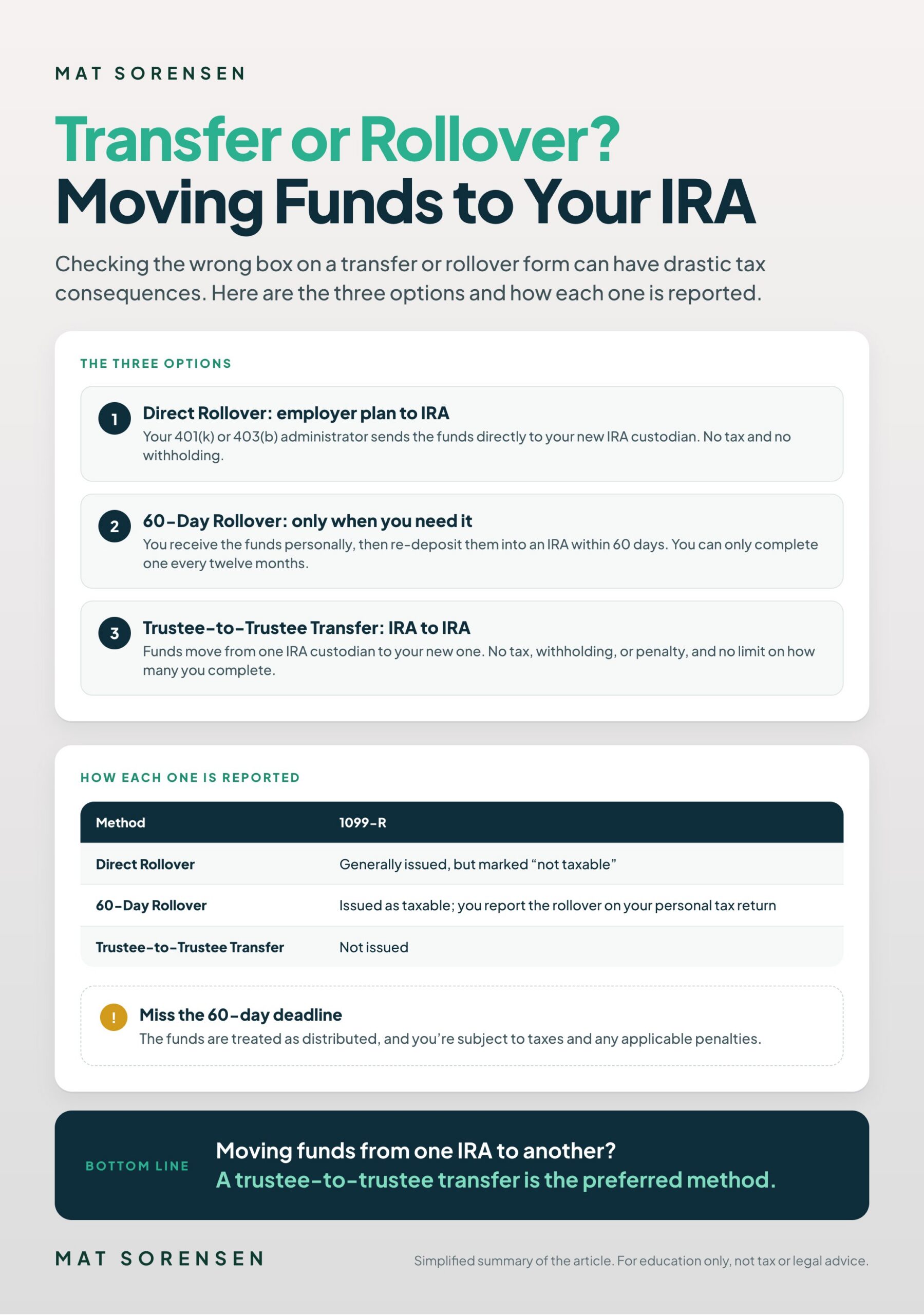
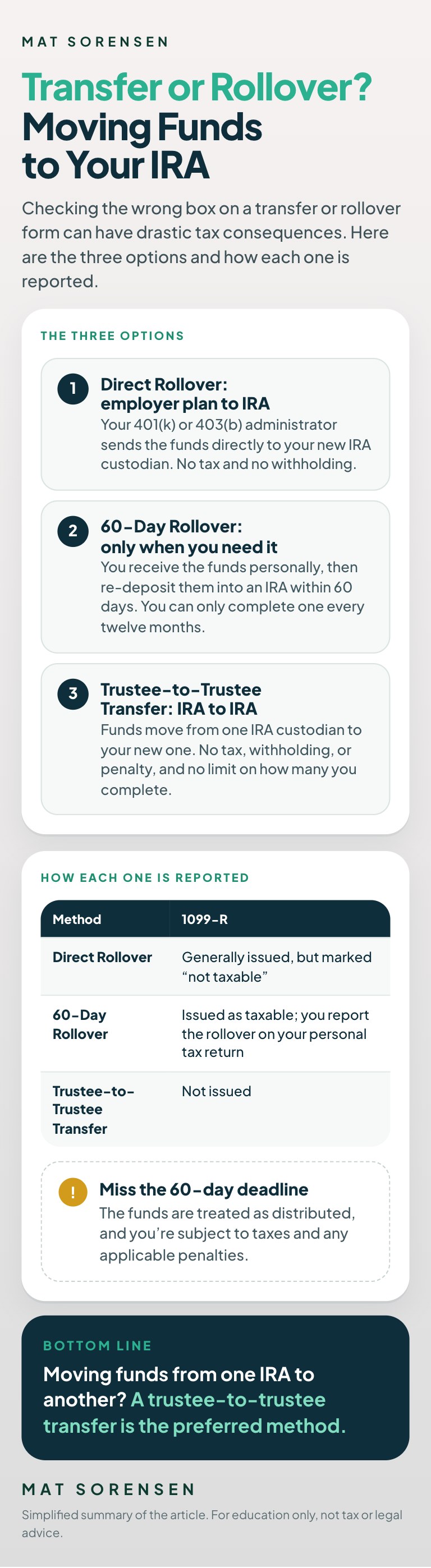
A Direct Rollover is generally used when moving funds from an employer plan (e.g. former employer 401(k) or 403(b)) to an IRA. Under a direct rollover, the retirement plan administrator will send the retirement plan funds directly to the new custodian of your IRA. There is no tax consequence and there is no withholding. There is simply a “direct” rollover of the funds to the new IRA account. Most employer plans like 401(k)s and 403(b)s are traditional accounts, so those funds are generally rolled to a traditional IRA. If you are moving the funds to a Roth IRA, which is possible, you will need to convert the funds with the IRA custodian as they are being rolled into a Roth IRA. And of course, there are taxes due from the Roth conversion.
There are no limits on the number of Direct Rollovers you may complete, except as may be reasonably imposed by your employer’s retirement plan.
EXAMPLE
For example, some employer plans may say that it’s an all or nothing option if you want to move funds once you no longer work there (e.g. keep all your funds there or move everything to an IRA).
If you are currently employed with your employer, you are usually only allowed to move funds from the employer’s plan when you have reached retirement plan age under the plan. This is usually 55 or 59 1/2 depending on your employer’s plan.
A direct rollover from an employer plan is not subject to tax or withholding. When a direct rollover is completed, a 1099 is generally issued from the current plan, but is marked as “not taxable” as the funds are being sent to another qualifying retirement account.
2. 60-Day Rollover – Only When You Need It This Way
A 60-Day Rollover allows you to take a distribution from one IRA, so long as you re-deposit that same amount into another IRA within 60 days, and the funds are no longer considered distributed. When using a 60-Day Rollover, you receive the funds personally from the current IRA plan custodian, and then re-deposit those funds into a qualifying IRA within 60 days. Failure to re-deposit in time will cause a distribution of the funds, and you will be subject to taxes and any applicable penalties (e.g. early withdrawal penalty if under 59 1/2) for failure to re-deposit in time. There are no extensions, and there is no mercy if you miss the 60-day deadline. The new IRA custodian will generally require a certification, and your prior IRA account custodian’s statement to verify that the funds were in an IRA within the past 60 days.
UPDATE (NOV 2026)
The 60-day rule is no longer absolute: the IRS now lets you self-certify a late rollover for certain listed reasons (Rev. Proc. 2016-47, expanded in 2020) and can grant waivers. (Source: IRS)
It is very important to note that as of 2015 you can only complete one 60-Day Rollover every twelve months. See my prior article here on the 12-month rule for 60-Day Rollovers. Consequently, you should not use the 60-Day Rollover method option on a regular basis.
When using a 60-Day Rollover, the former IRA custodian will issue a 1099-R reporting the distribution as taxable and you will need to certify that you re-deposited within 60 days on your personal tax return to avoid the distribution. The 60-Day Rollover is communicated to the IRS on your personal tax return on line 4a where you report the distribution from the 1099-R, and then on line 4b you report that it was not taxable, since it was rolled over within 60 days. On line 4b, you indicate that the taxable amount is zero and you write the word Rollover next to line 4b. See the IRS instructions for line 4a here.
3. Trustee-to-Trustee Transfer – the Best Option When Changing IRA Custodians
The Trustee-to-Trustee transfer is the preferred method of moving funds from one IRA to another (e.g. from a Roth IRA at Fidelity to a Roth IRA with a self-directed custodian). Under a Trustee-to-Trustee transfer, the funds are sent from one IRA custodian (partial or full account) to your new IRA custodian. There is no tax, withholding, or penalty for moving funds via a Trustee-to-Trustee transfer, and there is no limit on the amount of Trustee-to-Trustee transfers you may complete.
A 1099-R is not issued when a Trustee-to-Trustee transfer occurs, and there is no withholding or tax due. Consequently, the Trustee-to-Trustee transfer is the preferred method to use when moving funds from one IRA to another.
FREE ROLLOVER GUIDE
Learn how to move an old 401(k) or IRA into a self-directed IRA, tax-free.
Get the Free Transfers & Rollovers Guide
Prefer to talk it through? Book a call with a Directed IRA specialist