Your Roth IRA is only tax-free if you satisfy two separate five-year rules—each running on its own clock. Get either one wrong, and what you thought was a tax-free withdrawal can land on your 1040 as ordinary income, plus potential penalties.
These rules affect more investors than you might expect: anyone with multiple Roth IRAs, anyone who has changed custodians, backdoor Roth contributors, savers executing gap-year conversion strategies before retirement, and those who opened their first Roth IRA later in life and assumed age 59½ made everything automatically tax-free.
The key question is simple but critical: which clock applies to which dollars? Every Roth IRA can hold three types of money: contributions, conversions, and earnings. The two five-year rules treat each type differently. Some funds are immediately accessible, some unlock on a schedule, and some remain conditional until a specific date.
The short version:
RULE 1
The Account Clock
You must have a Roth IRA open for five years before earnings can be withdrawn tax-free. This clock starts on January 1 of the tax year of your first Roth contribution (or conversion, if earlier) and applies collectively to all your Roth IRAs. It never resets when you switch custodians or open additional Roth accounts.
RULE 2
The Conversion Clock
Each Roth conversion has its own five-year clock. This rule does not affect whether the conversion itself is taxed—you already paid that—but it can shield you from the 10% early-withdrawal penalty if you take converted funds out before age 59½.
The costly mistake: Most costly mistakes come from applying the right rule to the wrong dollars. Misstep on $50,000 of earnings, and you could hand the IRS $12,000 in taxes on growth that should have been yours, tax-free, forever.
Clock #1 — The Account Clock (This One Applies to Everyone)
For your Roth IRA earnings to come out completely tax-free, you must satisfy two conditions:
- 1Be at least age 59½ (or meet another qualifying exception), and
- 2Have satisfied the Roth IRA five-year rule
The five-year clock starts on January 1 of the tax year in which you made your first Roth IRA contribution—whether that contribution was to a traditional Roth IRA or a Roth conversion IRA. Once that clock starts, it applies to all your Roth IRAs and never resets.
If you make a Roth contribution in April 2027 but designate it for the 2026 tax year, the five-year clock is treated as starting on January 1, 2026. In that case, you reach the five-year mark in under four calendar years.
A common misconception is that each Roth IRA has its own five-year timer. It doesn’t. You get one lifetime clock tied to your first Roth contribution. Switching custodians, rolling assets, or opening additional Roth IRAs does not restart the five-year period; the clock follows you.
EXAMPLE: SWITCHING CUSTODIANS
You opened a Roth IRA at Fidelity, held it for three years, then transferred everything to Directed IRA and bought real estate inside the Roth IRA. Your clock kept running. You now have six years on the same clock.
EXAMPLE: OPENING YOUR FIRST ROTH IRA LATE IN LIFE
You open your first Roth IRA at 58 and want to withdraw at 60. At 60, you’re past the 59½ threshold, so the 10% early-withdrawal penalty no longer applies—but earnings remain taxable until the five-year rule is satisfied. In this scenario, contributions can be withdrawn tax- and penalty-free at 60, but any earnings taken before age 63 are taxable. Once the five-year clock is met at 63, qualified distributions—including earnings—become entirely tax-free.
Age 58
First Roth IRA opened. The account clock starts.
Age 59½
The 10% penalty no longer applies, but earnings are still taxable.
Age 63
Five-year clock met. Earnings come out tax-free.
Age 59½ eliminates the penalty, not the tax on earnings. Tax-free treatment on earnings requires both (1) being at least 59½ (or meeting another qualifying condition) and (2) satisfying the five-year account clock. Once any Roth IRA has been open for five years—counting transfers and custodian changes—earnings can be withdrawn tax-free as soon as the age or other qualifying condition is met.
FREE SELF-DIRECTED IRA GUIDE
Learn how a self-directed Roth IRA can invest in real estate, private funds, and other alternative assets you actually understand.
Clock #2 — The Conversion Clock (Situational, and the One People Mess Up)
Every Roth conversion carries its own five-year clock, starting January 1 of the conversion year. This rule exists to prevent investors from using conversions as a loophole to sidestep the 10% early-withdrawal penalty. You pay income tax on the conversion in the year it occurs, but that does not automatically make the converted funds penalty-free if withdrawn immediately.
The rule is narrow but important: if you withdraw converted Roth dollars within five years and you’re under 59½, the IRS imposes a 10% early-withdrawal penalty on the amount taken. Wait out the full five years, and those converted dollars behave like regular Roth contributions which are withdrawable at any age, tax- and penalty-free. Earnings, however, remain subject to Rule 1 (the account clock) and the age 59½ requirement.
EXAMPLE: EARLY ACCESS AFTER CONVERSION
At 45, you have $100,000 in a Roth IRA and $100,000 in a traditional IRA. You convert the entire traditional IRA to Roth, pay the tax in 2026, and let the account grow. By age 51, the five-year conversion clock has run its course, and the converted funds have grown to $150,000. You can withdraw the $100,000 of converted principal tax- and penalty-free at 51. The $50,000 of earnings, however, remains off-limits without tax and penalty until you satisfy Rule 1 and reach 59½. Withdrawing earnings early could trigger both income tax and a 10% penalty—potentially costing $17,000 on a $50,000 distribution.
$100,000
Converted principal: tax- and penalty-free at 51
$50,000
Earnings: taking them early could cost about $17,000 in tax and penalty
EXAMPLE: BACKDOOR ROTH AND MULTIPLE CLOCKS
For backdoor Roth IRA users, each annual conversion starts its own five-year timer. If you’re 50 and contribute $7,500 annually to a non-deductible traditional IRA, then convert to Roth each year, every conversion has a separate timeline. The 2026 conversion unlocks in 2031, the 2027 conversion in 2032, and so on. After six years of this strategy, you don’t have a single locked Roth balance; you have a rolling conveyor belt of penalty-free principal, with a new tranche becoming available each January 1.
EXAMPLE: THE “SHUTOFF SWITCH” AT 59½
The conversion five-year rule only guards against the 10% early-withdrawal penalty, which disappears at 59½. After that age, the rule no longer matters. A 62-year-old executing a gap-year conversion strategy can convert traditional IRA funds to Roth at 62 and withdraw those converted dollars at 63 without penalty.
However, Rule 1—the account five-year clock—still applies. If this investor opened their first Roth IRA at 60 and has never held one before, earnings cannot be withdrawn tax-free until age 65, when the five-year account requirement is satisfied. Converted principal remains accessible without penalty, but growth and earnings must wait.
For anyone new to Roth IRAs after 59½, the key is to track both clocks: the conversion timers for penalty avoidance before 59½, and the single lifetime account clock for tax-free treatment of earnings.
The Two Roth Clocks at a Glance
The Machinery That Makes This Navigable — Ordering Rules
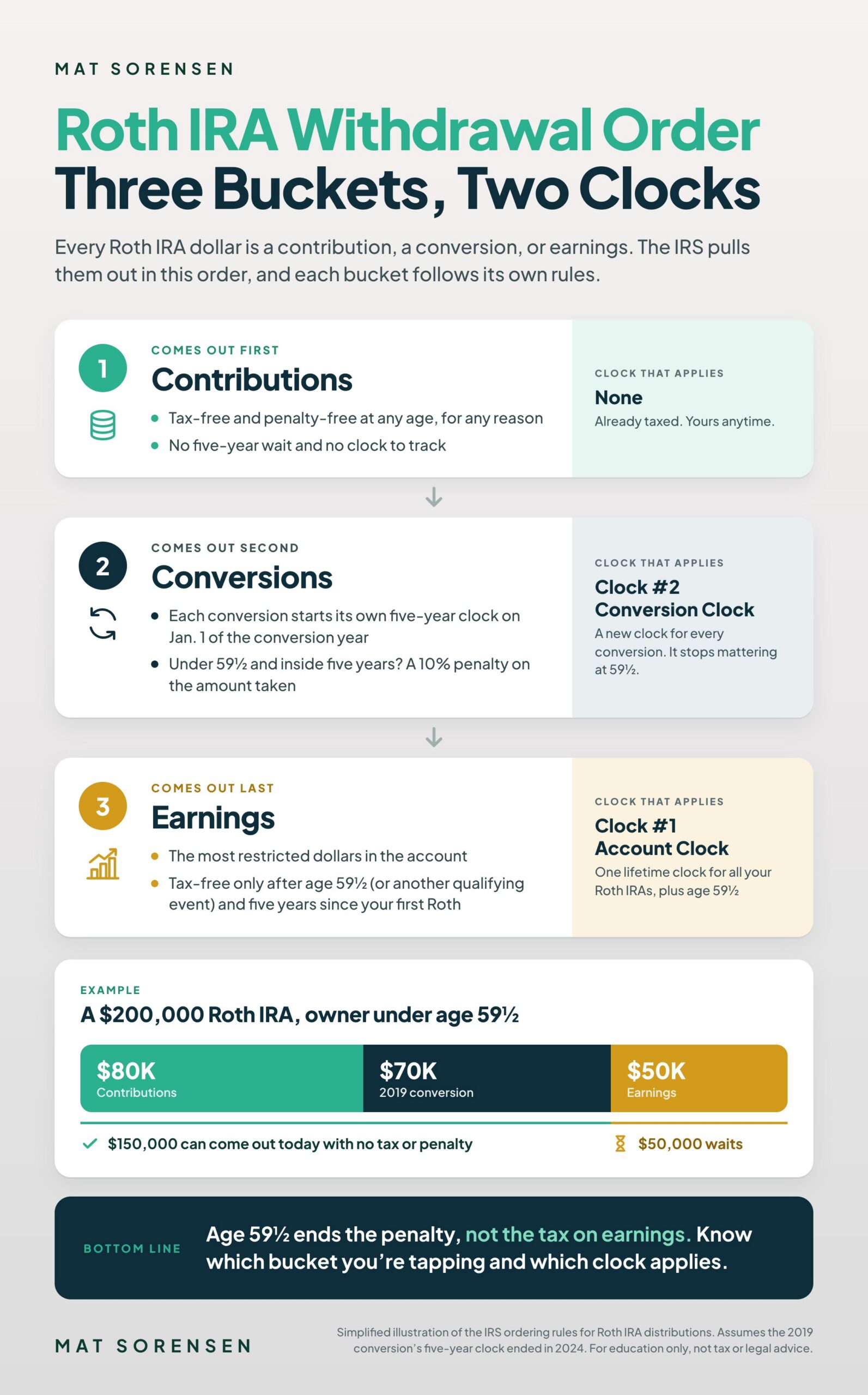
When Congress created Roth IRAs, it built in a powerful safeguard: a strict ordering rule for withdrawals. Every distribution comes out in a specific sequence—contributions first, then conversions, then earnings. This order matters because each bucket carries different tax and penalty treatment. The rules ensure you access the safest dollars first and only reach the most restricted funds last.
The Three Buckets, in Order
ALWAYS COME OUT FIRST
Regular Roth Contributions
These are tax- and penalty-free at any age, with no five-year waiting period. If you withdraw at 50, you’re pulling contributions first—no clocks to track, no forms to justify.
COME OUT SECOND
Converted Amounts
Each conversion has its own five-year clock (Clock #2). Once that period has passed, the converted principal can be withdrawn tax- and penalty-free, even before age 59½. If the clock hasn’t run, a 10% penalty may apply if you’re under 59½.
ALWAYS COME OUT LAST
Earnings and Growth
This is the most restricted bucket. To withdraw earnings tax- and penalty-free, you must satisfy both five-year rules and be at least 59½ (or meet another qualifying condition). The IRS won’t let you touch earnings until contributions and conversions are exhausted.
This ordering is automatic—you don’t choose which dollars come out. The IRS mandates the sequence that minimizes your tax burden. You cannot accidentally withdraw taxable earnings while untaxed contributions or seasoned conversions remain in the account.
EXAMPLE: KNOW WHICH DOLLARS YOU CAN TOUCH
Suppose your Roth IRA holds $200,000:
- $80,000 in regular contributions
- $70,000 from a 2019 Roth conversion
- $50,000 in earnings and growth
You can withdraw $150,000 today with zero tax or penalty, even if you’re under 59½:
- The $80,000 in contributions is always accessible
- The $70,000 conversion is seasoned—its five-year clock ended in 2024
- Only the $50,000 in earnings remains conditional. The IRS requires you to exhaust the $150,000 first before any earnings can be distributed
Your custodian’s statements show your account balance, but not the breakdown by bucket. To track contributions, conversions, and distributions, you’ll use IRS Form 8606, which reports Roth IRA activity—including conversions and distributions—on your federal tax return. This form ensures the IRS knows which dollars you’ve withdrawn and whether any portion is taxable or subject to penalty.
Understanding these three buckets—and the ordering rule that governs them—gives you clarity on what you can access today, what requires waiting, and how to avoid unnecessary taxes and penalties.
When Neither Rule Matters (So You Don’t Overthink It)
Most Roth IRA owners never need to stress over the two five-year clocks. In many common situations, the rules are already satisfied—or simply don’t apply.
You can ignore the clocks if:
- ✓You’re withdrawing regular Roth contributions (not conversions). These come out first, tax- and penalty-free, at any age, for any reason
- ✓You’re 59½ or older and have held a Roth IRA for at least five years. Both clocks are effectively dead: the conversion clock only guards the 10% early-withdrawal penalty (which no longer exists after 59½), and the account clock is already met, so earnings are tax-free
If you’re 45 and don’t plan to touch your Roth until 60, these rules are largely trivial. Contribute, invest, and let compounding work. By retirement, both five-year requirements will be long satisfied, and your Roth will function as the tax-free ATM it was designed to be.
Where mistakes happen:
- !Early withdrawal of converted funds: You convert to Roth, then pull those dollars out before five years have passed while under 59½—triggering a 10% penalty on the amount taken
- !Late starters: You open your first Roth IRA at 58, assume everything is tax-free at 59½, and withdraw earnings early. In reality, earnings remain taxable until the account itself has existed for five years—meaning tax-free treatment doesn’t begin until age 63 in this scenario
If neither situation describes you, relax. Your Roth IRA’s tax-free growth is intact. Wait until after 59½ and once the five-year account clock is met, and you’ll enjoy the full benefit: tax-free income in retirement, exactly as Congress intended.
What This All Really Comes Down To
Here’s what the 5-year Roth rule really comes down to: it isn’t one rule, and it isn’t simply about waiting five years.
The key is knowing which Roth dollars you’re dealing with. The tax code effectively treats your Roth IRA as three separate buckets: contributions, conversions, and earnings. Those buckets don’t all follow the same rules. Add in two different five-year clocks, and it’s easy to see where the confusion starts.
In fact, the people most likely to make a costly mistake aren’t necessarily those who have never heard of the five-year rule. They’re the people who know about it—but apply the wrong five-year rule to the wrong bucket of money.
That distinction becomes especially important if you have multiple Roth IRAs, have switched custodians, regularly make backdoor Roth contributions, have completed Roth conversions, or opened your first Roth later in life. Before taking money out, make sure you know which bucket the distribution is coming from and which clock—if any—actually applies.
And remember, a Roth IRA doesn’t have to be limited to publicly traded stocks and mutual funds. A self-directed Roth IRA can hold assets such as real estate, private funds, private businesses, cryptocurrency, and more. At Directed IRA, we help investors establish and administer self-directed retirement accounts. If you want to explore whether a self-directed Roth IRA fits your strategy, book a free 15-minute call with our team here.
FREE 15-MINUTE CALL
See whether a self-directed Roth IRA fits your strategy, from real estate to private funds.