Roth conversions are one of the most frequently recommended strategies in retirement planning, and for good reason. I appreciate their benefits for a variety of reasons, but they’re not suitable for everyone.
In this article, I’ll cover eight common scenarios where a Roth conversion may actually not make sense. These are not obscure or unusual situations; they’re real-world examples I see regularly in practice.
The challenge is that Roth conversions have been oversimplified into the idea that you should always convert. In reality, this approach ignores important factors such as current and future tax rates, timing, retirement income planning, and even your age. Getting a conversion right can create tens or even hundreds of thousands of dollars in long-term savings. Doing it wrong can have the opposite effect.
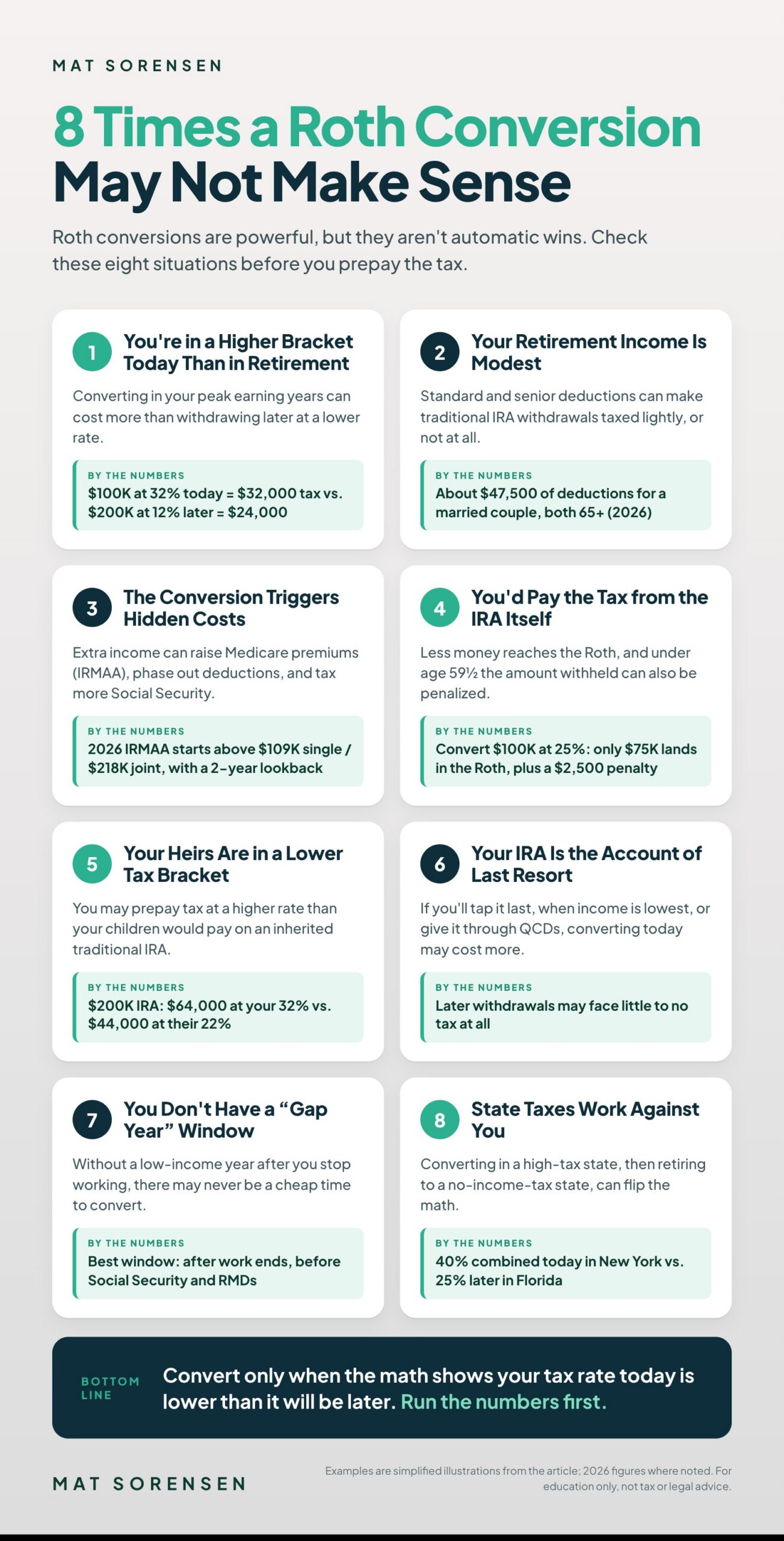

The Core Principle: It’s a Tax Rate Arbitrage Decision
Before diving into specific scenarios, it’s important to understand the core principle behind a Roth conversion. When you convert traditional IRA funds to a Roth, you pay taxes today so that future withdrawals are tax-free.
At first glance, it may seem straightforward: convert now if your current tax rate is lower than what you expect to pay later. For example, imagine you’re 50 years old with a $100,000 traditional IRA and currently fall into the 10% tax bracket. Converting that balance today would trigger a $10,000 tax bill.
Now picture that same IRA ten years later—worth $200,000 when you’re 60 years old and in a 20% tax bracket. If you withdraw in retirement instead of converting earlier, you’d owe $40,000 in taxes. In this example, converting at the lower rate would clearly have been the smarter move.
However, the reality for many investors is the opposite. Most people are in a higher tax bracket during their working years than they will be in retirement. Because of this, Roth conversions can easily become more expensive than beneficial. That’s why it’s essential to evaluate your current versus future tax brackets before deciding if a conversion truly makes sense.
Scenario #1: You’re in a Higher Tax Bracket Today Than You Will Be Later
Let’s look at a common scenario where a Roth conversion can actually backfire. This happens when you’re in a higher tax bracket today than you’ll be later in retirement.
Imagine you’re 55 years old, earning $250,000 per year, and in the 32% tax bracket. If you convert a $100,000 traditional IRA to a Roth right now, you’ll owe $32,000 in taxes immediately.
Now suppose you don’t convert. You let the account grow for 10 years, and by age 65, it has doubled to $200,000. At that point, your retirement income is around $100,000, placing you in a 12% tax bracket. When you begin taking withdrawals, you’ll pay $24,000 in taxes (12% of $200,000), which is far less than the $32,000 you would have paid in your high-earning years.
This is a very typical scenario for people in their peak earning years who consider converting while their tax bracket is highest. Ten years later, when they’re retired and earning less, their tax rate is lower, making the earlier conversion costlier than necessary.
Key takeaway: A Roth conversion typically isn’t advisable when your expected retirement tax rate will be lower than what you pay today. There are exceptions, such as when you expect only a modest drop, for example 32% to 22%. If the difference is substantial, like 32% down to 12%, converting could be a mistake. Always run the numbers and compare what your tax burden would be today versus in retirement before making the decision.
Scenario #2: You Don’t Have Enough Income or Assets for It to Matter
This scenario doesn’t get discussed nearly enough, but for many middle-income households, a Roth conversion often doesn’t move the needle at all.
Consider this example: you retire with a $150,000 traditional IRA and have about $40,000–$60,000 in annual retirement income. In this situation, you may owe little to no income tax when taking IRA distributions. In effect, your traditional IRA can behave much like a Roth, thanks to the deductions available to seniors.
For instance, once you’re 65 or older, you can claim the standard deduction of $32,200, the additional senior deduction of $3,300, and potentially the new senior deduction from the One Big Beautiful Bill of $12,000 (for married couples filing jointly). That’s roughly $47,500 in total deductions. This means your first $47,500 of retirement income is tax-free, and income above that is taxed at only about 10–12%.
For someone with $150,000 in income, after deductions you’d be taxed on roughly $102,500, resulting in no more than about $12,000 in federal tax. With taxes this low in retirement, converting to a Roth doesn’t provide much benefit because your traditional IRA withdrawals are already taxed lightly.
When your projected retirement income keeps you in a relatively low tax bracket and when generous standard and senior deductions apply, the traditional IRA can already deliver near tax-free outcomes. In these situations, pre-paying taxes through a Roth conversion offers little advantage. Doing nothing, leaving funds in your traditional IRA and taking distributions strategically, often proves the more tax-efficient and financially prudent approach.
Scenario #3: The Conversion Triggers Hidden Costs (IRMAA, Phaseouts)
Another situation where a Roth conversion can work against you is when you are in your 60s and the conversion triggers hidden costs that you might not be considering. Roth conversions do not only affect your tax bill, although that is often the main focus. They can also influence several other parts of your financial picture.
When you convert to a Roth IRA, the amount converted is treated as taxable income. For individuals in their 60s, that income increase can have several ripple effects. One of the biggest concerns is the Medicare Income-Related Monthly Adjustment Amount, or IRMAA. IRMAA is an additional charge added to your Medicare Part B and Part D premiums if your income exceeds certain thresholds. For 2026, this applies when income is above roughly $109,000 for single filers or $218,000 for married couples filing jointly.
Crossing those limits can raise your Medicare premiums by roughly $96 to $578 per month per person, depending on how far over the line you go—that’s anywhere from about $1,100 to nearly $7,000 per year for each spouse on Medicare. A higher reported income can also cause you to lose certain deductions or credits that phase out at higher income levels, and it can increase the taxable portion of your Social Security benefits.
This issue is especially important for people around age 63 and older. Medicare uses a two-year lookback when determining IRMAA surcharges. That means conversions done at age 63 could affect your Medicare costs when you turn 65.
Key takeaway: If you are approaching Medicare eligibility, consider the potential IRMAA surcharges and their long-term impact as part of your Roth conversion analysis.
Scenario #4: You’re Paying the Taxes from the IRA Itself
The next scenario where a Roth conversion does not make sense is when you plan to pay the taxes for the conversion using money from the IRA itself. This is a major mistake and, in my view, a dealbreaker in every situation.
When doing a Roth conversion, you should always pay the taxes with money from outside the IRA. That way, the full amount of the conversion ends up in the Roth as after-tax dollars that can grow and eventually come out tax-free.
If you do not have outside cash to cover the tax bill, some people make the costly mistake of taking a distribution from their traditional IRA to pay the taxes. This approach creates two problems. First, you will owe income tax on the withdrawal. Second, if you are under age 59½, you will also face a 10% early withdrawal penalty. Both of these reduce the amount that stays invested and growing in the Roth IRA.
For example, say you convert $100,000 while in the 25% tax bracket. You take out $25,000 from the IRA to pay the tax. You will owe another 10% penalty on that $25,000, bringing your total cost to $27,500 in taxes and penalties. That leaves only $75,000 invested in the Roth—and you still have to cover the $2,500 penalty on top of that—which greatly reduces the long-term benefit of the conversion.
If you are in a situation where paying the taxes requires taking money from the IRA itself, it is usually best to pause and reconsider. In nearly every case, a conversion under these circumstances will hurt more than it helps.
Scenario #5: You Plan to Leave the Account to Lower-Tax-Bracket Heirs
A Roth conversion may not make sense when you plan to leave the account to heirs who are in a lower tax bracket. This is where estate planning starts to overlap with your tax and retirement strategy.
If you are in a 24%, 32%, or higher tax bracket, but your children or heirs are only in a 12% or 22% bracket, you may be prepaying taxes at a higher rate than they would pay later. For example, if you convert a $200,000 traditional IRA to a Roth IRA and you are in the 32% bracket, that conversion would cost $64,000 in taxes. If your child later inherits a traditional IRA and withdraws the money while in the 22% bracket, they would pay $44,000 in taxes instead. That is a $20,000 difference, which means the conversion may not be the most efficient move.
In some cases, it can actually be better to leave the account as a traditional IRA.
The analysis changes, though, if you are in lower income years in retirement and plan to leave the account to children who are still in their peak earning years. If you are paying 10% to 20% today while your heirs are paying 30% or more, converting to a Roth IRA may make more sense. In that case, you are paying the tax upfront at a lower rate so your heirs can inherit a tax-free asset that can continue to grow.
The facts matter here. Whether it makes sense to convert now or leave the account as-is depends on your tax rate, your heirs’ tax rate, and how the IRA fits into your broader estate plan.
Scenario #6: Your Traditional IRA Is Your Account of Last Resort
The next scenario where a Roth conversion does not make sense is when your traditional IRA is really your account of last resort. In other words, you do not expect to rely on it for retirement income in your 60s or 70s, and you may eventually use it for qualified charitable distributions to causes you care about.
For many people, the traditional IRA is simply the last bucket of money they expect to spend. If that is your situation, and you have other assets or income sources to live on first, converting to Roth may not provide much benefit. By the time you reach your later retirement years, your taxable income may be low enough that withdrawals from the traditional IRA result in little to no tax anyway.
That is why this scenario often comes down to timing and intent. If your plan is to leave the IRA untouched for years and then use it later when your income is lowest, the tax cost of converting today may be higher than the tax cost of leaving it alone. In many cases, the traditional IRA can remain the more efficient choice.
Scenario #7: You Don’t Have a “Gap Year” Window
Another reason a Roth conversion may not make sense is if you do not have a gap year window. One of the best times to convert is during a year when your income is temporarily lower, such as after you stop working but before Social Security or RMDs begin. Those years can create a valuable opportunity to convert at a lower tax rate, sometimes with little or no tax at all.
However, not everyone has that window. You may keep working into your 70s and stay in a high tax bracket, or you may simply never have a year where your income drops enough to make a conversion attractive. In those cases, the clear-cut opportunity to convert at a low tax cost may never appear.
That is why timing matters so much. If you do not have a gap year or another low-income year to work with, a Roth conversion may not deliver the same benefit it would for someone who does.
Scenario #8: State Taxes Work Against You
Finally, the last scenario where a Roth conversion may not make sense is when state taxes work against you. For example, if you live in New York when you do the conversion but plan to retire in Florida and take withdrawals there, state taxes can change the entire equation.
If you are in a high-tax state today, say 8% to 10%, a Roth conversion may look much more expensive than it will later in retirement. For instance, if you are paying 30% in federal taxes and 10% in state taxes today, your total tax cost is 40%. But if you retire in Florida and your future withdrawals are taxed at only 25% federally with no state income tax, then leaving the money in a traditional IRA could actually be the better move.
In that case, you would be paying 40% today to convert to Roth instead of paying 25% later on traditional withdrawals. That is a much bigger tax bill upfront, so the conversion does not make sense. Always factor in where you live now versus where you expect to live in retirement, because state taxes can significantly change the outcome.
The Big Picture: Why It Always Depends
Now that we have covered the 8 scenarios where a Roth conversion may not make sense, it is worth stepping back to look at the bigger picture. Whether a Roth conversion is the right move is always situational.
It depends on your current income, your expected future income, the amount you want to convert, your tax bracket today versus later in retirement, the state you live in now versus the state you may live in later, and your long-term legacy goals. Are you planning to spend down this account in retirement, or are you trying to preserve it for children or other heirs?
One of the biggest mistakes people make is converting without running the numbers first. Roth accounts are powerful, but they are not always the right tool. A traditional IRA to Roth IRA conversion only makes sense when the math supports it. Do not leave your decision to guesswork; crunch the numbers specific to your situation first.
If you would like help determining whether a Roth conversion makes sense in your situation or building a more tax-efficient retirement strategy, my team at KKOS Lawyers works with investors and business owners across the country. You can book a free call using the link below, and we will help you map out the smartest approach based on your numbers.
FREE STRATEGY CALL
Find out whether a Roth conversion actually makes sense for your numbers.