Inheriting an IRA or 401(k) can create a costly deadline many beneficiaries do not see coming. If you miss a required distribution, the IRS can impose a 25% excise tax on the amount you should have withdrawn—on top of the ordinary income tax that generally applies to distributions from inherited traditional IRAs and 401(k)s.
The IRS temporarily waived the excise tax for certain missed inherited-account required minimum distributions (RMDs) from 2021 through 2024 because the post-SECURE Act rules caused widespread confusion. That broad relief has ended. For 2025 and later tax years, beneficiaries who miss an applicable inherited-account RMD may again be exposed to the penalty.
The 10-year rule is not always just a 10-year deadline. Depending on the original account owner’s RMD status at death, a beneficiary may have to take annual distributions during the 10-year period—not simply wait and empty the account at the end.
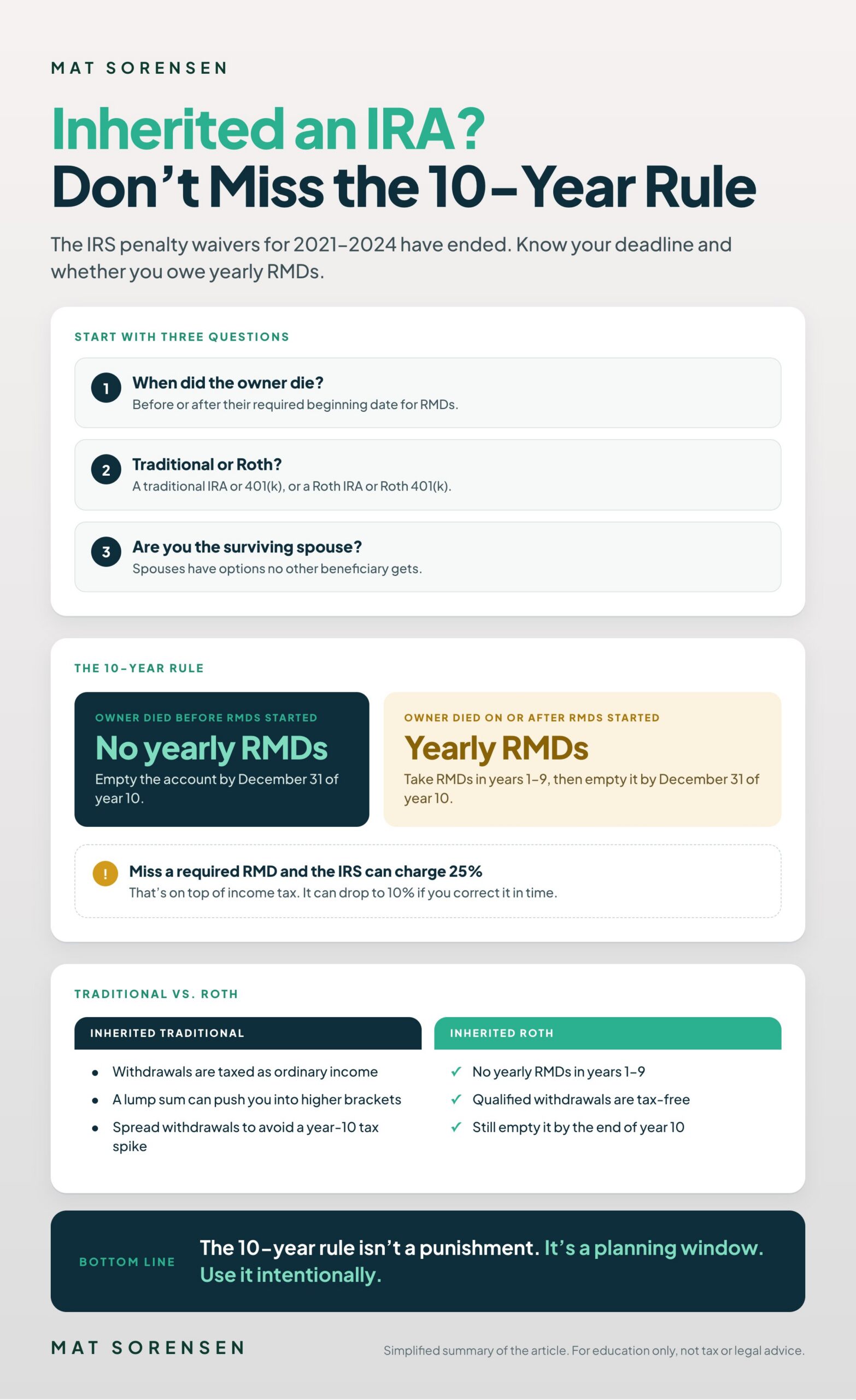

Start with These Questions
Before taking—or postponing—an inherited-retirement-account distribution, confirm three facts:
- 1Did the original owner die before or after their required beginning date for RMDs?
- 2Is the account a traditional IRA or 401(k), or a Roth IRA or Roth 401(k)?
- 3Are you a surviving spouse?
These answers determine the applicable deadline, whether annual RMDs are required, and how to structure distributions for tax purposes.
This article focuses on the current rules that apply in many common situations. If the original owner died before 2020, different “stretch IRA” rules may apply. Confirm the owner’s date of death before assuming the 10-year rule governs your account.
The 10-Year Rule
For most non-spouse designated beneficiaries, an inherited IRA or retirement-plan account must be fully distributed by December 31 of the 10th calendar year following the year of the original owner’s death.
For example, if the original owner died in 2026, the inherited account generally must be fully distributed by December 31, 2036. The deadline is not simply 10 years from the date of death.
For beneficiaries subject to the 10-year rule, the central question is whether the original owner died before or after their required beginning date for RMDs.
For many current retirees, the applicable RMD age is 73. For younger account owners, it can be age 75. The required beginning date for a first RMD is generally April 1 of the year after the owner reaches the applicable RMD age.
| Original owner’s status at death | Annual beneficiary RMDs in years 1–9 | Final deadline |
|---|---|---|
| Died before their RMD beginning date | Generally no | December 31 of year 10 |
| Died on or after their RMD beginning date | Generally yes | December 31 of year 10 |
EXAMPLE
Consider two beneficiaries with identical $300,000 inherited traditional IRAs:
Your uncle dies at age 78 while already taking RMDs. You inherit his traditional IRA. You must take annual RMDs during the 10-year period and empty the account by the end of year 10.
Your mother dies at age 68. You inherit her traditional IRA. You still face the 10-year deadline, but you are not required to take annual distributions during years one through nine.
KEY POINT
Same account type. Same account balance. Completely different distribution obligations—solely because of the original owner’s age and RMD status at death.
Traditional Accounts: Annual RMDs and Taxes
If you inherit a traditional IRA or traditional 401(k) from an owner who died on or after their required beginning date, you generally must take annual RMDs in years one through nine. You must also fully distribute the remaining balance by the end of year 10.
This is where many beneficiaries make an expensive mistake. They understand the year-10 deadline but do not realize that annual RMDs may be required along the way.
WATCH OUT
If an annual inherited-account RMD is required and you miss it, the IRS can impose a 25% excise tax on the amount that should have been withdrawn. For example, if your RMD was $10,000 and you withdrew nothing, the excise tax could be $2,500. The excise tax may be reduced to 10% if you correct the mistake within the IRS correction window. That penalty is separate from the ordinary income tax generally due when the $10,000 is eventually withdrawn.
Annual inherited-IRA RMDs are not calculated by simply dividing the account by 10. The calculation uses the beneficiary’s age-based life-expectancy factor and the prior December 31 account balance.
EXAMPLE
Assume you inherit a $300,000 traditional IRA from your father, who died at age 78 while already taking RMDs. You are 40 in the year after his death, which is the year your first annual RMD is due. Under the IRS Single Life Expectancy Table, a 40-year-old beneficiary has an initial life-expectancy factor of 45.7.
Your first annual RMD, using this simplified illustration, would be: $300,000 ÷ 45.7 = $6,565
For the following year, reduce the initial factor by one, from 45.7 to 44.7. Assume that, after the first distribution and investment performance, the prior December 31 account balance is $304,000. Your second-year RMD would be: $304,000 ÷ 44.7 = $6,801
You would continue reducing the initial factor by one each year—43.7, 42.7, 41.7, and so on—while using the account’s prior December 31 balance to calculate each year’s RMD.
$6,565
First annual RMD
$6,801
Second-year RMD
This example illustrates the life-expectancy method. The applicable first-year calculation can depend on the year of death, the beneficiary’s age, and whether the owner had already begun taking RMDs. Confirm the calculation with the custodian or a qualified tax professional before relying on it.
These annual amounts are minimums, not a schedule designed to evenly empty the account over 10 years. A large balance may still remain in year 10, when the entire remainder must be distributed.
That is why inherited traditional retirement accounts require two separate decisions:
- 1Determine whether annual RMDs are mandatory.
- 2Determine how much additional income to recognize each year before the year-10 deadline.
The required minimum may be relatively small, but the optimal distribution may be larger if it helps prevent a major tax spike in the final year.
Lump Sums and Tax Planning
When you inherit an IRA or 401(k), one of the first decisions is whether to take the money immediately or preserve it in an inherited IRA. A lump-sum distribution is generally available at any age and, unlike an early withdrawal from your own retirement account, it typically does not trigger the 10% early-withdrawal penalty.
But penalty-free does not mean tax-free.
With a traditional IRA or traditional 401(k), the distribution is generally taxable as ordinary income in the year you take it. Imagine inheriting a $300,000 traditional IRA and withdrawing the entire balance at once. That adds $300,000 to your taxable income in a single year and may push a substantial part of the distribution into higher marginal tax brackets.
If you need the money immediately, a lump sum may be necessary. Otherwise, it is often worth considering whether distributions can be coordinated over several tax years. Keeping the assets invested in an inherited IRA may preserve growth potential while giving you more control over when taxable income appears on your return.
EXAMPLE
Consider a $300,000 inherited traditional IRA from a parent who died at age 68. No annual RMDs may be required in years one through nine, which gives the beneficiary flexibility—but can create a year-10 tax trap.
If the account grows to $600,000 and the beneficiary withdraws the full balance in year 10, the entire $600,000 is generally added to taxable income for that year. A more intentional approach may be to allow the account to compound during the first several years, assuming the beneficiary does not need the money, then begin taking planned distributions in later years.
KEY TAKEAWAY
The objective is not always to avoid every increase in marginal tax rate. It is to avoid unnecessarily concentrating a large amount of ordinary income into one tax year when distributions could have been spread more efficiently across several years.
Roth Accounts: A Different Strategy
Inherited Roth retirement accounts generally offer a simpler planning framework. For most non-spouse beneficiaries subject to the 10-year rule, an inherited Roth IRA or Roth 401(k) must be fully distributed by December 31 of year 10. However, annual RMDs are generally not required during years one through nine because the original Roth owner was not subject to lifetime RMDs.
That allows the beneficiary to leave the account invested for the full 10-year period, if appropriate, and distribute the balance at the end of year 10.
Unlike an inherited traditional retirement account, waiting until year 10 generally does not create a large ordinary-income-tax issue. Qualified Roth distributions are tax-free, so continued compounding can increase the eventual tax-free inheritance without pushing the beneficiary into a higher tax bracket.
EXAMPLE
For example, assume you inherit a $300,000 Roth IRA and leave it invested for 10 years. At a hypothetical 8% annual return—not a guarantee—the account could grow to approximately $648,000. If the distribution is qualified, the full amount could be distributed tax-free at the end of year 10.
$300,000
Inherited Roth IRA
~$648,000
After 10 years at a hypothetical 8%
CAVEAT
One important caveat: the original Roth IRA owner’s five-year holding period matters. If the original owner had not met the Roth IRA five-year requirement, the earnings portion of distributions may be taxable.
You also cannot convert an inherited traditional IRA into an inherited Roth IRA. If you inherit pre-tax traditional IRA assets, they must remain in an inherited traditional IRA. If you inherit Roth assets, they remain in an inherited Roth IRA.
Spousal Rollover Options
A surviving spouse has options no other beneficiary receives. If you inherit an IRA or employer retirement plan from a deceased spouse, you may be able to move the assets into an IRA in your own name or, in certain cases, elect to treat the inherited IRA as your own.
Traditional assets may be moved into the surviving spouse’s own traditional IRA. Roth assets may be moved into the surviving spouse’s own Roth IRA. Once the account is treated as the surviving spouse’s own, the inherited-account 10-year deadline does not apply.
EXAMPLE
A spousal rollover is powerful, but it is not automatically the best choice. Consider a 53-year-old widow who needs to use inherited traditional IRA assets for living expenses. If she rolls the account into her own IRA, distributions before age 59½ may generally be subject to the 10% additional tax, in addition to ordinary income tax.
If she instead retains the funds in an inherited IRA, distributions attributable to the deceased spouse may generally be available without the 10% additional tax. She could use the inherited IRA for penalty-free withdrawals if needed, then consider a rollover into her own IRA later.
The right choice depends on age, cash-flow needs, investment goals, tax circumstances, and the plan’s available options.
Common Tax Questions
Do you owe inheritance tax or estate tax simply because you inherited an IRA?
Generally, no. Receiving an inherited IRA is not itself a federal income-tax event. With traditional retirement accounts, income tax is generally due when distributions are taken—not when you become the beneficiary.
Federal estate tax affects only very large estates. For deaths in 2026, the federal estate-tax basic exclusion amount is $15 million per person. With appropriate planning, a married couple may be able to protect up to $30 million.
State law is different. Some states impose estate taxes, inheritance taxes, or both, and their exemption amounts can be much lower than the federal exclusion, such as Oregon and Massachusetts. The deceased person’s state of domicile, the property involved, and state-specific rules can all matter.
Does an inherited traditional IRA receive a step-up in basis?
No. Inherited stock, real estate, and other taxable assets may receive a step-up in basis to fair market value at death. Traditional IRAs and 401(k)s are different.
Traditional retirement assets are generally treated as income in respect of a decedent. There is no step-up in basis for the pre-tax portion of a traditional IRA or 401(k), and distributions are generally taxed as ordinary income at the beneficiary’s tax rates.
Can I self-direct an inherited retirement account?
Yes—an inherited IRA can generally be self-directed. Instead of limiting the account to brokerage investments, you may be able to invest in assets such as real estate, private funds, private lending, certain private businesses, or cryptocurrency. But the 10-year deadline and any annual RMDs still apply, so illiquid investments must leave enough cash available for required distributions.
For more information on self-directing, download my free guide and learn how an inherited IRA can invest in real estate, private funds, small businesses, and crypto here.
If you are considering self-directing an inherited IRA—or need help evaluating liquidity, RMD deadlines, alternative investments, or prohibited-transaction risk—schedule a free consultation call with my firm, Directed IRA. We can help you understand your options and structure the account thoughtfully before you invest or take a distribution.
The Bottom Line
What this ultimately comes down to is stewardship. Someone spent a lifetime building this retirement account and chose to leave it to you. The 10-year rule is not a punishment—it is a planning window, and often the final planning opportunity the original owner could not complete on your behalf.
The beneficiaries who lose five or six figures unnecessarily to taxes are not usually careless. They are often careful in the wrong direction. Some leave the account untouched for nearly a decade, assuming that continued tax-deferred growth is always the best answer, only to face a large taxable distribution in year 10. Others do the opposite: they withdraw the entire account immediately and push themselves into higher tax brackets.
The goal is not simply to take distributions—or to avoid taking them. It is to use the 10-year window intentionally: preserve growth where it makes sense, meet any annual RMD requirements, and distribute traditional retirement assets on a schedule that manages taxable income. That is how more of the account stays with the beneficiary and less is unnecessarily lost to taxes.
INHERITED IRA
Inherited an IRA? Talk with a Directed IRA specialist about your options for self-directing it.

Mat has been at the forefront of the self-directed IRA industry since 2006. He is the CEO of Directed IRA & Directed Trust Company where they handle all types of self-directed accounts (IRAs, Roth IRAs, HSAs, Coverdell ESA, Solo Ks, and Custodial Accounts) which are typically invested into real estate, private company/private equity, IRA/LLCs, notes, precious metals, and cryptocurrency. Mat is also a partner at KKOS Lawyers and serves clients nationwide from its Phoenix, AZ office.
He is published regularly on retirement, tax, and business topics, and is a VIP Contributor at Entrepreneur.com. Mat is the best-selling author of the most widely used book in the self-directed IRA industry, The Self-Directed IRA Handbook: An Authoritative Guide for Self-Directed Retirement Plan Investors and Their Advisors.