Self-Directed IRAs, Real Estate Crowdfunding, and UBIT Tax Explained

The most common asset class for self-directed IRA accounts is real estate. Real estate investments for self-directed IRAs come in various forms from simple single-family rentals owned 100% by the IRA to LLC or LP investment partnerships with multiple investors in larger commercial or multi-family properties.
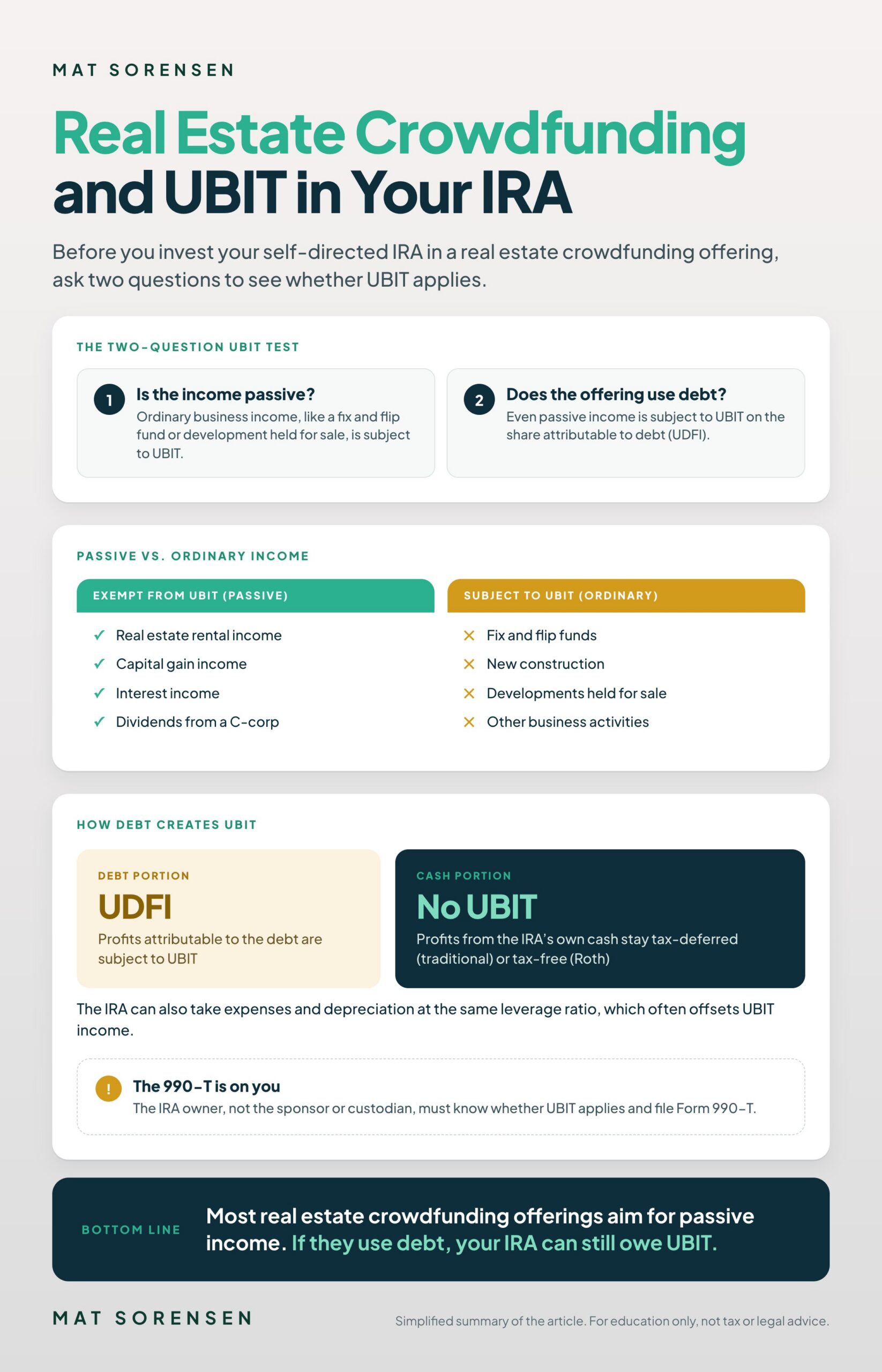
Infographic: the two-question test for whether UBIT applies to a self-directed IRA real estate crowdfunding investment, passive versus ordinary income, and how debt financing creates UDFI

Real Estate Crowdfunding and Your IRA

Given the changes in federal securities laws that now allow investment sponsors and real estate syndicators to raise capital more easily, many self directed IRA investors have considered investing their IRAs into these offerings. Crowdfunding sites such as Realcrowd are already offering Crowdfunding type investment opportunities for investors under SEC Rule 506(c). This rule and those investments are currently only available to accredited investors and have no restriction on the investment amount that may come from the accredited investor. These offerings have traditionally been known as private placements or “PPMs” but can now be marketed and there is no requirement that they be “private” so long as the offering company only accepts accredited investors.

For those who are not accredited investors, “true” Crowdfunding under Title III of the JOBS Act goes into effect in May of 2016. Under these Crowdfunding offerings everyone will be able to invest into Crowdfunding opportunities and the investment amount will be based on the investor’s income and assets. These new Crowdfunding rules were enacted in Title III of the JOBS Act and were put into final regulations by the SEC in late 2015.

Before investing your self-directed IRA into a real estate Crowdfunding offering, you must first learn and understand one very important tax called UBIT tax that may apply to your self-directed IRA’s income.

Will My IRA Be Subject to UBIT Tax?

Unrelated Business Income Tax (“UBIT”) applies to an IRA that receives non-passive income. UBIT is a hefty tax and has a maximum rate of 39.6%. IRC § 511. The tax table is copied below.

2016 UBIT Tax Rates

 If taxable income is: The tax is:
Not over $2550 15% of the taxable income
Over $2550 but not over $5950 $375 plus 25% of the excess over $2550
Over $5950 but not over $9050 $1225 plus 28% of the excess over $5950
Over $9050 but not over $12300 $2107 plus 33% of the excess over $9050
Over $12400 $3179 plus 39.6% of the excess over $12400

UPDATE (NOV 2026)

This table shows 2016 rates. For 2026, the top rate for UBIT (trust tax rates) is 37%, on taxable income above $16,000; it was 39.6% when this article was written. The $1,000 specific deduction still applies. (Source: AAII; IRC 511(b), 512(b)(12))

Although not shown on the table, the first $1,000 in UBIT gross income is exempt and you receive an automatic $1,000 deduction.

UBIT will apply to your self-directed IRA’s real estate investment in two scenarios. First, it will apply if the income to the IRA is ordinary. And second, it will apply if the offering company uses debt to acquire its properties.

Step One: Is the income passive?

First, UBIT will apply if the investment is an ordinary income producing business. An ordinary income business in real estate investing would include investing into an LLC or LP that conducts new construction, real estate developments held for sale, or other activities that are deemed business activities. Passive income investments, on the other hand, are specifically exempt from UBIT and include real estate rental income, capital gain income, interest income, and dividend income from a c-corp. IRC § 512(b). The vast majority of real estate Crowdfunding offerings are structured to obtain passive income such as rental income while the property is held and capital gain income when the property is sold. Typical real estate offerings where UBIT can be due include offerings to fix and flip properties or offerings for new construction or real estate development where the investment strategy is to buy properties to then immediately sell.

If you have an investment offering that is ordinary income (e.g. a fix and flip fund), then the income to the IRA from the fund will be subject to UBIT tax and the IRA will be required to file and pay the tax each year by using IRS Form 990-T. This responsibility to file the return each year is on the IRA account owner and not the investment sponsor or the IRA custodian so IRA owners need to know for themselves whether the IRA is subject to UBIT or not. So for example, let’s say that a self-directed IRA invested into a Crowdfunding offering that was a real estate development with properties held immediately for sale and that the income was ordinary income. Let’s further assume that the self-directed IRA received a K-1 for profits to the IRA for the year of $10,000. Based on the UBIT tax table, and after the $1,000 deduction, the IRA would owe UBIT tax in the amount of $2,079. This amount is due from the IRA to the IRS and is reported and payable using form 990-T.

If you’ve determined that the Crowdfunding offering income is passive (e.g. rental, capital gain), then you may still be subject to UBIT if the LLC or LP offering company is using debt to leverage and acquire its properties.

Step Two: Will the investment be leveraged with debt?

EXAMPLE

Second, UBIT will apply to profits returned to your IRA from a Crowdfunding real estate offering (and really any real estate owned by your IRA) if the offering company uses debt to leverage its acquisition of properties. For example, let’s say the offering company raises $1M in cash to buy a $4M multi-family property. There will be $1M of cash invested into the property and $3M of debt. The property will therefore be leveraged 75% with debt.

Whenever an IRA’s investment is leveraged with debt, the tax code requires the IRA owner to determine what profits are attributable to the IRA’s cash and what profits are attributable to the debt. The profits attributable to the cash invested is still treated as tax deferred (traditional IRA) or tax free (roth IRA) and is not subject to UBIT. The profits and income attributable to the debt, however, is called unrelated debt financed income (“UDFI”) and is subject to UBIT. IRC § 514. So, in the multi-family property example above where the property is leveraged 75% with debt, the self-directed IRA will be subject to UBIT tax on 75% of the income.

In order to calculate UBIT tax based on debt, you must first determine the leverage ratio. Once we know the leverage ratio, we can then begin to calculate how UBIT will apply. The good news is that the IRA is also allowed to take expenses against the property using the same leverage ratio and is able to take depreciation expenses which help to offset UBIT. In many situations, even where a property is cash-flowing the IRA will not be subject to UBIT because the property expenses and depreciation will offset UBIT income.

Let’s continue through this example to illustrate how this works.

Example

EXAMPLE

Property Purchase Price = $4M

Debt/Leverage = $3M

Leverage Ratio = 75%

Income = $1.3M

Income at Leverage Ratio (75%) = $975,000

Operating Expenses= $1,000,000

Operating Expenses at Leverage Ratio (75%) = $750,000

Net Leveraged Income = $225,000

Depreciation Expense ($4M / 27.5) = $145,500

Depreciation Expense at Leverage Ratio = $109,125

Net UDFI/UBIT Income = $115,875

SDIRA Investor Invested $20K and received 1.5% of Company Profit/Loss

SDIRA Investor 1.5% of Net UDFI/UBIT = $1,738.

Automatic IRS $1,000 deduction = $738 subject to UBIT/UDFI

UBIT Table Rate of 15% of $738 = $110 in UBIT is Due

As the example demonstrates, given the low-level of investment from the IRA it isn’t subject to much UBIT as the net UBIT income (after expenses and depreciation) keeps the tax rate on the low end of the tax table. That being said, 990-T tax returns must be filed by the IRA investor for the IRA and the IRA will be responsible for the tax due. Factors that will cause more UBIT are higher returns and income, larger investment amounts and ownership, and more leverage.

While self-directed IRA’s are subject to UDFI and UBIT on leveraged real estate investments, it is worth noting that self-directed 401(k) and other employer based plans are exempt from UDFI on leveraged real estate investments. IRC § 514(c)(9). Unfortunately, self-directed IRAs do not receive this exemption.

So, in short, the quick list to determine whether UBIT will be due a self-directed IRA Crowdfunding real estate investment requires analysis of two issues. First, is the offering company’s income passive or is it ordinary. If it is ordinary then it is subject to UBIT. If it is passive, then it is only subject to UBIT if the company uses debt to leverage its investments. Once you can answer these questions you know whether UBIT will apply to your investment and whether your IRA will need to report and pay tax on its income.

FREE REAL ESTATE IRA GUIDE

Learn how to buy rental property and other real estate with your IRA, and how to avoid prohibited transactions.

Get the Free Real Estate IRA Guide

Prefer to talk it through? Book a call with a Directed IRA specialist
Correcting Your IRA’s RMD Failures and Avoiding the Penalty

If you failed to take required minimum distributions (RMD’s) from your IRA, then you are subject to a 25% penalty (10% if corrected within two years). The penalty is 25% on the amount you should have distributed from your IRA to yourself. It’s a steep penalty for simply failing to pay yourself from your own IRA and it’s something every IRA owner with RMD needs to understand. For my prior article explaining RMD rules for IRAs, please click here.

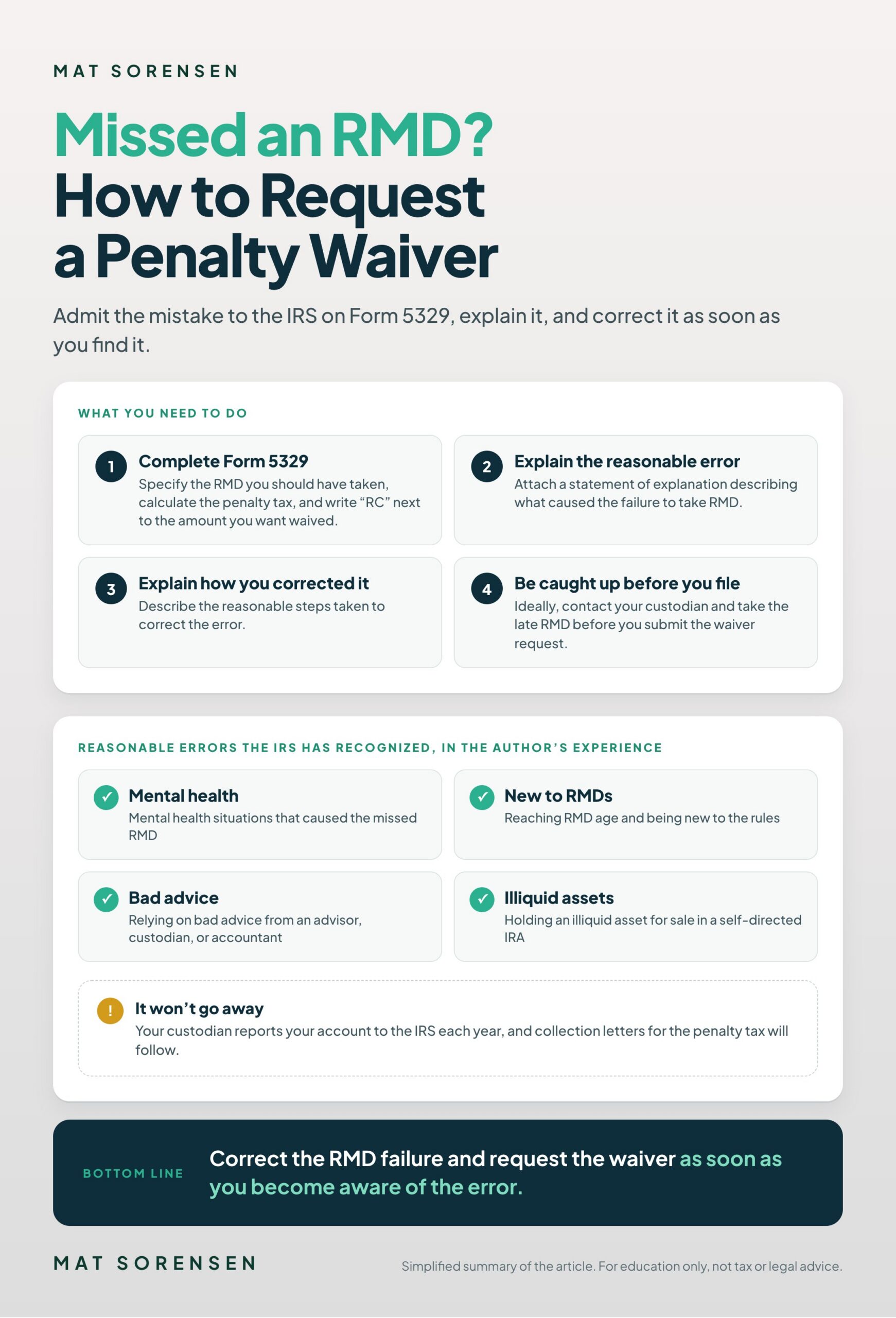
Infographic: the steps to request an IRS waiver of the missed RMD penalty on Form 5329, and examples of reasonable errors

Waiver of the Penalty Tax

UPDATE (NOV 2026)

The penalty for a missed RMD is now 25% of the amount not taken, or 10% if you correct it within two years. It was 50% when this article was written. (Source: IRS)

If you’ve failed to take RMD for your IRA, you have a chance at obtaining a waiver from the penalty but you must admit the mistake to the IRS by filing IRS form 5329. In the instructions to form 5329, the IRS outlines the waiver process to avoid the 50% penalty tax.

What You Need to Do

  1. 1Complete Section IX of Form 5329. You need to specify what you should have taken as RMD  and then you calculate the penalty tax due. You then write the letters “RC” next to the amount you want waived on line 52.
  2. 2Statement of Explanation. Attach a Statement of Explanation outlining two items.
    1. First, explain what was the “reasonable error” that caused a failure to take RMD. The IRS does not provide a definition or acceptable examples of “reasonable error”. See IRC 4974(d)(1). From my own experience and from examples I’ve heard from colleagues, the IRS does recognize reasonable errors and oversights in most situations where there is reason for the error. This would include situations such mental health, to turning 73 and being new to RMD, to relying on bad advice from an advisor, custodian or accountant, to holding an illiquid asset for sale in a self directed IRA.
    2. Second, explain the reasonable steps taken to correct the error. Ideally, by the time you’re filing the exemption request you would’ve already contacted your IRA custodian and would’ve taken the late RMD so that by the time you submit the RMD penalty tax waiver, you would be caught up and would have already remedied the error.  This makes for an easy and clean explanation of what steps you’re going to take as your explanation will be that you already corrected the RMD failure once you realized the error.

WATCH OUT

Keep in mind that RMD failures won’t go away as your IRA custodian will be updating your account each year with the IRS. Eventually, you’ll start getting collection letters from the IRS requesting the penalty tax. Consequently, IRA owners are well advised to correct the RMD failure and request the waiver as soon as they become aware of the error or oversight.

FREE SELF-DIRECTED IRA GUIDE

Learn how to invest your IRA in real estate, private companies, notes, precious metals, and more.

Get the Free Self-Directed IRA Guide

Prefer to talk it through? Book a call with a Directed IRA specialist

Fact and Fiction for IRA RMDs

If you are age 70 1/2 or older and if you have a traditional IRA (or SEP or SIMPLE IRA or 401k), you must take your 2015 required minimum distributions (“RMD”) by December 31, 2015. In short, the RMD rules require you to distribute a portion of funds from your retirement account to yourself personally. These distributed funds are subject to tax and need to be included on your personal tax return.

UPDATE (NOV 2026)

This article was written for the 2015 tax year. Required minimum distributions now start at age 73 (rising to 75 in 2033) under the SECURE 2.0 Act, and the penalty for a missed RMD is now 25% of the amount not taken (10% if corrected within two years). When this article was written, RMDs started at 70½ and the penalty was 50%. (Source: IRS)

EXAMPLE

Let’s take an example to illustrate how the rule works. Sally is 72 and is required to take RMD each year. She has an IRA with $250,000 in it. According to the distribution rules, see IRS Publication 590-B, she will need to distribute $9,765 by the end of the year. This equates to about 4% of her account value. Next year, she will re-calculate this annual distribution amount based on the account’s value and her age.

Once you know how to calculate the RMD, determining the distribution amount is relatively easy. However, the rules of when RMD applies and to what accounts can be confusing. To help sort out the confusion, I have outlined some facts and fiction that every retirement account owner should know about RMDs. First, let’s cover the facts. Then, we’ll tackle the fiction.

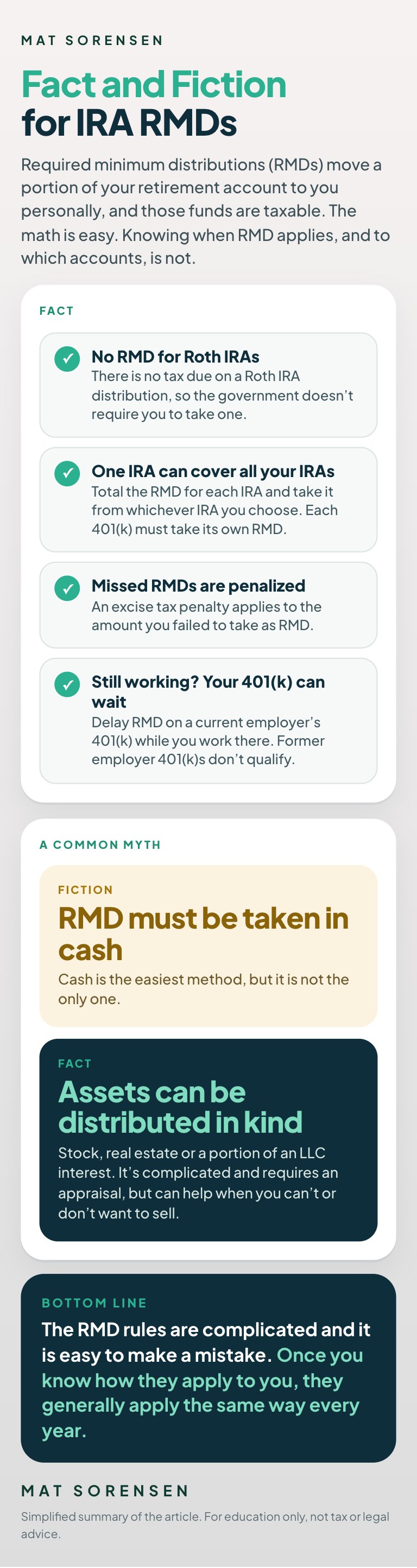
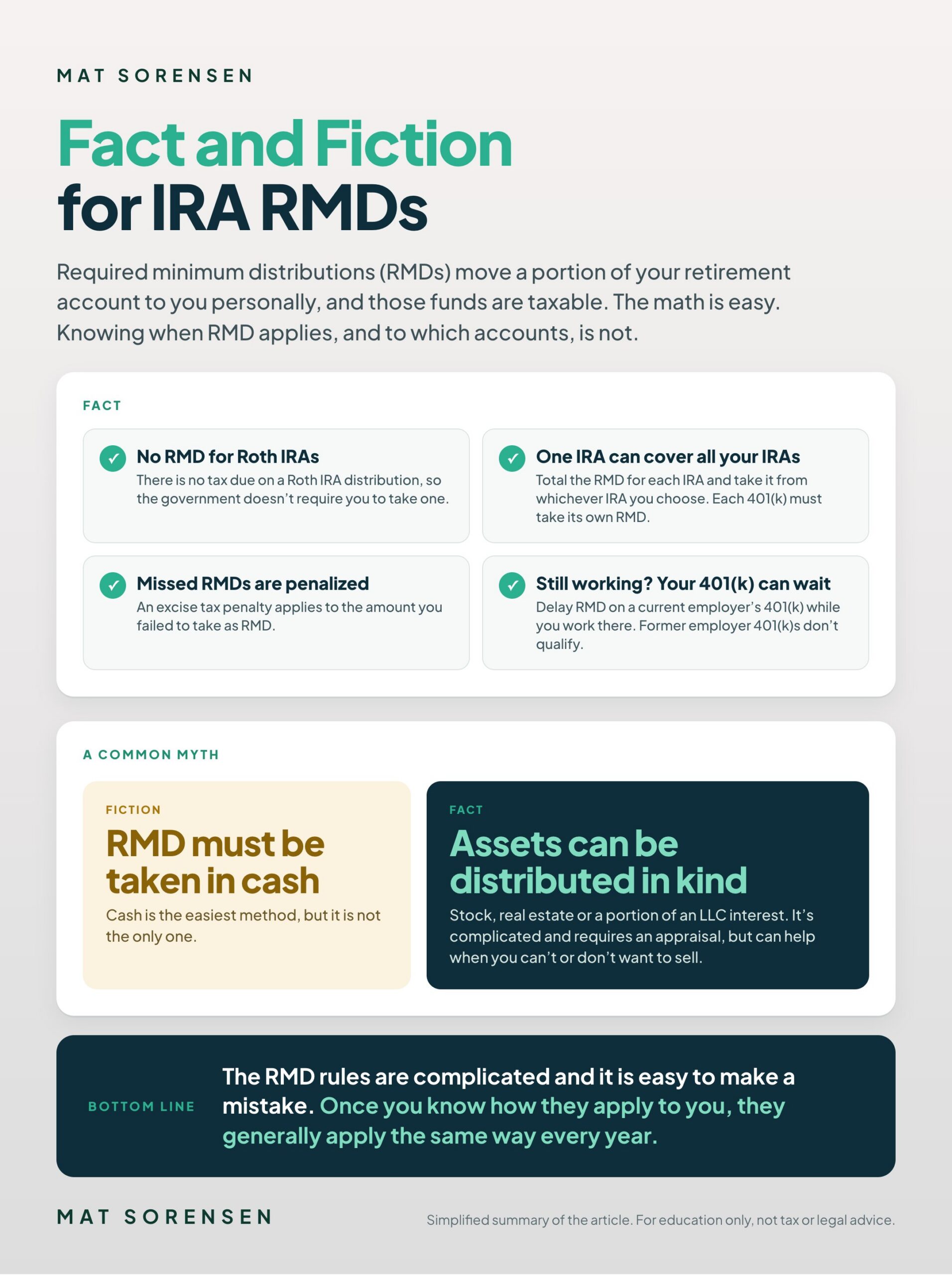
Infographic: facts about IRA required minimum distributions and the myth that RMD must be taken in cash

Fact

  1. 1No RMD for Roth IRAs: Roth IRAs are exempt from RMDs. Even if you are 73 or older, you’re not required to take distributions from your Roth IRA. Why is that? Because there is no tax due when you take a distribution from your Roth IRA. As a result, the government doesn’t really care whether you distribute the funds or not as they don’t receive any tax revenue.
  2. 2RMD Can Be Taken From One IRA to Satisfy RMD for All IRAs: While each account will have an RMD amount to be distributed, you can total those amounts and can satisfy that total amount from one IRA. It is up to you. So, for example, if you have a self directed IRA with a property you don’t want to sell to pay RMD and a brokerage IRA with stock you want to sell to pay RMD, then you can sell the stock in the brokerage IRA and use those funds to satisfy the RMD for both IRAs. You can’t combine RMD though for 401(k) and IRA accounts. Only IRA to IRA. Each 401(k) must take its own RMD.
  3. 350% Excise Tax Penalty: There is a 50% excise tax penalty on the amount you failed to take as RMD. So, for example, if you should’ve taken $10,000 as RMD, but failed to do so, you will be subject to a $5,000 excise tax penalty. Check back next month where I will summarize some measures and relief procedures you can take if you failed to take required RMD.
  4. 4401(k) Account Holder Still Working for 401(k) Employer: If you have a 401(k) with a current employer and if you are still working for that employer, you can delay RMD for as long as you are still working at that employer. This exception doesn’t apply to former employer 401(k) accounts even if you are otherwise employed.

Fiction

UPDATE (NOV 2026)

Since 2024, Roth 401(k) and Roth 403(b) accounts no longer require RMDs during the owner’s lifetime (SECURE 2.0 Act). Item 2 below describes the rules before that change. (Source: IRS)

  1. 1RMD Due by End of Year: You can make 2015 RMD payments until the tax return deadline of April 15, 2016. Wrong! While you can make 2015 IRA contributions up until the tax return deadline of April 15, 2016, RMD distributions must be done by December 31, 2015.
  2. 2Roth 401(k)s are Subject to RMDs: While Roth IRAs and Roth 401(k)s are both tax-free accounts, the RMD rules apply differently. As I stated above, Roth IRAs are exempt from RMD rules. However, Roth 401(k) owners are required to take RMD. The distributions will not be subject to tax but they will start the slow process of removing funds from the tax-free account.
  3. 3RMD Must Be Taken In Cash: False. Required Minimum distributions may be satisfied by taking cash distributions or by taking a distribution of assets in kind. While a cash distribution is the easiest method to take RMD, you may also satisfy RMD by distributing assets in kind. This may be stock or real estate or other assets that you don’t want to sell or that you cannot sell. This doesn’t occur often but some self directed IRA owners will end up holding an asset they don’t want to sell because of current market conditions (e.g. real estate) and they decide to take distributions of portions of the real estate in-kind in order to satisfy RMD. This process is complicated and requires an appraisal of the asset(s) being distributed and partial deed transfers (or partial LLC membership interest transfers, if the IRA owns an LLC and the LLC owns the real estate) from the IRA to the IRA owner. While this isn’t the recommended course to satisfy RMD, it is a potential solution to IRA owners who are holding an asset, who have no other IRA funds to distribute for RMD, and who wish to only take a portion of the asset to satisfy their annual RMD.

The RMD rules are complicated and it is easy to make a mistake. Keep in mind that once you know how the RMD rules apply in your situation it is generally going to apply in the same manner every year thereafter with only some new calculations based on your age and account balances each year thereafter.

Click here for a nice summary of the RMD rules from the IRS.

FREE SELF-DIRECTED IRA GUIDE

Learn how to invest your IRA in real estate, private companies, notes, precious metals, and more.

Get the Free Self-Directed IRA Guide

Prefer to talk it through? Book a call with a Directed IRA specialist
WHEN TO USE A LIMITED PARTNERSHIP?

Limited Partnerships (LP) have taken a back seat over the past ten years to the more popular Limited Liability Company (LLC).  That being said, LPs are still often used to hold assets, raise funds, or to achieve specific tax benefits. Here are 5 things you should know about Limited Partnerships.

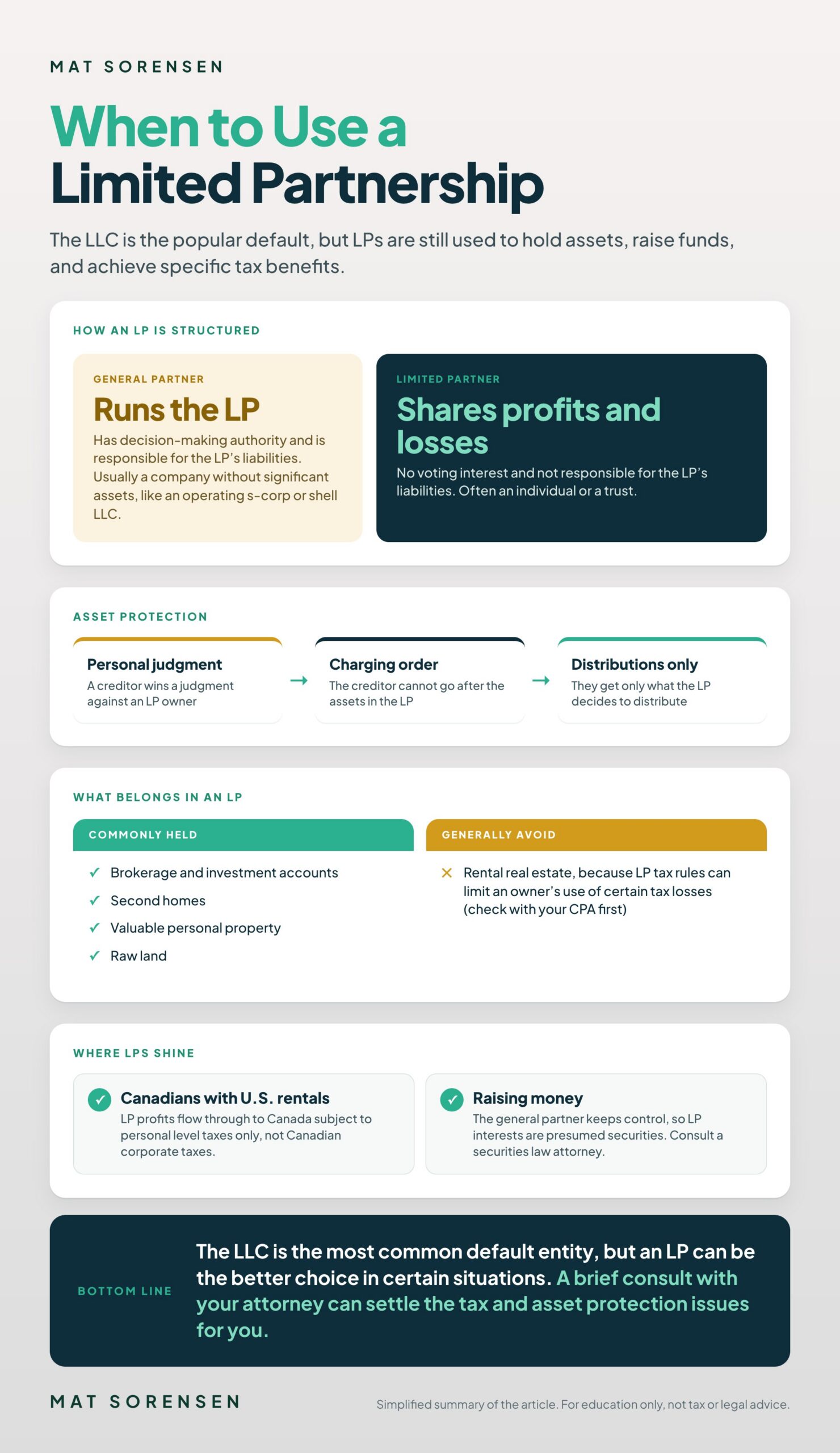
Infographic: how a limited partnership is structured, how it protects assets, what it should hold, and where LPs work best

1. General Partners and Limited Partners

Every Limited Partnership consists of at least one general partner and one limited partner. The general partner has decision-making authority and is also responsible for the liabilities of the limited partnership. The limited partners participate in the sharing of profits and losses but do not have a voting interest. Because the general partner is subject to liability of the LP, the general partner is usually a company that does not hold significant assets.  The limited partner on the other hand is not responsible for the liabilities of the LP.

EXAMPLE

For example, the general partner may be an operating s-corp or a shell company LLC while the limited partner may be an individual or a trust.

2. Limited Partnerships and Asset Protection

Limited partnerships provide asset protection for the limited partners of the LP against the activities of the LP.

EXAMPLE

For example, if there is a judgment against the LP, that creditor cannot go after the limited partners.

In addition, if an owner of an LP has a judgment against themselves personally, that creditor cannot go after the assets in the limited partnership. Instead, the creditor is given a charging order that only entitles them to the assets or income that the LP decides to distribute to the owner of the limited partnership. As a result, the assets of the limited partnership are protected from the personal activities/liabilities of the owner. Because of this, many individuals will use limited partnerships to hold their valuable assets. While some states offer this same liability protection to LLCs (protect the entity from the owners actions), most states do not.

3. Hold Rentals in an LLC

Because LP’s are a great place to hold assets, it is important to know what assets should be held in an LP. The following assets are commonly held by LPs: brokerage/investment accounts; second homes; valuable personal property, and raw land.

WATCH OUT

An LP, however, generally should not hold rental real estate, because the tax rules applicable to LP’s limit an owner’s ability to fully take advantage of certain tax losses. As a result, please consult with your CPA prior to placing rental real estate into an LP.

4. Canadians Love LPs for Real Estate

While LLCs are great for U.S. Citizens, they cause corporate taxes in Canada for Canadian residents. As a result, Canadians who own rental real estate in the U.S. should use an LP to hold their properties as opposed to an LLC. The LP profits flow through to Canada and are only subject to personal level taxes and are not subject to Canadian corporate taxes. LLC income, on the other hand, flows to Canada and is subject to both corporate and personal taxes.

5. Limited Partnerships Are Great Entities for Raising Money

Limited partnerships are often used to raise funds because under the LP structure, the general partner (the one usually raising the funds) has authority to run the LP while the investors or limited partners do not have a voting right or interest. Because the LP structure places the control in the hands of the person raising the funds, the LP is presumed to be a security for securities law purposes and as a result a securities law attorney should be consulted as to the proper filings and disclosures necessary to raise funds and sell limited partnership interests to investors.

While an LLC is the most common default entity amongst business owners and investors, the LP can be a more beneficial entity or choice in certain situations and circumstances.  In a brief consult with your attorney, you will be able to determine what entity is right for you while taking into account the tax and asset protection issues that will apply to your specific situation.

Tax Court Rules Against Self-Directed IRA Owner Who Failed to Properly Make a Real Estate Investment

In a recent U.S. Tax Court case, the Court ruled against an IRA owner and deemed his IRA distributed and taxable as the IRA owner failed to properly execute his intended self-directed IRA real estate investment. Dabney v. Commissioner, T.C. Memo 2014-108.

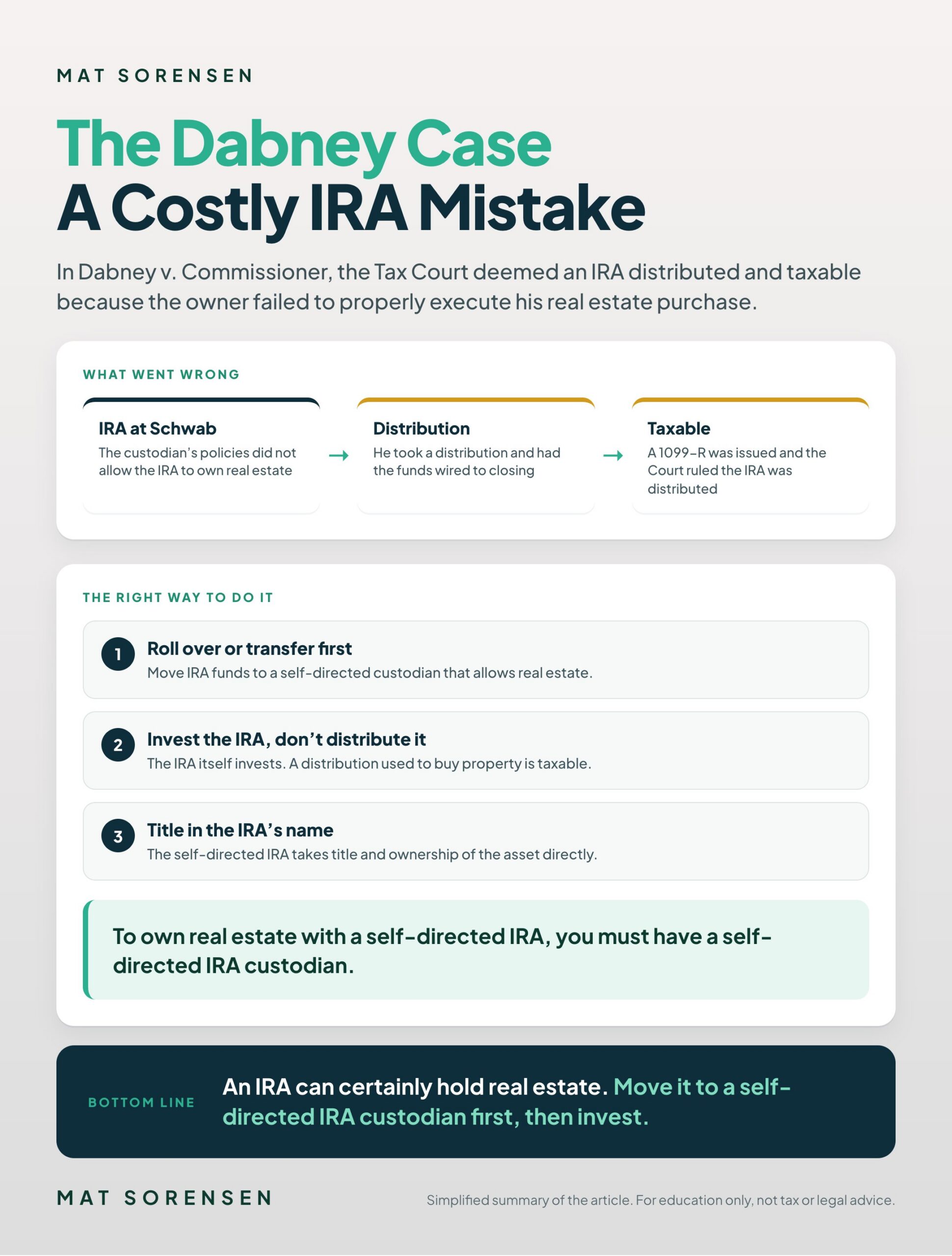
Infographic: how the IRA owner in Dabney v. Commissioner triggered a taxable distribution, and the right way to buy real estate with a self-directed IRA

What Went Wrong in Dabney

The IRA owner had an IRA at Charles Schwab and intended to use the IRA to acquire real estate in Brian Head, UT. Upon conducting research Mr. Dabney learned that an IRA could own real estate. However, instead of rolling or transferring his IRA funds to a self directed IRA custodian who would allow his IRA to own real estate, Mr. Dabney took a distribution of the IRA and directed Schwab to wire the funds to closing for the purchase of the property. Additionally, he instructed title and eventually received a deed in the name of his Schwab IRA.

The problem was that rather than invest his IRA into real estate he instead distributed his IRA and used the distributed funds to buy real estate outside of his IRA. Charles Schwab issued Mr. Dabney a 1099-R for that distribution and Mr. Dabney contested the 1099-R and the taxes owed as a result arguing that the funds were used to buy a property owned by his Schwab IRA. Mr. Dabney argued that Charles Schwab made a mistake. However, the Court ruled against him because his funds were distributed out of his Charles Schwab IRA and because his IRA funds and the real estate were not held by a self-directed IRA custodian that allowed for IRAs to own real estate. The Court stated that an IRA can certainly hold real estate but that Charles Schwab’s policies did not allow for Mr. Dabney’s IRA to own real estate and since his custodian would not hold the real estate as an asset of his IRA that it was deemed distributed.

The Lesson to Be Learned

The lesson to be learned from the Dabney case is that in order to properly execute a self-directed IRA investment into an asset such as real estate, the IRA owner needs to roll over or transfer their IRA funds first to a self-directed IRA custodian who allows the IRA to own real estate and then that self-directed IRA will actually take title and ownership to the IRA asset directly. While these rules seem simple, I’d estimate that I speak to at least one or two IRA owners a year who took a distribution from an IRA and used those funds to buy real estate (or some other alternative asset) thinking that the real estate would still be owned by their IRA and that the funds would not be distributed and subject to tax. The confusion usually arises with the non-self directed custodian who misunderstands what the account owner is trying to do (invest the IRA, not distribute it).

KEY TAKEAWAY

Keep in mind, that in order to own real estate with a self-directed IRA, you must have a self-directed IRA custodian.

FREE REAL ESTATE IRA GUIDE

Learn how to buy rental property and other real estate with your IRA, and how to avoid prohibited transactions.

Get the Free Real Estate IRA Guide

Prefer to talk it through? Book a call with a Directed IRA specialist