Fact and Fiction for IRA RMDs

If you are age 70 1/2 or older and if you have a traditional IRA (or SEP or SIMPLE IRA or 401k), you must take your 2015 required minimum distributions (“RMD”) by December 31, 2015. In short, the RMD rules require you to distribute a portion of funds from your retirement account to yourself personally. These distributed funds are subject to tax and need to be included on your personal tax return.

UPDATE (NOV 2026)

This article was written for the 2015 tax year. Required minimum distributions now start at age 73 (rising to 75 in 2033) under the SECURE 2.0 Act, and the penalty for a missed RMD is now 25% of the amount not taken (10% if corrected within two years). When this article was written, RMDs started at 70½ and the penalty was 50%. (Source: IRS)

EXAMPLE

Let’s take an example to illustrate how the rule works. Sally is 72 and is required to take RMD each year. She has an IRA with $250,000 in it. According to the distribution rules, see IRS Publication 590-B, she will need to distribute $9,765 by the end of the year. This equates to about 4% of her account value. Next year, she will re-calculate this annual distribution amount based on the account’s value and her age.

Once you know how to calculate the RMD, determining the distribution amount is relatively easy. However, the rules of when RMD applies and to what accounts can be confusing. To help sort out the confusion, I have outlined some facts and fiction that every retirement account owner should know about RMDs. First, let’s cover the facts. Then, we’ll tackle the fiction.
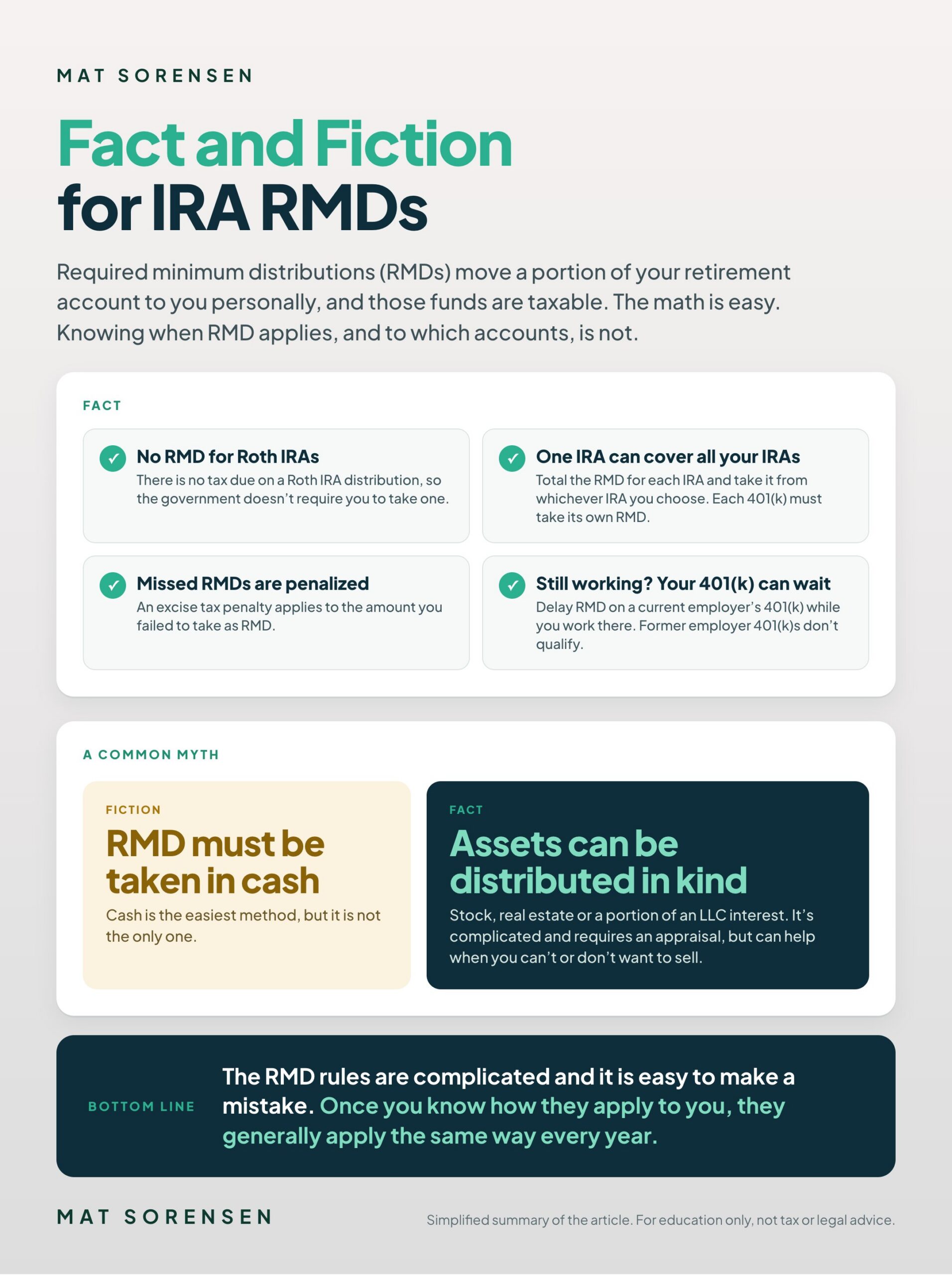
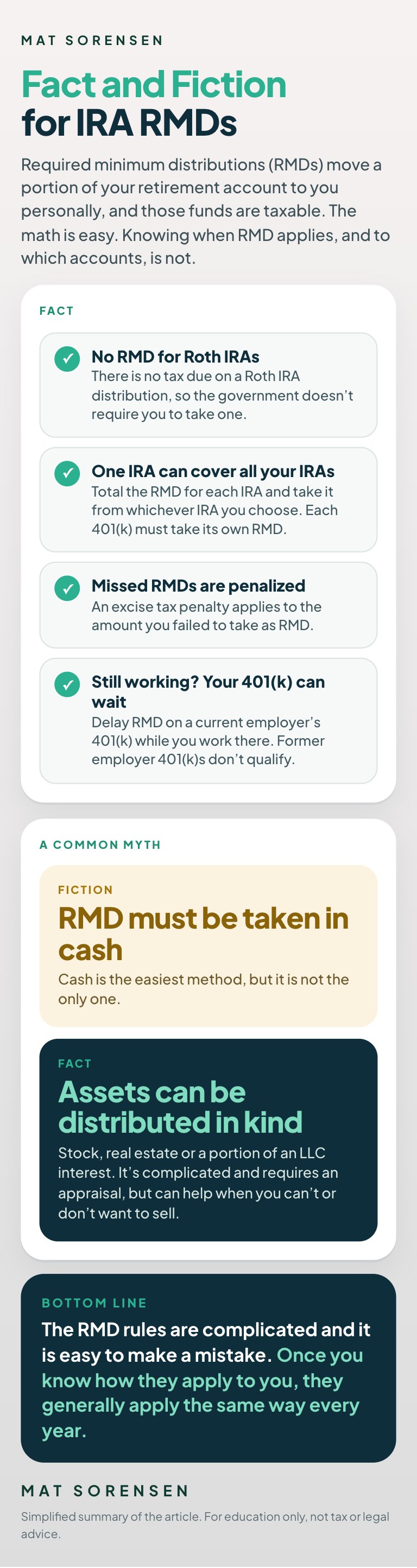
Infographic: facts about IRA required minimum distributions and the myth that RMD must be taken in cash

Fact

  1. 1No RMD for Roth IRAs: Roth IRAs are exempt from RMDs. Even if you are 73 or older, you’re not required to take distributions from your Roth IRA. Why is that? Because there is no tax due when you take a distribution from your Roth IRA. As a result, the government doesn’t really care whether you distribute the funds or not as they don’t receive any tax revenue.
  2. 2RMD Can Be Taken From One IRA to Satisfy RMD for All IRAs: While each account will have an RMD amount to be distributed, you can total those amounts and can satisfy that total amount from one IRA. It is up to you. So, for example, if you have a self directed IRA with a property you don’t want to sell to pay RMD and a brokerage IRA with stock you want to sell to pay RMD, then you can sell the stock in the brokerage IRA and use those funds to satisfy the RMD for both IRAs. You can’t combine RMD though for 401(k) and IRA accounts. Only IRA to IRA. Each 401(k) must take its own RMD.
  3. 350% Excise Tax Penalty: There is a 50% excise tax penalty on the amount you failed to take as RMD. So, for example, if you should’ve taken $10,000 as RMD, but failed to do so, you will be subject to a $5,000 excise tax penalty. Check back next month where I will summarize some measures and relief procedures you can take if you failed to take required RMD.
  4. 4401(k) Account Holder Still Working for 401(k) Employer: If you have a 401(k) with a current employer and if you are still working for that employer, you can delay RMD for as long as you are still working at that employer. This exception doesn’t apply to former employer 401(k) accounts even if you are otherwise employed.

Fiction

UPDATE (NOV 2026)

Since 2024, Roth 401(k) and Roth 403(b) accounts no longer require RMDs during the owner’s lifetime (SECURE 2.0 Act). Item 2 below describes the rules before that change. (Source: IRS)

  1. 1RMD Due by End of Year: You can make 2015 RMD payments until the tax return deadline of April 15, 2016. Wrong! While you can make 2015 IRA contributions up until the tax return deadline of April 15, 2016, RMD distributions must be done by December 31, 2015.
  2. 2Roth 401(k)s are Subject to RMDs: While Roth IRAs and Roth 401(k)s are both tax-free accounts, the RMD rules apply differently. As I stated above, Roth IRAs are exempt from RMD rules. However, Roth 401(k) owners are required to take RMD. The distributions will not be subject to tax but they will start the slow process of removing funds from the tax-free account.
  3. 3RMD Must Be Taken In Cash: False. Required Minimum distributions may be satisfied by taking cash distributions or by taking a distribution of assets in kind. While a cash distribution is the easiest method to take RMD, you may also satisfy RMD by distributing assets in kind. This may be stock or real estate or other assets that you don’t want to sell or that you cannot sell. This doesn’t occur often but some self directed IRA owners will end up holding an asset they don’t want to sell because of current market conditions (e.g. real estate) and they decide to take distributions of portions of the real estate in-kind in order to satisfy RMD. This process is complicated and requires an appraisal of the asset(s) being distributed and partial deed transfers (or partial LLC membership interest transfers, if the IRA owns an LLC and the LLC owns the real estate) from the IRA to the IRA owner. While this isn’t the recommended course to satisfy RMD, it is a potential solution to IRA owners who are holding an asset, who have no other IRA funds to distribute for RMD, and who wish to only take a portion of the asset to satisfy their annual RMD.

The RMD rules are complicated and it is easy to make a mistake. Keep in mind that once you know how the RMD rules apply in your situation it is generally going to apply in the same manner every year thereafter with only some new calculations based on your age and account balances each year thereafter.

Click here for a nice summary of the RMD rules from the IRS.

FREE SELF-DIRECTED IRA GUIDE

Learn how to invest your IRA in real estate, private companies, notes, precious metals, and more.

Get the Free Self-Directed IRA Guide

Prefer to talk it through? Book a call with a Directed IRA specialist

Avoiding the 20% Withholding Tax on 401(k) Distributions

Distributions from a 401(k) to its owner are subject to a 20% withholding tax whereas distributions from an IRA are not subject to a withholding tax. As a result, any amounts distributed from a 401(k) to its owner will be reduced by 20% and that 20% will be sent to the IRS in expectation of the taxes that will be due from the account owner for the distribution. Any amounts distributed from an IRA, however, are not subject to the 20% withholding as the IRA owner can elect out of withholding. The discrepancy in the rules is one advantage of using an IRA in retirement as opposed to a 401(k) since the amounts distributed from the IRA can be received in their entirety.

Keep in mind, the tax owed on a distribution from an IRA or 401(k) is the exact same. The difference is when you are required to pay it. In both instances you will receive a 1099-R from your custodian/administrator but in the 401(k) distribution you are required to set aside and effectively pre-pay the taxes owed.

Infographic: how rolling 401(k) funds to an IRA before taking a distribution avoids mandatory 401(k) withholding

The 401(k) Withholding Rule in Practice

EXAMPLE

Let’s walk through a common situation that outlines the issue. Sarah is 64 and has a 401(k). She would like to distribute $100,000 from the 401(k). She contacts her 401(k) administrator and is told that on a $100,000 distribution they will send her $80,000 and that $20,000 will be sent to the IRS for her to cover the 20% withholding requirement.

Since this 20% withholding requirement does not apply to IRAs, Sarah decides to roll/transfer the $100,000 from her 401(k) directly to an IRA. Once the funds arrive at the IRA, Sarah takes the $100,000 distribution from the IRA and there is no mandatory 20% withholding so she actually receives $100,000 in total.

Keep in mind, Sarah will still owe taxes on the $100,000 distribution from the IRA and she will receive a 1099-R to include on her tax return. That being said, Sarah has given herself the ability to access all of the amounts distributed for her retirement account without the need for sending withholding to the IRS at the time of distribution.

$80,000

What Sarah would receive from the 401(k)

$100,000

What she receives from the IRA

It’s that simple. Don’t take distributions from a 401(k) and subject yourself to the 20% withholding tax when you can roll/transfer those 401(k) funds to an IRA and receive the entire distribution desired without a 20% withholding.

FREE ROLLOVER GUIDE

Learn how to move an old 401(k) or IRA into a self-directed IRA, tax-free.

Get the Free Transfers & Rollovers Guide

Prefer to talk it through? Book a call with a Directed IRA specialist

Who are Self Directed IRA Investors? An Essay

I was recently interviewed and asked, “what has caused so many investors to self-direct their retirement plan?” As many people know, self-directed retirement plan investors use their self-directed IRA and 401(k)s to invest into real estate, private companies, precious metals and other “non-wall street” investments. I’ve worked with thousands of self-directed IRA and 401(k) investors and as I reflected on the question, I realized that there are three primary categories of self-directed investors.

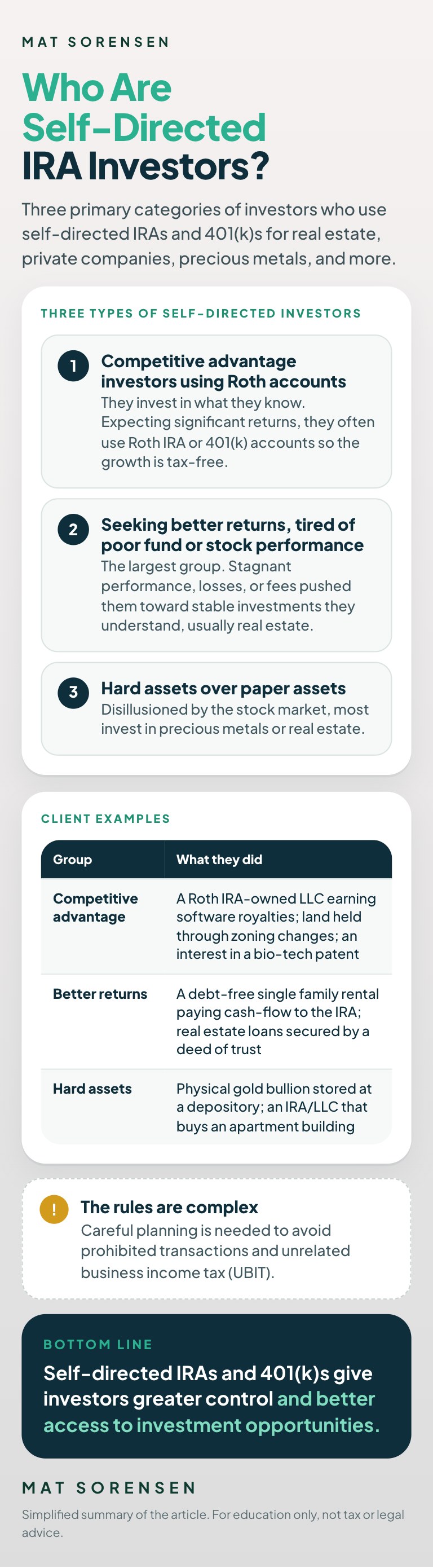
Infographic: the three primary categories of self-directed IRA and 401(k) investors, with client examples from the article

I. Competitive Advantage Investors Using Roth Accounts

These investors like to invest in what they know. They avoid mutual funds and the stock market because they have a competitive advantage over other investors and usually have a special expertise over other investors. Because they have a special expertise, they often expect to make significant returns and therefore will frequently use Roth IRA or 401(k) accounts for their investments. Let me offer a few examples from actual un-named clients of mine that all resulted in 7 figure returns.

CLIENT EXAMPLE

Software Engineer. Software Engineer who used Roth IRA funds along with some other technology savvy investors and funded an LLC. This LLC then engaged and paid some un-related developers to develop new programming that the Roth IRA investors knew would have value. The LLC owned by the Roth IRAs then in turn negotiated a royalty agreement with an unrelated company who wanted the technology to be used in a specific software program that it would sell commercially. The LLC receives royalties on the use/sales of the product. The income goes back to the Roth IRAs tax free.

CLIENT EXAMPLE

Real Estate Developer. Real estate developers and investors personally develop millions of dollars of real estate a year and decides to use his Roth IRA to fund a specific real estate investment. Real estate developer converted a couple hundred thousand dollars of traditional IRA funds to Roth IRA funds so that he could acquire a specific piece of real estate that was to be held and later sold. The developer knows the land would have significant value over the next few years as a result of zoning law changes and planned development from neighboring property. The Roth IRA paid for some paper development zoning changes upon acquisition and then held the property as an investment for a few years. The property later increased nearly 10 times in value as neighboring development took off.

CLIENT EXAMPLE

Bio-Tech Start-Up Entrepreneur. An experienced bio-tech investor had an opportunity to invest at early stages in a patent that was going to be the basis for a new bio-tech start-up. The investor used Roth IRA funds and funded additional research costs in exchange for an interest in the patent that was being developed by un-related researchers for commercial purposes. The patent was the basis of value for a start-up venture and the Roth IRA received a significant share of the company in exchange for the patent interest.

This group would also include former Republican Party Nominee, Mitt Romney, and famous Venture Capitalist, Peter Thiel, whose large self-directed IRAs have been reported on extensively.

Keep in mind, the rules for these investments are complex and careful planning must be taken to avoid prohibited transactions, as well as unrelated business income tax (UBIT). However, when properly executed with the right investment, this group can sock away significant returns in tax-free Roth accounts. There’s no better deal in the tax code than this!

II. Seeking Increased Returns and Tired of Poor Fund or Stock Performance

This is the largest group of self directed IRA investors. These investors have seen stagnant performance, losses, or ridiculous fees eat away at their retirement account. They are generally tired of the ups and downs of the stock market and want stable investments they can actually understand. This group usually invests in real estate, in its various forms, because it can offer more stable returns and because the investor can actually understand the investment (something they can’t do from a 100 page mutual fund prospectus). Here are a couple of actual client examples.

CLIENT EXAMPLE

Retired Corporate Manager Becomes a Real Estate Investor. A retired real estate investor client of mine rolled over former employer 401(k) funds to a traditional self-directed IRA. This investor is in their early 60’s and uses the income from her retirement account to live on. She invested her traditional IRA into a modest 3 bd 2 bth single family rental. The property has no debt and the cash-flow goes back into her IRA. She routinely takes distributions of the cash-flow to supplement her retirement income. Since this is a traditional IRA she is taxed on the distributions (as she would with any traditional IRA) but she is not reducing the actual investment value of the IRA as she only distributes the cash-flow. This client has had an increase in confidence as the rental income has proven to be consistent over time and she still knows that her IRA owns the property so she doesn’t feel like she’s depleting her retirement account when she takes distributions of the cash-flow. Frankly, I’ve talked to hundreds if not thousands of clients in a scenario similar to this.

CLIENT EXAMPLE

Real Estate Broker Loans Solo 401(k) Funds to Other Investors. This real estate broker uses his self-directed 401(k) to loan money to real estate investors buying investment properties. Some people refer to these loans as hard money loans or as trust deed loans. The 401(k) will loan funds to other real estate investors in situations where banks are typically un-willing to lend. The real estate broker lends to properties in markets that he knows and receives a first or second place deed of trust (mortgage) securing his loan. The typical loan terms are 10% annual interest with 2 points. This self-directed investor knows real estate and has been able to receive annual returns far in excess of the stock market.

III. Hard Assets Over Paper Assets

These investors value hard assets over paper assets. They are generally disillusioned by the stock market and feel that price to earnings ratios of publicly traded companies have sky-rocketed without regard to company performance. They tend to believe that stock prices have nothing to do with actual value but instead are propped up by the Wall Street money machine. They’ve usually had retirement accounts for years and have seen their account go through the dot-com bubble and the financial crisis. They have little faith in paper assets and desire to move to a self-directed account at a time when they believe the market is going to collapse. Most of these investors will invest in precious metals or real estate.

CLIENT EXAMPLE

Retired Corporate 401(k). A retired corporate employee rolls over a portion of his prior employer’s 401(k) to a self-directed IRA and buys actual precious metals that are stored at a depository for his IRA. The precious metals are not an ETF or a fund but are actual, physical, gold bullion that meets the retirement plan rules for ownership by an IRA. Common precious metals would be gold or silver bullion as well as specifically approved American Eagle coins.

CLIENT EXAMPLE

Working Corporate Employee with Prior Employer 401(k). A 50 year old corporate employee uses her present employer retirement plan for standard mutual fund investments based on risk factors and tolerances for investors her age. Her current employer’s plan cannot be self-directed but she rolls over a prior employer’s 401(k) to a self-directed IRA and uses that self-directed IRA to invest in real estate investments with other like-minded investors. The investors use their self directed IRAs and each invest into the newly created IRA/LLC (an LLC owned by IRAs). The LLC then uses the combined funds to purchase a multi-family property. In the end, her IRA owns a 20% interest in an LLC that owns an apartment building.

There are many other characteristics of self-directed investors and even more examples of these groups in the industry. However, the three groups above seem to capture 90% of the growing self-directed retirement plan market. Additionally, many investors have cross over and identify in two or all three of these groups. Because self-directed IRAs and 401(k)s give investors options for greater control and because they provide better access to investment opportunities, we will only continue to see growth in the self-directed retirement plan market.

FREE SELF-DIRECTED IRA GUIDE

Learn how to invest your IRA in real estate, private companies, notes, precious metals, and more.

Get the Free Self-Directed IRA Guide

Prefer to talk it through? Book a call with a Directed IRA specialist

By: Mat Sorensen, Attorney and best-selling Author of The Self Directed IRA Handbook

Mat Sorensen

Mat has been at the forefront of the self-directed IRA industry since 2006. He is the CEO of Directed IRA & Directed Trust Company where they handle all types of self-directed accounts (IRAs, Roth IRAs, HSAs, Coverdell ESA, Solo Ks, and Custodial Accounts) which are typically invested into real estate, private company/private equity, IRA/LLCs, notes, precious metals, and cryptocurrency. Mat is also a partner at KKOS Lawyers and serves clients nationwide from its Phoenix, AZ office.

He is published regularly on retirement, tax, and business topics, as well as a VIP Contributor at Entrepreneur.com. Mat is the best-selling author of the most widely used book in the self-directed IRA industry, The Self-Directed IRA Handbook: An Authoritative Guide for Self-Directed Retirement Plan Investors and Their Advisors.

Swimming in Liability: Demi Moore, Pools, and Landlord Tips

Actress Demi Moore recently discovered a dead man in her pool. This unfortunate situation caught the media’s attention and caused many to think of pool safety and liability issues.

As a lawyer with many clients who own rentals in Arizona, Florida, and California and other states where pools are common, I thought it would be helpful to address the issues of pool liability and safety.

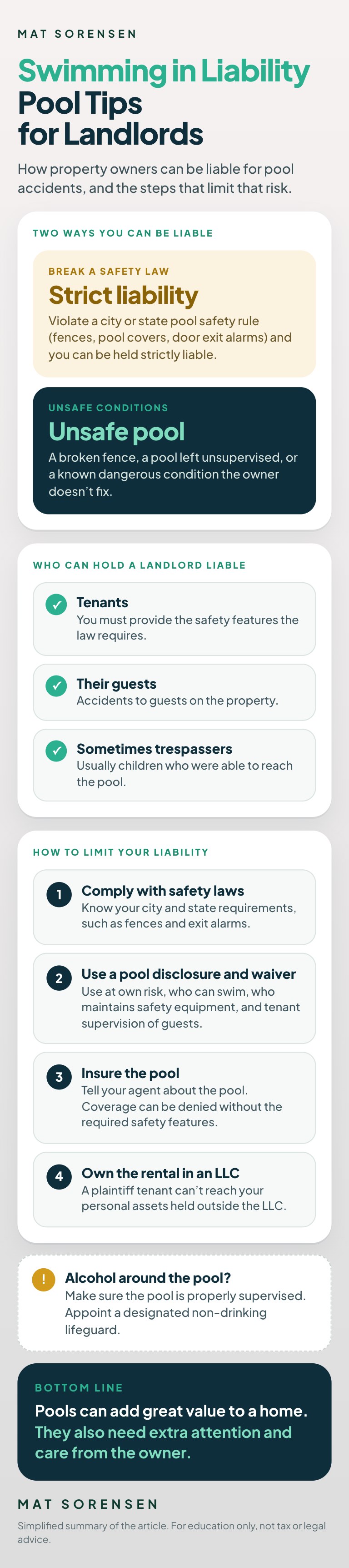
Infographic: two ways a property owner can be liable for a pool accident, who can hold a landlord liable, and four steps to limit pool liability

Liability

First, let’s discuss liability as it relates to pools. Generally, the property owner is responsible for maintaining the pool in a safe and reasonable manner. In the case of Demi Moore, what occurred was that her assistant held a party at the house while Demi was away and a man drowned in the pool at this party. Because Demi’s assistant is an employee that means that Demi is also responsible for her employee’s actions. So her assistant’s failure to keep the pool safe during the party becomes a liability issue for Demi. Also, as the pool and property owner, Demi is responsible to maintain care at the home and around the pool.

There are two ways a property owner can be liable for accidents that occur at a pool. First, if you violate a local law (city or state) that relates to pool safety you can be held strictly liable. In most instances, there are laws that govern what safety precautions should be present on a home. These requirements vary by state but include a combination of safety barriers (e.g. fences), pool covers, and door exit alarms. If your property and pool do not comply with these requirements and if an accident occurs at your property’s pool, you can be held “strictly” liable for the accident that occurs on the property. Consequently, make sure you understand the rules in your city and state so that you are complying with the safety laws. Not only will this help prevent unfortunate accidents but it will also make you less liable in the event of an accident.

The second way you can be liable for a pool accident, is if the property and pool is otherwise unsafe. This could occur if safety precautions aren’t working (e.g. broken fence) or if the pool is otherwise unsafe or is left unsupervised while children or other persons who may need supervision are around. In many instances, if the landlord is aware of a dangerous pool condition and doesn’t fix it then they are liable for any accidents. In the case of Demi Moore, the argument may likely be that the pool was un-safe because it was not properly supervised while there was a party where alcohol was served (I’m assuming that occurred). While I haven’t seen these facts alleged, this is a common issue and safety problem and if alcohol is being served around a pool you better make sure the pool is properly being supervised. Appoint a designated non-drinking lifeguard.

As a landlord, you have a duty to your tenants to ensure that the pool includes the necessary safety features required by law. You can also be liable for damages and accidents to their guests to the property. And sometimes, even trespassers can hold you liable for damages incurred from the pool while trespassing (usually this would only apply to children who were able to access the pool).

How to Prevent Liability and Protect Assets

Here’s a quick summary of things to do that will limit your liability from pool accidents.

  1. 1Comply with all safety requirements for your city/state (e.g. fences, exit alarms, etc.)
  2. 2Include a clause or separate pool disclosure and waiver. This document will include the following.
    1. The tenants use the property at their own risk.
    2. Have the tenant specify if all of the occupants of the property can swim. If any occupant cannot swim (e.g. young children), then additional caution should be taken and indicate in the waiver that the pool must be supervised at all times the child is at home. This may also be a good reason not to rent to someone as your liability does increase.
    3. State that the tenant is responsible for maintenance of the pool safety equipment (e.g. fences, exit alarms, as applicable) and that the tenant must immediately notify the landlord of any safety feature or pool equipment repairs that are needed.
    4. State that the Tenant agrees to supervise the pool at all times that guests are at the property.
  3. 3Make sure that your property/landlord insurance (rental dwelling landlord policy) includes protection for the swimming pool and that your agent knows there is a swimming pool on the property. The presence of a pool will increase your insurance premium slightly. I have a rental with a swimming pool personally and it increased my premium slightly over a similar rental I have without a pool but it isn’t significant. The pool is listed on my policy and accidents are covered under my Landlord/Business liability policy provisions. One thing to keep in mind is that your insurance company could deny coverage if you do not have the adequate pool safety features on the property required by law. So, again, make sure you know the local pool safety laws and requirements for pools in your state and city.
  4. 4Own your property with an LLC so that if something occurs on the property your LLC is liable for any damages as opposed to exposing all of your personal assets. In general, when the LLC owns the property the LLC is liable for anything that occurs on the property and a plaintiff tenant cannot reach your personal assets held outside the LLC.

Hopefully none of us have to deal with a tragic pool accident. I hope this article helps landlords and real estate investors understand their responsibility and precautions that should be taken when a pool is located on one of your rentals. Pools can add great value to a home and are a nice feature for the “move-up” rental market but they need some extra attention and care from property owners.

Avoiding State Income Tax on Retirement Plan Distributions

When a retiree begins taking distributions from a traditional IRA, 401(k), or pension plan, those distributions are taxable to the retiree under federal income tax and any applicable state income tax rules. While federal taxation cannot be avoided, state taxation may be avoided depending on your state of residency. In general, there are some states that have zero income tax and therefore don’t tax retirement plan distributions, some states that have special exemptions for retirement plan distributions, and other states that do in fact tax retirement plan distributions. This article breaks down the basics and discusses some of the states where income taxes can be avoided.

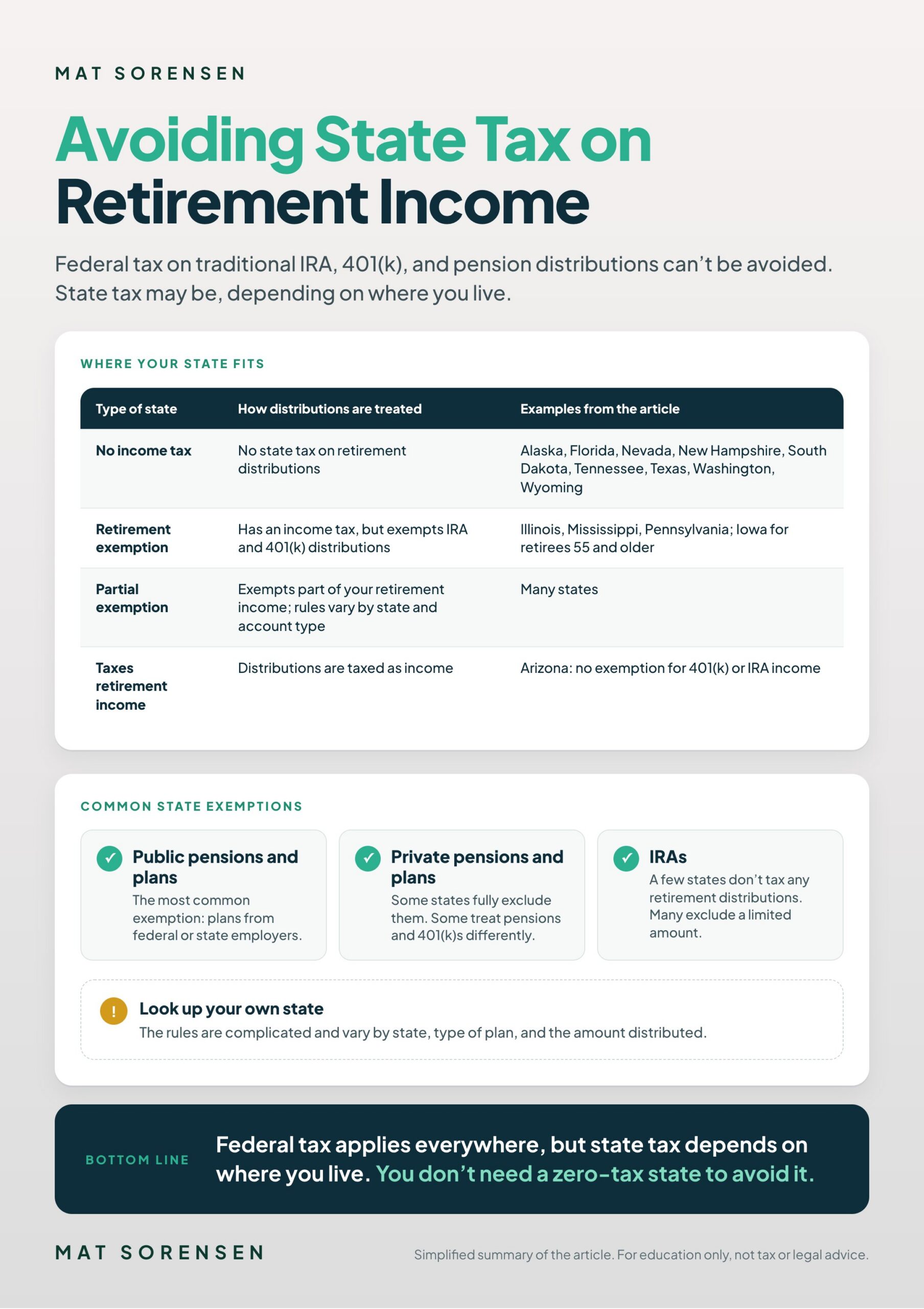
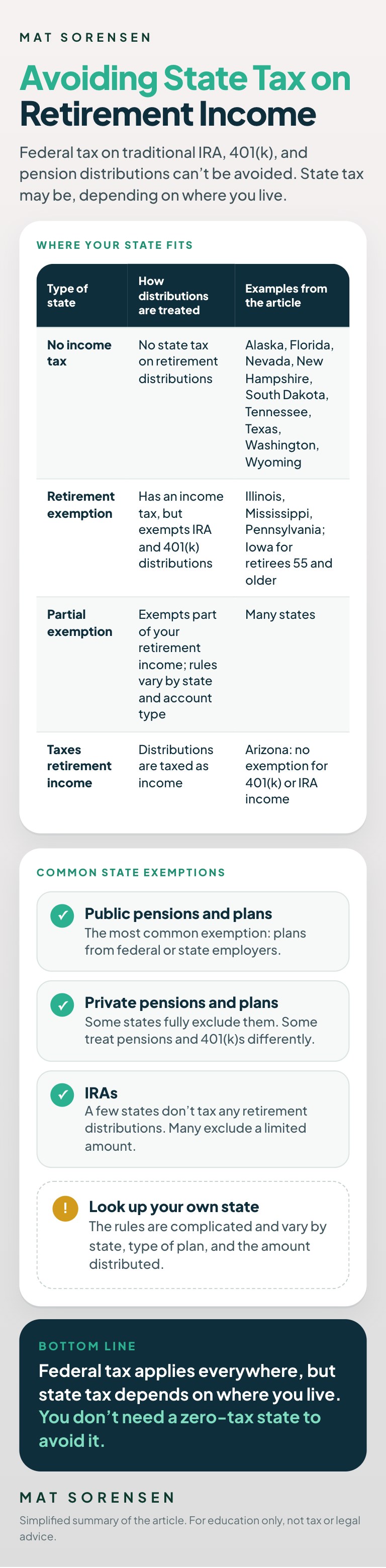
Infographic: how no-income-tax states, retirement exemption states, and taxing states treat IRA, 401(k), and pension distributions, plus common state exemptions

The No State Income Tax States

First, the easiest way to avoid state income tax on retirement plan distributions is to establish residency in a state that has no state income tax. It isn’t just the fun and sun of Florida that helps attract all of those retirees. It’s the tax-free state treatment of all that money stocked away in your retirement account. As of 2026, nine states have no income tax on wages or retirement distributions: Alaska, Florida, Nevada, New Hampshire, South Dakota, Tennessee, Texas, Washington, and Wyoming.

States with Retirement Income Exclusions

Second, some states have an income tax but exempt retirement plan distributions. In 2026, Illinois, Mississippi, and Pennsylvania exempt IRA and 401(k) distributions, and Iowa exempts them for retirees 55 and older. Many other states exempt part of your retirement income, and the rules vary by state and by type of account. Here’s a quick summary of the common exemptions found in the states.

  1. 1For Public Pensions and Retirement Plans. Distributions from federal or state employer plans are exempt from taxation in many states. This is the most common exemption amongst states that have an income tax but who exempt some types of retirement plan distributions from income. Most of the states that have an exemption for retirement plan income provide an exemption for public employee pensions and retirement plans.
  2. 2For Private Pensions and Retirement Plans. Some states offer a full exclusion for private pensions and retirement plans. Some of them differ between pension and contributory plans (e.g. 401(k)) and some of them make no distinction. Pennsylvania, for example, excludes all income distributions. Hawaii excludes certain distributions from state income tax for private retirement plans and for portions from company plans rolled over to a rollover IRA and then distributed from the rollover IRA.
  3. 3For IRAs. There are some states that do not tax any retirement plan distributions, including IRA distributions to retirees. Illinois for example does not tax distributions from retirement plans at all (pensions, IRAs, 401(k)s). There are also numerous states that exclude a certain limit of retirement plan income from taxation.

Know Your State’s Rules

In sum, the state tax rules for retirement plan distributions are complicated and vary significantly. Each state can be understood rather quickly though and everyone planning for retirement should understand how state income taxes may eat into their planned retirement plan distributions.

EXAMPLE

I, for example, looked into Arizona and found that there is no exemption for 401(k) or IRA income in the state of Arizona. While we do have a low state income tax rate, Arizona state income tax includes income from private retirement plans (pensions and 401(k)s) and IRAs and has a modest deduction for distributions from public retirement plans.

Each state is unique to the type of plan, and the amounts being distributed but don’t just think you need to be in a state with zero income tax to avoid taxes on retirement plan distributions. For example, you could be in Illinois, Tennessee, or New Hampshire and could realize state income tax-free distributions of your IRA or 401(k).  The National Conference of State Legislators has an updated 2015 chart that is very useful and can be used to look up your state’s tax treatment of retirement plan distributions for retirees.

FREE SELF-DIRECTED IRA GUIDE

Learn how to invest your IRA in real estate, private companies, notes, precious metals, and more.

Get the Free Self-Directed IRA Guide

Prefer to talk it through? Book a call with a Directed IRA specialist

Court Rules in Favor of Self-Directed IRA Real Estate Investor in Prohibited Transaction Case

A recent Bankruptcy Court decision dealt with prohibited transaction claims against a self directed IRA owner who was using their IRA to flip real estate for profit. The claims were brought by a bankruptcy trustee who argued that the protected IRA was no longer an IRA because it engaged in a number of prohibited transactions. If the trustee is successful in disqualifying the retirement account because of a prohibited transaction, then the funds and assets held in such retirement account are no longer protected from creditors and may be used to pay debtors involved in the bankruptcy. While most prohibited transaction cases arise in Tax Court, I’m seeing more cases on prohibited transactions in Bankruptcy Court as trustees are becoming more aggressive and as self directed IRAs are becoming more popular.

The case in question is known as In re Cherwenka, Case 13-57592-MGD (Bankr. N. D. GA 2014). The case included two important prohibited transaction analysis that are helpful to IRA owners.

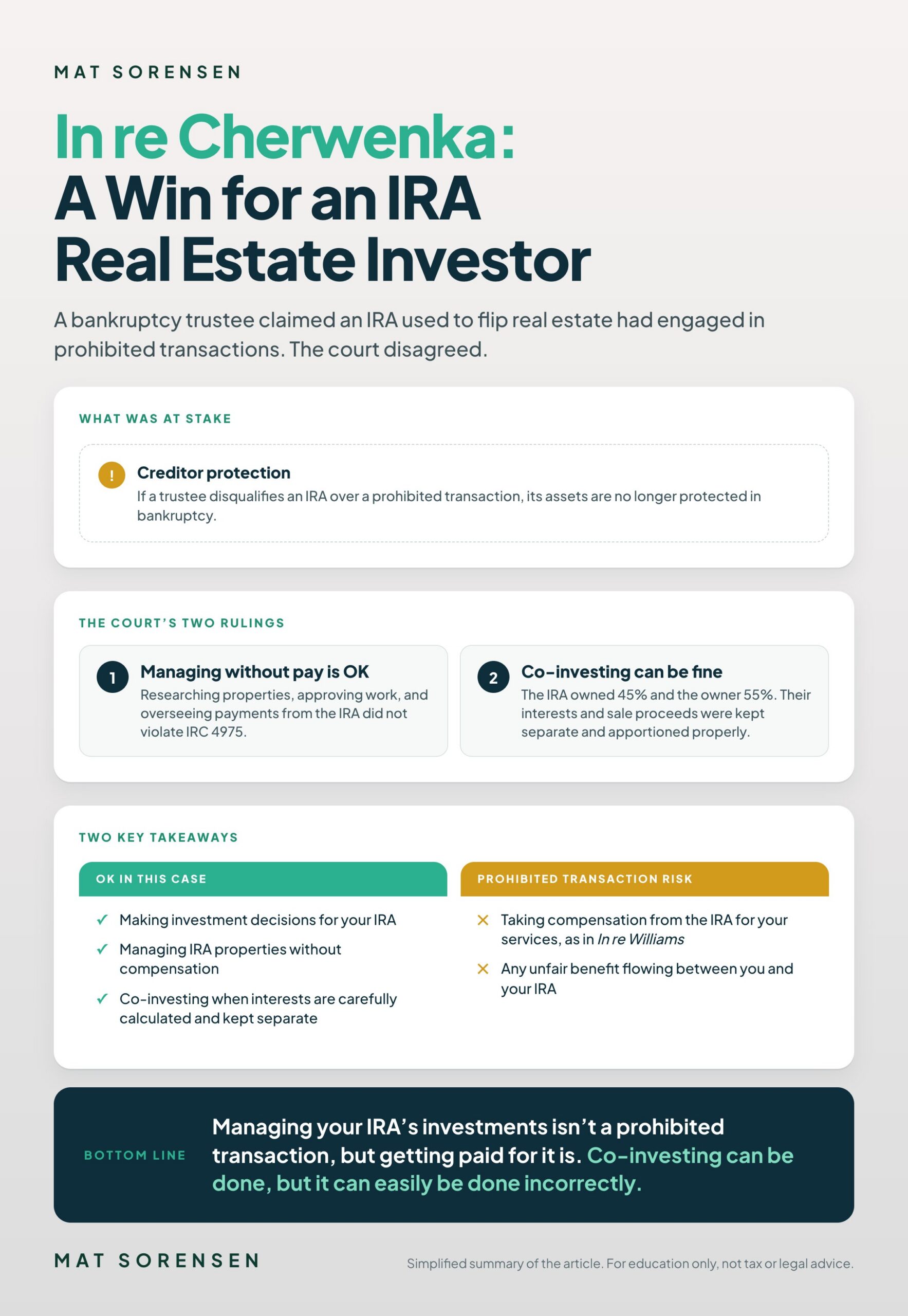
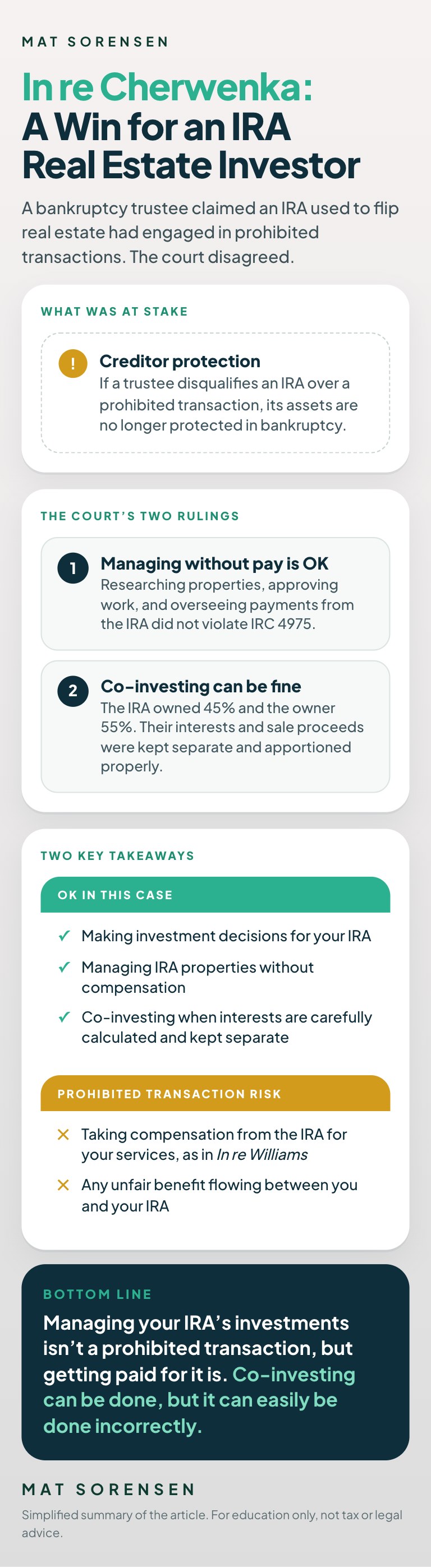
Infographic: the two prohibited transaction rulings in In re Cherwenka and key takeaways for self-directed IRA real estate investors

Court Rules No Prohibited Transaction When Managing IRA Investment Properties Without Compensation

The first significant ruling from the Court was that there was no prohibited transaction when the IRA owner completed the following tasks related to the IRA owned property.

  • ✓Research and identified properties to buy
  • ✓Appointed and approved work on the properties
  • ✓Oversaw payments on the property for work from the self-directed IRA.

The Court reasoned that these actions do not constitute a “transaction” as defined in IRC § 4975 and as a result they cannot constitute a prohibited transaction. The Court further stated that, “…self-directed IRAs as qualified IRAs, necessarily implies that a disqualified person (the owner as fiduciary) will make investment decisions regarding the plan. The Court distinguished this case from In re Williams, 2011 WL 10653865 (Bankr E.D. Cal 2011) a similar case in which the self-directed IRA owner was managing properties owned by the IRA because in Williams the IRA was paying the self-directed IRA owner for the services. The court stated that it was the payment from the IRA to the IRA owner in Williams that caused the prohibited transaction and not the mere provision of managing the IRA’s investment owned by the IRA.

Court Ruled That No Prohibited Transaction Occurred When IRA and Owner Invested Into Property Together

The second significant ruling from the Court was that there was no prohibited transaction when the IRA owner and the IRA co-invested into a property together. The property in question was owned 45% by the IRA and 55% by the IRA owner. The Court rejected the bankruptcy Trustee’s argument that such co-investment purchase resulted in a prohibited transaction and stated that the interests appeared to have been treated distinctly and that the HUD documents from the sale of the property show that the IRA and the IRA owner’s proceeds from the sale were treated separately and that they were apportioned properly. As a result, the Court concluded that no prohibited transaction occurred since there was no evidence of unfair benefit between the IRA owner and his IRA. In its reasoning, the Court referenced DOL Opinion 2000-10A which addressed an IRA and the IRA owner co-investing into a partnership. In the Opinion the DOL states that, “a violation of section 4975 (c)(1)(D) or (E) will not occur merely because the fiduciary [IRA owner] derives some incidental benefit from the transaction involving IRA assets.” The Court referenced this opinion and stated that unless there is evidence of some unfair benefit that no prohibited transaction occurred merely because of co-investment into the same property.

Key Takeaways for Investors

There are two key take-aways for self-directed IRA investors from this case.

First, never take compensation or payment from the IRA for services rendered. It is clear that the Courts will find a prohibited transaction if you do and that you will no longer have an IRA.

Second, if you are buying property or other assets (e.g. LLC interests) between your IRA and yourself personally (or another disqualified person) those interests must be carefully calculated and treated such that there is no benefit going unfairly between the IRA and the disqualified person (e.g. IRA owner). In sum, get advice and plan carefully as there are many land-mines you could encounter when investing IRA funds with your own personal funds. Bottom line, it can be done but it can easily be done incorrectly.

FREE REAL ESTATE IRA GUIDE

Learn how to buy rental property and other real estate with your IRA, and how to avoid prohibited transactions.

Get the Free Real Estate IRA Guide

Prefer to talk it through? Book a call with a Directed IRA specialist