A recent Bankruptcy Court decision dealt with prohibited transaction claims against a self directed IRA owner who was using their IRA to flip real estate for profit. The claims were brought by a bankruptcy trustee who argued that the protected IRA was no longer an IRA because it engaged in a number of prohibited transactions. If the trustee is successful in disqualifying the retirement account because of a prohibited transaction, then the funds and assets held in such retirement account are no longer protected from creditors and may be used to pay debtors involved in the bankruptcy. While most prohibited transaction cases arise in Tax Court, I’m seeing more cases on prohibited transactions in Bankruptcy Court as trustees are becoming more aggressive and as self directed IRAs are becoming more popular.
The case in question is known as In re Cherwenka, Case 13-57592-MGD (Bankr. N. D. GA 2014). The case included two important prohibited transaction analysis that are helpful to IRA owners.
Court Rules No Prohibited Transaction When Managing IRA Investment Properties Without Compensation
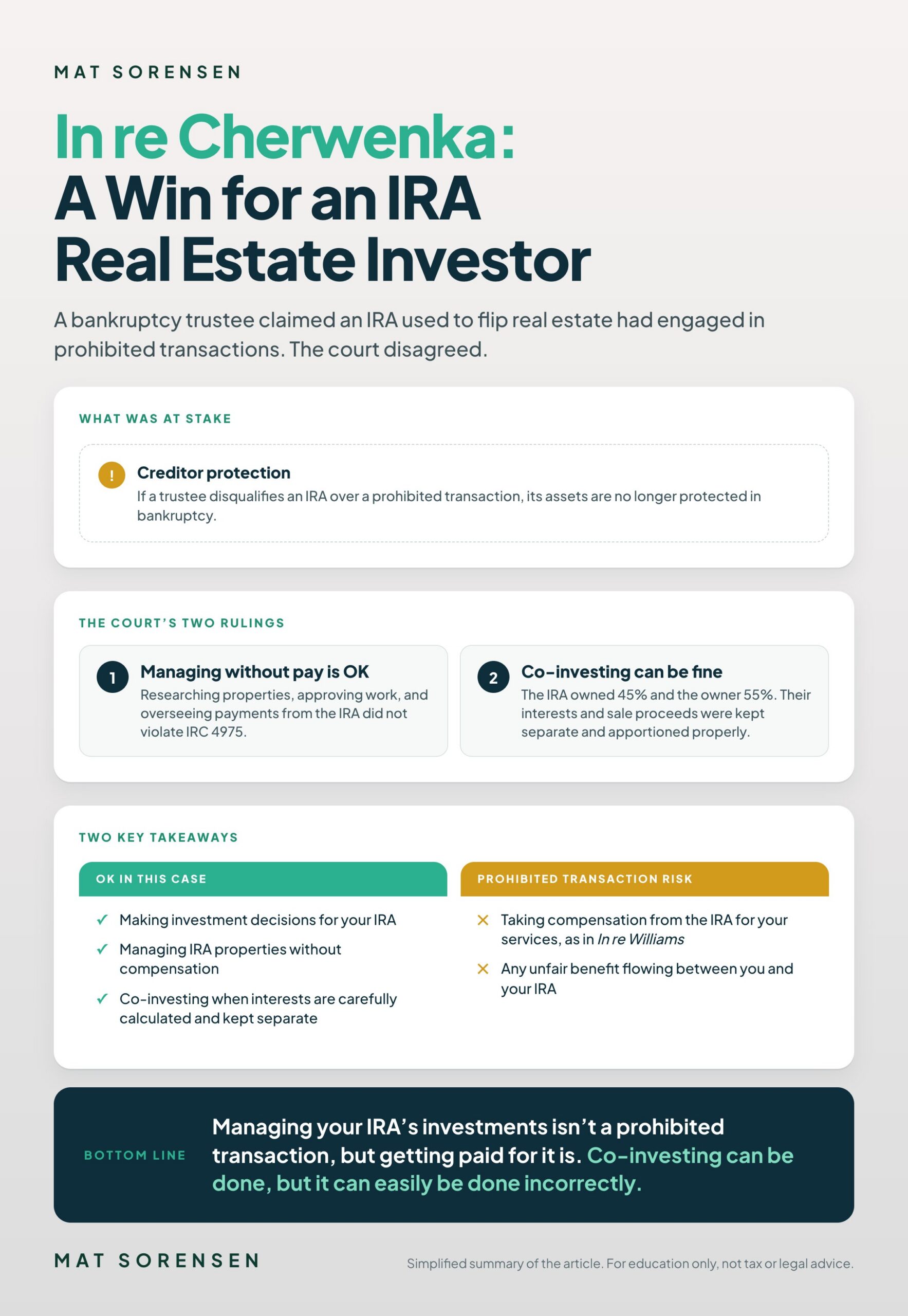
The first significant ruling from the Court was that there was no prohibited transaction when the IRA owner completed the following tasks related to the IRA owned property.
- ✓Research and identified properties to buy
- ✓Appointed and approved work on the properties
- ✓Oversaw payments on the property for work from the self-directed IRA.
The Court reasoned that these actions do not constitute a “transaction” as defined in IRC § 4975 and as a result they cannot constitute a prohibited transaction. The Court further stated that, “…self-directed IRAs as qualified IRAs, necessarily implies that a disqualified person (the owner as fiduciary) will make investment decisions regarding the plan. The Court distinguished this case from In re Williams, 2011 WL 10653865 (Bankr E.D. Cal 2011) a similar case in which the self-directed IRA owner was managing properties owned by the IRA because in Williams the IRA was paying the self-directed IRA owner for the services. The court stated that it was the payment from the IRA to the IRA owner in Williams that caused the prohibited transaction and not the mere provision of managing the IRA’s investment owned by the IRA.
Court Ruled That No Prohibited Transaction Occurred When IRA and Owner Invested Into Property Together
The second significant ruling from the Court was that there was no prohibited transaction when the IRA owner and the IRA co-invested into a property together. The property in question was owned 45% by the IRA and 55% by the IRA owner. The Court rejected the bankruptcy Trustee’s argument that such co-investment purchase resulted in a prohibited transaction and stated that the interests appeared to have been treated distinctly and that the HUD documents from the sale of the property show that the IRA and the IRA owner’s proceeds from the sale were treated separately and that they were apportioned properly. As a result, the Court concluded that no prohibited transaction occurred since there was no evidence of unfair benefit between the IRA owner and his IRA. In its reasoning, the Court referenced DOL Opinion 2000-10A which addressed an IRA and the IRA owner co-investing into a partnership. In the Opinion the DOL states that, “a violation of section 4975 (c)(1)(D) or (E) will not occur merely because the fiduciary [IRA owner] derives some incidental benefit from the transaction involving IRA assets.” The Court referenced this opinion and stated that unless there is evidence of some unfair benefit that no prohibited transaction occurred merely because of co-investment into the same property.
Key Takeaways for Investors
There are two key take-aways for self-directed IRA investors from this case.
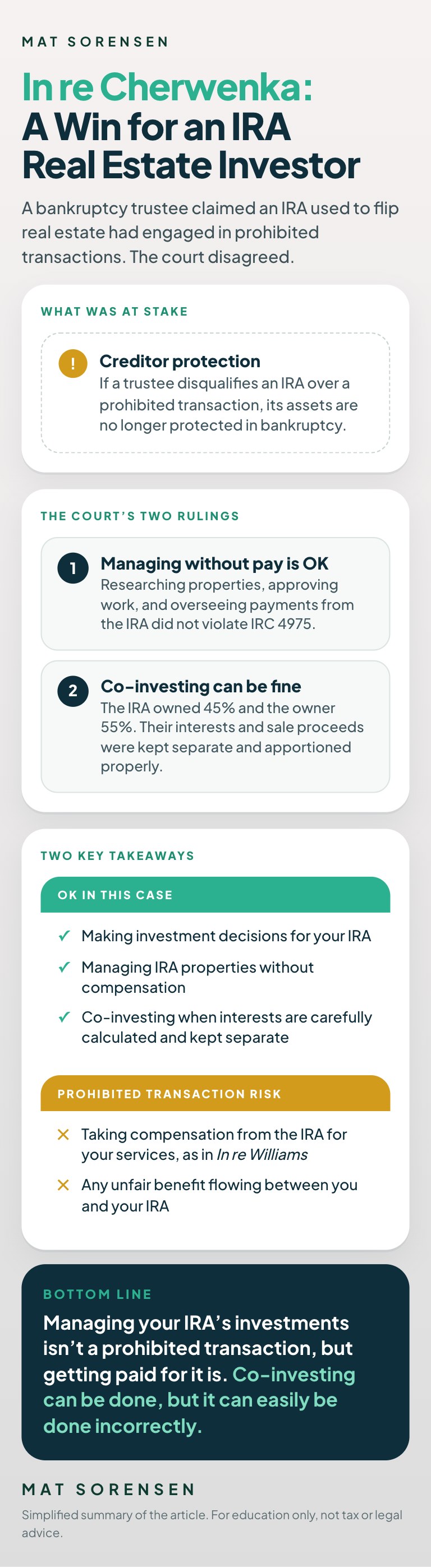
First, never take compensation or payment from the IRA for services rendered. It is clear that the Courts will find a prohibited transaction if you do and that you will no longer have an IRA.
Second, if you are buying property or other assets (e.g. LLC interests) between your IRA and yourself personally (or another disqualified person) those interests must be carefully calculated and treated such that there is no benefit going unfairly between the IRA and the disqualified person (e.g. IRA owner). In sum, get advice and plan carefully as there are many land-mines you could encounter when investing IRA funds with your own personal funds. Bottom line, it can be done but it can easily be done incorrectly.
FREE REAL ESTATE IRA GUIDE
Learn how to buy rental property and other real estate with your IRA, and how to avoid prohibited transactions.
Get the Free Real Estate IRA Guide
Prefer to talk it through? Book a call with a Directed IRA specialist