UBIT Tax and Self-Directed IRAs: Three Key Tips Every Investor Should Know

Unrelated Business Income Tax (“UBIT”) is often misunderstood by self-directed IRA investors and their professional advisors. In essence, UBIT is a tax that is due to an IRA when it receives “business income” as opposed to “investment income”. When we think of IRAs and retirement accounts, we think of them as receiving income without having to pay tax when the income is made. For example, when your IRA sells stock for a profit and that profit goes back to your IRA you don’t pay any tax on the gain. Similarly, when you sell real estate owned by your IRA for a profit and that profit goes back to your IRA, you don’t pay any tax on the gain. The reason for this is because the gain from the sale of an investment asset is deemed investment income and as a result it is exempt from UBIT tax.
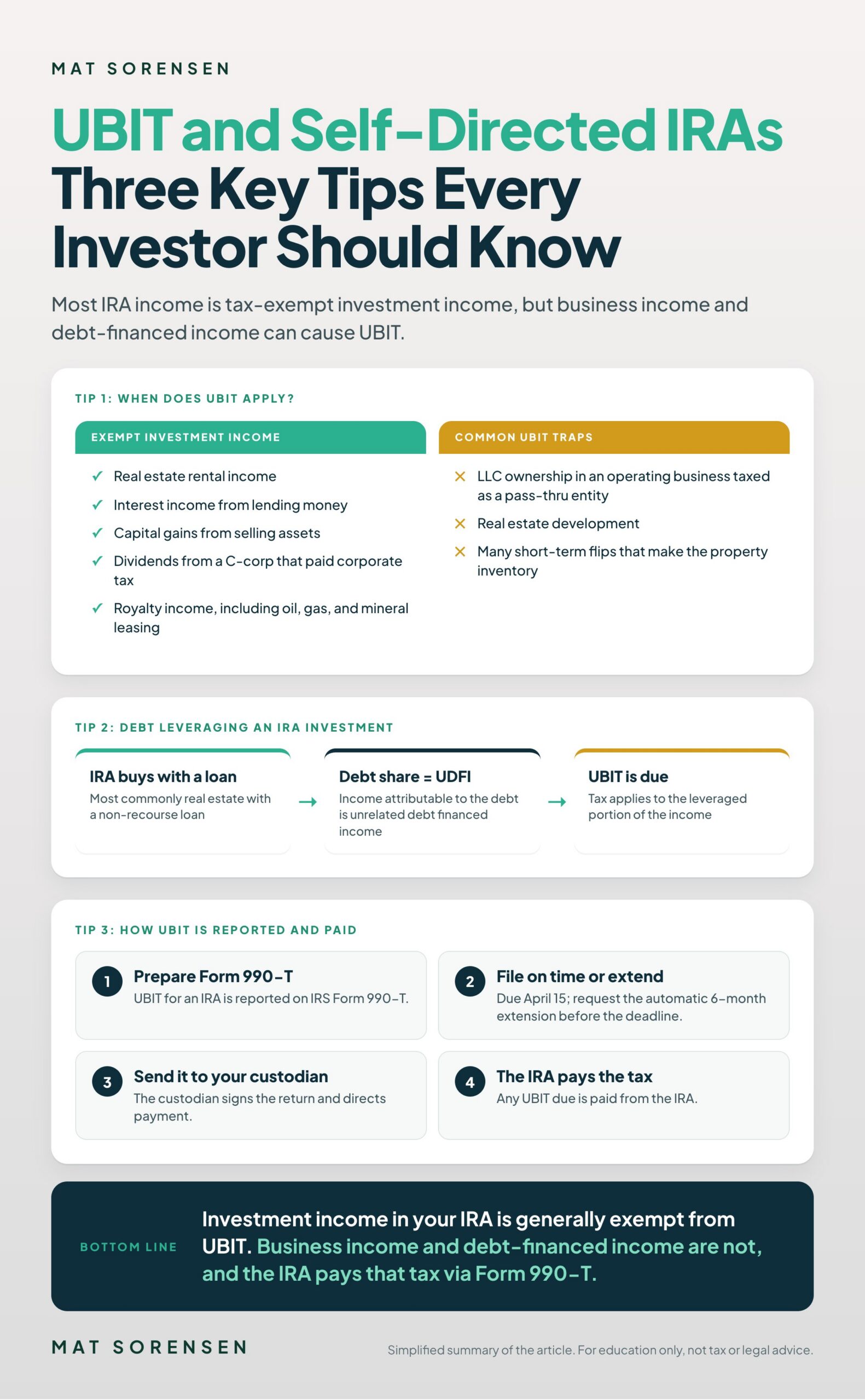
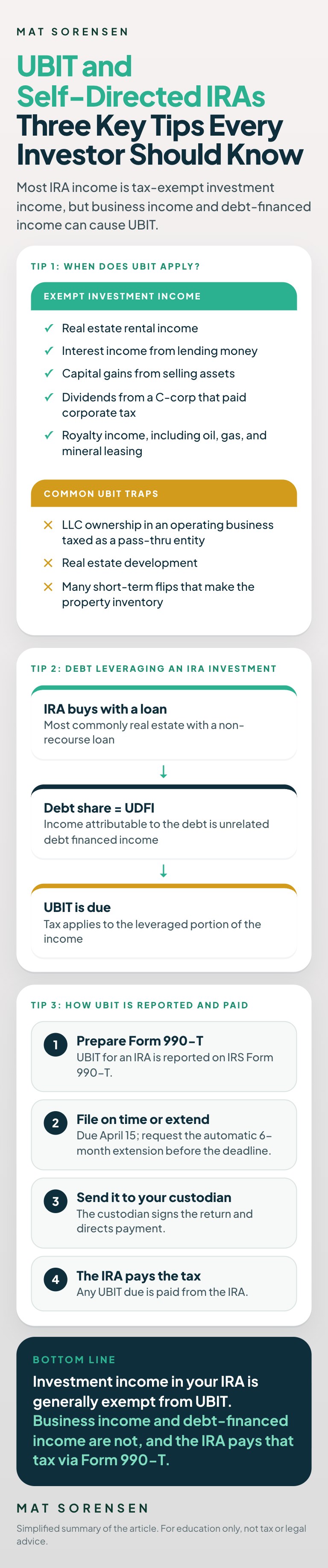
Infographic: when UBIT applies to a self-directed IRA, how debt financing creates UDFI, and how UBIT is reported and paid on Form 990-T

Tip 1: “When Does UBIT Apply?”

UBIT applies when your IRA receives “unrelated business income”. However, if your IRA receives investment income, then that income is exempt from UBIT tax. Investment income that is exempt from UBIT includes the following.

Investment Income Exempt from UBIT:

  • ✓Real Estate Rental Income, IRC 512(b)(3) – The rent of real estate is investment income and is exempt from UBIT
  • ✓Interest Income, IRC 512(b)(1) – Interest and points made from the lending of money is investment income and is exempt from UBIT.
  • ✓Capital Gain Income, IRC 512(b)(5) – The sale, exchange, or disposition of assets is investment income and is exempt from UBIT.
  • ✓Dividend Income, IRC 512(b)(1) – Dividend income from a c-corp where the company paid corporate tax is investment income and exempt from UBIT.
  • ✓Royalty Income, IRC 512(b)(2) – Royalty income derived from intangible property rights such as intellectual property and from oil/gas and mineral leasing activities is investment income and is exempt from UBIT.

There are two common areas where self-directed IRA investors run into UBIT issues and are outside of the exemptions outlined above. The first occurs when an IRA invests and buys LLC ownership in an operating business (e.g. sells goods or services) that is structured as a pass-thru entity for taxes (e.g. partnership) and that does not pay corporate taxes. The income from the LLC flows to its owners and would be ordinary income. If the company has net taxable income it will flow down to the IRA as ordinary income on the k-1 and this will cause tax to the IRA as this will be business income and it does not fit into one of the investment income exemptions.

The second problematic area is when IRAs engage in real estate investment that do not result in investment income. For example, real estate development or a number of significant short-term real estate flips by an IRA will cause the assets of the IRA to be considered as inventory as opposed to investment assets and this will cause UBIT tax to the IRA.

Tip 2: UBIT Applies When You Have Debt Leveraging an IRA Investment

UBIT also applies to an IRA when it leverages its purchasing power with debt. If an IRA uses debt to buy an investment, then the income attributable to the debt is subject to UBIT. This income is referred to as unrelated debt financed income (UDFI) and it causes UBIT. The most common situation occurs when an IRA buys real estate with a non-recourse loan.

EXAMPLE

For example, let’s say an IRA buys a rental property for $100,000 and that $40,000 came from the IRA and $60,000 came from a non-recourse loan. The property is thus 60% leveraged and as a result, 60% of the income is not a result of the IRA’s investment but the result of the debt invested. Because of this debt, that is not retirement plan money, the IRS requires tax to be paid on 60% of the income. So, if there is $10K of rental income on the property then $6K would be UDFI and would be subject to UBIT taxes.

$100,000

Rental property bought by the IRA

60%

Financed with a non-recourse loan

$6K

Of $10K rental income is UDFI

For a more detailed outline on UDFI, please refer to my free one-hour webinar here.

Tip 3: UBIT Tax is Reported and Paid by the IRA via a Form 990-T Tax Return

Unrelated business income tax (UBIT) for an IRA is reported and paid via IRS Form 990-T. IRS Form 990-T is due for IRAs on April 15th of each year. IRA owners can file and obtain an automatic 6-month extension with the IRS by filing an extension request before the regular deadline.

If UBTI Tax is due, it is paid from the IRA and the IRA owner would send the prepared Form 990-T to their IRA custodian for their signature and for direction of payment to the IRS for any tax due as part of the 990-T Return.

For a more detailed outline of UBIT, please refer to Chapter 15 of The Self Directed IRA Handbook.

THE SELF-DIRECTED IRA HANDBOOK

Mat’s best-selling guide to the rules: prohibited transactions, UBIT, IRA/LLCs, and the mistakes to avoid.

Get the Free Handbook

Prefer to talk it through? Book a call with a Directed IRA specialist
Self-Directed IRAs, Real Estate Crowdfunding, and UBIT Tax Explained

The most common asset class for self-directed IRA accounts is real estate. Real estate investments for self-directed IRAs come in various forms from simple single-family rentals owned 100% by the IRA to LLC or LP investment partnerships with multiple investors in larger commercial or multi-family properties.

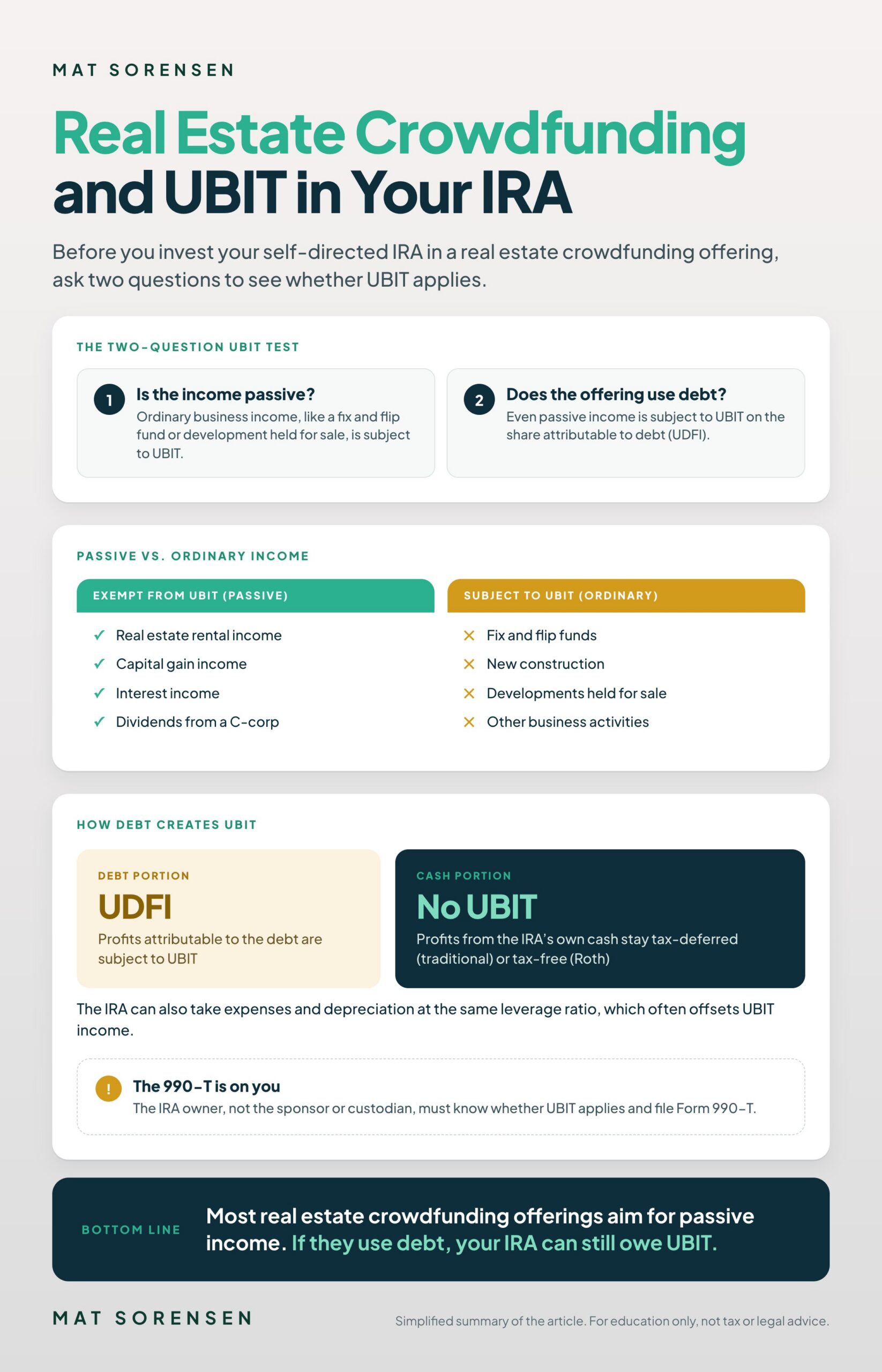
Infographic: the two-question test for whether UBIT applies to a self-directed IRA real estate crowdfunding investment, passive versus ordinary income, and how debt financing creates UDFI

Real Estate Crowdfunding and Your IRA

Given the changes in federal securities laws that now allow investment sponsors and real estate syndicators to raise capital more easily, many self directed IRA investors have considered investing their IRAs into these offerings. Crowdfunding sites such as Realcrowd are already offering Crowdfunding type investment opportunities for investors under SEC Rule 506(c). This rule and those investments are currently only available to accredited investors and have no restriction on the investment amount that may come from the accredited investor. These offerings have traditionally been known as private placements or “PPMs” but can now be marketed and there is no requirement that they be “private” so long as the offering company only accepts accredited investors.

For those who are not accredited investors, “true” Crowdfunding under Title III of the JOBS Act goes into effect in May of 2016. Under these Crowdfunding offerings everyone will be able to invest into Crowdfunding opportunities and the investment amount will be based on the investor’s income and assets. These new Crowdfunding rules were enacted in Title III of the JOBS Act and were put into final regulations by the SEC in late 2015.

Before investing your self-directed IRA into a real estate Crowdfunding offering, you must first learn and understand one very important tax called UBIT tax that may apply to your self-directed IRA’s income.

Will My IRA Be Subject to UBIT Tax?

Unrelated Business Income Tax (“UBIT”) applies to an IRA that receives non-passive income. UBIT is a hefty tax and has a maximum rate of 39.6%. IRC § 511. The tax table is copied below.

2016 UBIT Tax Rates

 If taxable income is: The tax is:
Not over $2550 15% of the taxable income
Over $2550 but not over $5950 $375 plus 25% of the excess over $2550
Over $5950 but not over $9050 $1225 plus 28% of the excess over $5950
Over $9050 but not over $12300 $2107 plus 33% of the excess over $9050
Over $12400 $3179 plus 39.6% of the excess over $12400

UPDATE (NOV 2026)

This table shows 2016 rates. For 2026, the top rate for UBIT (trust tax rates) is 37%, on taxable income above $16,000; it was 39.6% when this article was written. The $1,000 specific deduction still applies. (Source: AAII; IRC 511(b), 512(b)(12))

Although not shown on the table, the first $1,000 in UBIT gross income is exempt and you receive an automatic $1,000 deduction.

UBIT will apply to your self-directed IRA’s real estate investment in two scenarios. First, it will apply if the income to the IRA is ordinary. And second, it will apply if the offering company uses debt to acquire its properties.

Step One: Is the income passive?

First, UBIT will apply if the investment is an ordinary income producing business. An ordinary income business in real estate investing would include investing into an LLC or LP that conducts new construction, real estate developments held for sale, or other activities that are deemed business activities. Passive income investments, on the other hand, are specifically exempt from UBIT and include real estate rental income, capital gain income, interest income, and dividend income from a c-corp. IRC § 512(b). The vast majority of real estate Crowdfunding offerings are structured to obtain passive income such as rental income while the property is held and capital gain income when the property is sold. Typical real estate offerings where UBIT can be due include offerings to fix and flip properties or offerings for new construction or real estate development where the investment strategy is to buy properties to then immediately sell.

If you have an investment offering that is ordinary income (e.g. a fix and flip fund), then the income to the IRA from the fund will be subject to UBIT tax and the IRA will be required to file and pay the tax each year by using IRS Form 990-T. This responsibility to file the return each year is on the IRA account owner and not the investment sponsor or the IRA custodian so IRA owners need to know for themselves whether the IRA is subject to UBIT or not. So for example, let’s say that a self-directed IRA invested into a Crowdfunding offering that was a real estate development with properties held immediately for sale and that the income was ordinary income. Let’s further assume that the self-directed IRA received a K-1 for profits to the IRA for the year of $10,000. Based on the UBIT tax table, and after the $1,000 deduction, the IRA would owe UBIT tax in the amount of $2,079. This amount is due from the IRA to the IRS and is reported and payable using form 990-T.

If you’ve determined that the Crowdfunding offering income is passive (e.g. rental, capital gain), then you may still be subject to UBIT if the LLC or LP offering company is using debt to leverage and acquire its properties.

Step Two: Will the investment be leveraged with debt?

EXAMPLE

Second, UBIT will apply to profits returned to your IRA from a Crowdfunding real estate offering (and really any real estate owned by your IRA) if the offering company uses debt to leverage its acquisition of properties. For example, let’s say the offering company raises $1M in cash to buy a $4M multi-family property. There will be $1M of cash invested into the property and $3M of debt. The property will therefore be leveraged 75% with debt.

Whenever an IRA’s investment is leveraged with debt, the tax code requires the IRA owner to determine what profits are attributable to the IRA’s cash and what profits are attributable to the debt. The profits attributable to the cash invested is still treated as tax deferred (traditional IRA) or tax free (roth IRA) and is not subject to UBIT. The profits and income attributable to the debt, however, is called unrelated debt financed income (“UDFI”) and is subject to UBIT. IRC § 514. So, in the multi-family property example above where the property is leveraged 75% with debt, the self-directed IRA will be subject to UBIT tax on 75% of the income.

In order to calculate UBIT tax based on debt, you must first determine the leverage ratio. Once we know the leverage ratio, we can then begin to calculate how UBIT will apply. The good news is that the IRA is also allowed to take expenses against the property using the same leverage ratio and is able to take depreciation expenses which help to offset UBIT. In many situations, even where a property is cash-flowing the IRA will not be subject to UBIT because the property expenses and depreciation will offset UBIT income.

Let’s continue through this example to illustrate how this works.

Example

EXAMPLE

Property Purchase Price = $4M

Debt/Leverage = $3M

Leverage Ratio = 75%

Income = $1.3M

Income at Leverage Ratio (75%) = $975,000

Operating Expenses= $1,000,000

Operating Expenses at Leverage Ratio (75%) = $750,000

Net Leveraged Income = $225,000

Depreciation Expense ($4M / 27.5) = $145,500

Depreciation Expense at Leverage Ratio = $109,125

Net UDFI/UBIT Income = $115,875

SDIRA Investor Invested $20K and received 1.5% of Company Profit/Loss

SDIRA Investor 1.5% of Net UDFI/UBIT = $1,738.

Automatic IRS $1,000 deduction = $738 subject to UBIT/UDFI

UBIT Table Rate of 15% of $738 = $110 in UBIT is Due

As the example demonstrates, given the low-level of investment from the IRA it isn’t subject to much UBIT as the net UBIT income (after expenses and depreciation) keeps the tax rate on the low end of the tax table. That being said, 990-T tax returns must be filed by the IRA investor for the IRA and the IRA will be responsible for the tax due. Factors that will cause more UBIT are higher returns and income, larger investment amounts and ownership, and more leverage.

While self-directed IRA’s are subject to UDFI and UBIT on leveraged real estate investments, it is worth noting that self-directed 401(k) and other employer based plans are exempt from UDFI on leveraged real estate investments. IRC § 514(c)(9). Unfortunately, self-directed IRAs do not receive this exemption.

So, in short, the quick list to determine whether UBIT will be due a self-directed IRA Crowdfunding real estate investment requires analysis of two issues. First, is the offering company’s income passive or is it ordinary. If it is ordinary then it is subject to UBIT. If it is passive, then it is only subject to UBIT if the company uses debt to leverage its investments. Once you can answer these questions you know whether UBIT will apply to your investment and whether your IRA will need to report and pay tax on its income.

FREE REAL ESTATE IRA GUIDE

Learn how to buy rental property and other real estate with your IRA, and how to avoid prohibited transactions.

Get the Free Real Estate IRA Guide

Prefer to talk it through? Book a call with a Directed IRA specialist
Court Rules in Favor of Self-Directed IRA Real Estate Investor in Prohibited Transaction Case

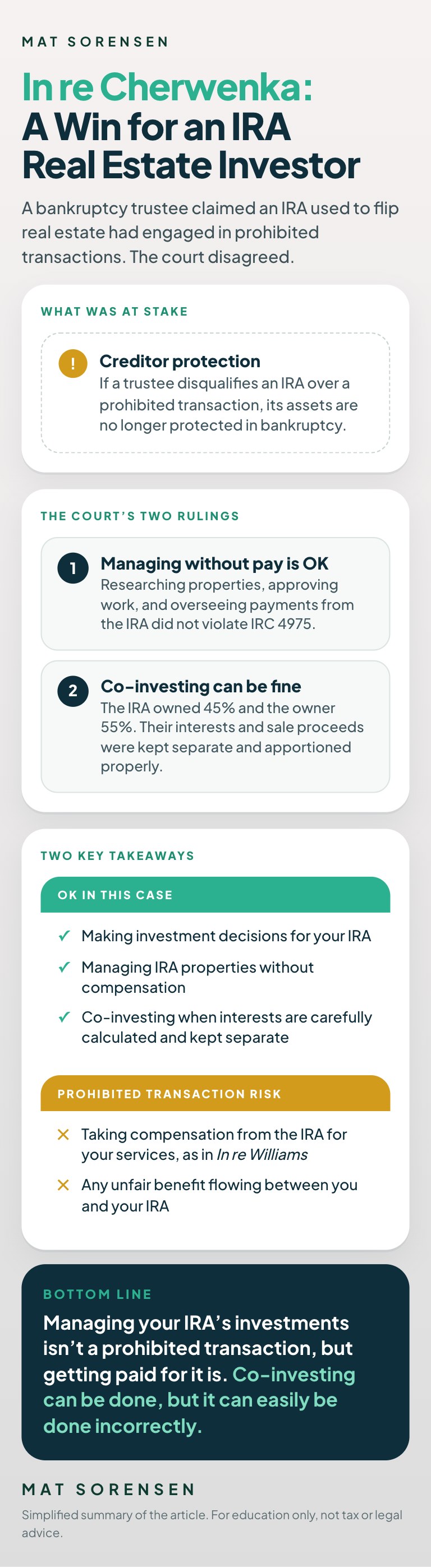
A recent Bankruptcy Court decision dealt with prohibited transaction claims against a self directed IRA owner who was using their IRA to flip real estate for profit. The claims were brought by a bankruptcy trustee who argued that the protected IRA was no longer an IRA because it engaged in a number of prohibited transactions. If the trustee is successful in disqualifying the retirement account because of a prohibited transaction, then the funds and assets held in such retirement account are no longer protected from creditors and may be used to pay debtors involved in the bankruptcy. While most prohibited transaction cases arise in Tax Court, I’m seeing more cases on prohibited transactions in Bankruptcy Court as trustees are becoming more aggressive and as self directed IRAs are becoming more popular.

The case in question is known as In re Cherwenka, Case 13-57592-MGD (Bankr. N. D. GA 2014). The case included two important prohibited transaction analysis that are helpful to IRA owners.

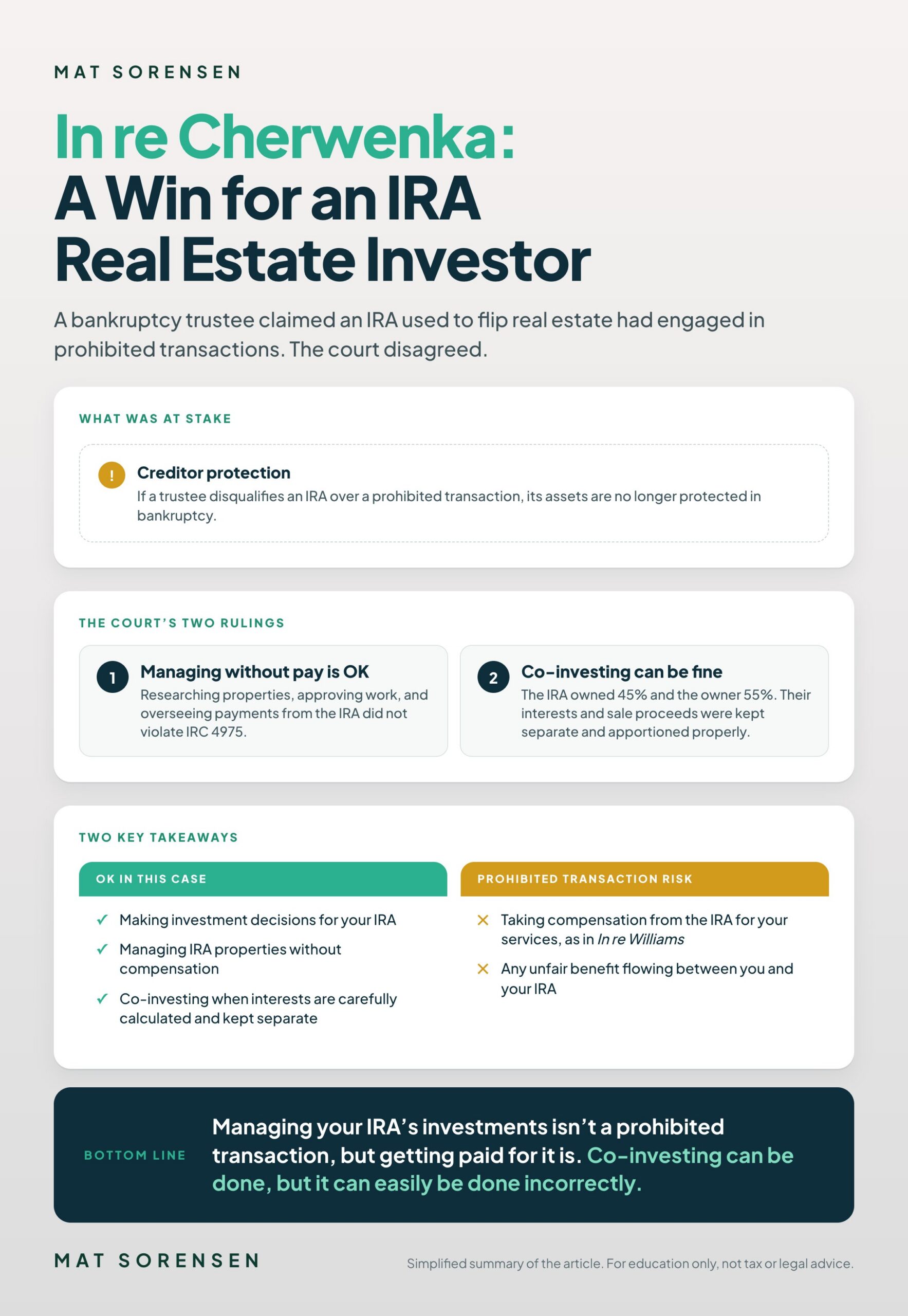
Infographic: the two prohibited transaction rulings in In re Cherwenka and key takeaways for self-directed IRA real estate investors

Court Rules No Prohibited Transaction When Managing IRA Investment Properties Without Compensation

The first significant ruling from the Court was that there was no prohibited transaction when the IRA owner completed the following tasks related to the IRA owned property.

  • ✓Research and identified properties to buy
  • ✓Appointed and approved work on the properties
  • ✓Oversaw payments on the property for work from the self-directed IRA.

The Court reasoned that these actions do not constitute a “transaction” as defined in IRC § 4975 and as a result they cannot constitute a prohibited transaction. The Court further stated that, “…self-directed IRAs as qualified IRAs, necessarily implies that a disqualified person (the owner as fiduciary) will make investment decisions regarding the plan. The Court distinguished this case from In re Williams, 2011 WL 10653865 (Bankr E.D. Cal 2011) a similar case in which the self-directed IRA owner was managing properties owned by the IRA because in Williams the IRA was paying the self-directed IRA owner for the services. The court stated that it was the payment from the IRA to the IRA owner in Williams that caused the prohibited transaction and not the mere provision of managing the IRA’s investment owned by the IRA.

Court Ruled That No Prohibited Transaction Occurred When IRA and Owner Invested Into Property Together

The second significant ruling from the Court was that there was no prohibited transaction when the IRA owner and the IRA co-invested into a property together. The property in question was owned 45% by the IRA and 55% by the IRA owner. The Court rejected the bankruptcy Trustee’s argument that such co-investment purchase resulted in a prohibited transaction and stated that the interests appeared to have been treated distinctly and that the HUD documents from the sale of the property show that the IRA and the IRA owner’s proceeds from the sale were treated separately and that they were apportioned properly. As a result, the Court concluded that no prohibited transaction occurred since there was no evidence of unfair benefit between the IRA owner and his IRA. In its reasoning, the Court referenced DOL Opinion 2000-10A which addressed an IRA and the IRA owner co-investing into a partnership. In the Opinion the DOL states that, “a violation of section 4975 (c)(1)(D) or (E) will not occur merely because the fiduciary [IRA owner] derives some incidental benefit from the transaction involving IRA assets.” The Court referenced this opinion and stated that unless there is evidence of some unfair benefit that no prohibited transaction occurred merely because of co-investment into the same property.

Key Takeaways for Investors

There are two key take-aways for self-directed IRA investors from this case.

First, never take compensation or payment from the IRA for services rendered. It is clear that the Courts will find a prohibited transaction if you do and that you will no longer have an IRA.

Second, if you are buying property or other assets (e.g. LLC interests) between your IRA and yourself personally (or another disqualified person) those interests must be carefully calculated and treated such that there is no benefit going unfairly between the IRA and the disqualified person (e.g. IRA owner). In sum, get advice and plan carefully as there are many land-mines you could encounter when investing IRA funds with your own personal funds. Bottom line, it can be done but it can easily be done incorrectly.

FREE REAL ESTATE IRA GUIDE

Learn how to buy rental property and other real estate with your IRA, and how to avoid prohibited transactions.

Get the Free Real Estate IRA Guide

Prefer to talk it through? Book a call with a Directed IRA specialist
IRAs and the UBIT/UDFI Tax Exception for REITs

An IRA may invest into a real estate investment trust. Real estate investment trusts (“REIT”) are trusts whereby the company undertakes certain real estate activities (e.g. own or lend on real estate) and returns profits to its owners. An IRA may invest and be an owner in a REIT. As many self directed IRA investors know,  a form of unrelated business income tax (“UBIT” tax) known as unrelated debt financed income tax (“UDFI” tax) can arise from real estate leveraged by debt.

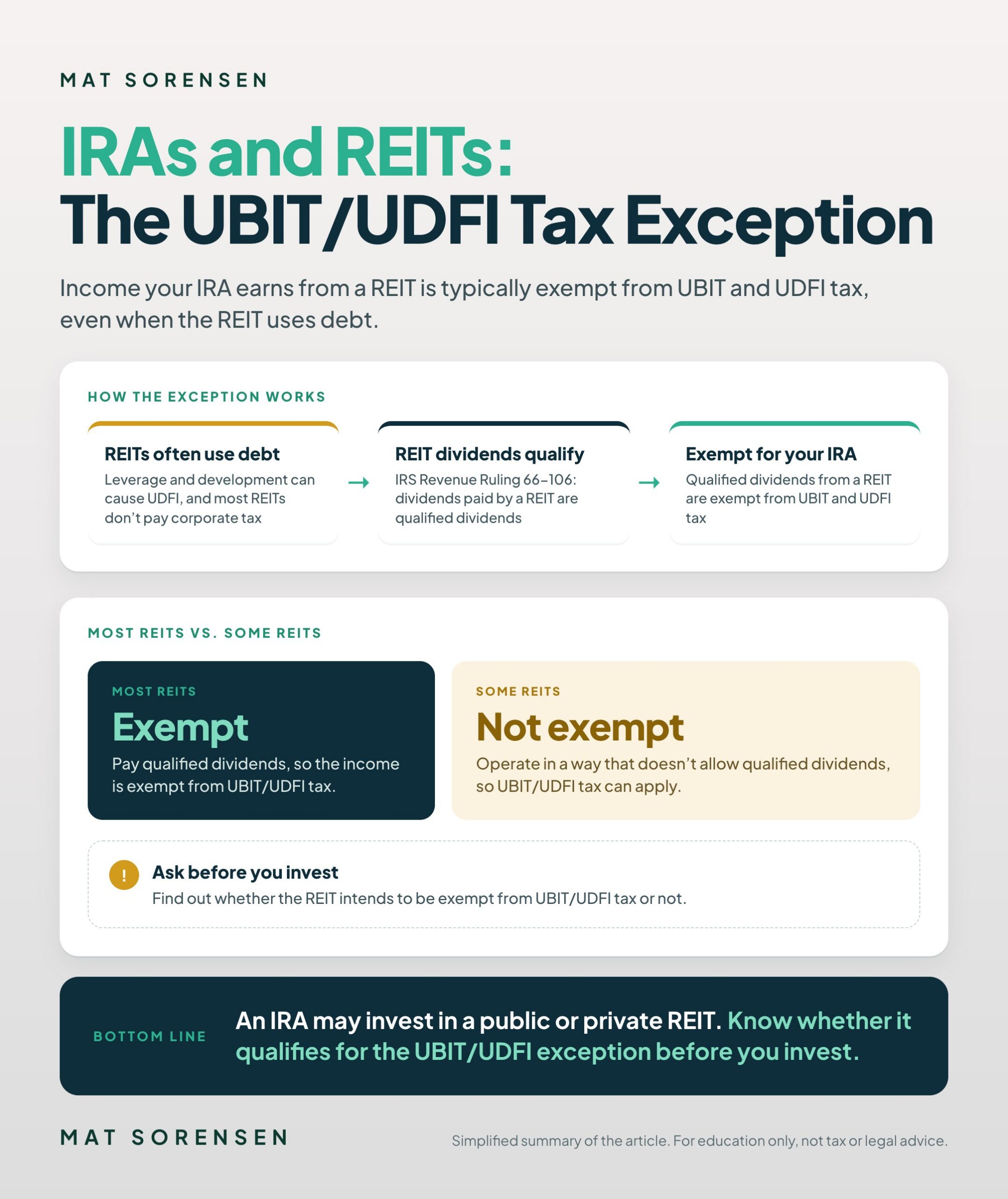
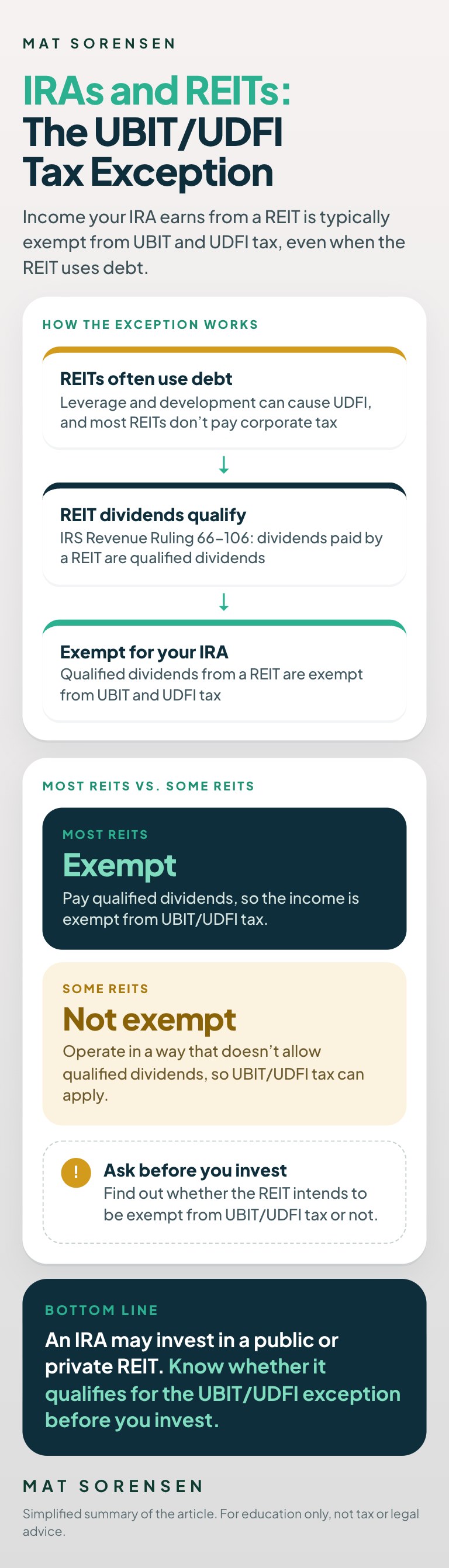
Infographic: why REIT dividends paid to an IRA are usually exempt from UBIT and UDFI tax, and when they may not be

Why REIT Income Is Usually Exempt

Many REITs engage in real estate development activities and/or use debt to leverage their cash purchasing power and as a result may cause a form of UBIT tax known as UDFI tax to IRA owners. Most REITS will not pay corporate taxes and as a result will not be considered exempt from UBIT tax as a result of having paid corporate tax. However, income from REITs is still typically exempt from UBIT and UDFI tax because the definition of a “qualified dividend” in a REIT has been defined to include dividends paid by a REIT to its owners. IRS Revenue Ruling 66-106. Qualified dividends from a REIT are exempt from UBIT and UDFI tax.

REITs can be publicly traded or private trusts but are not easy to establish. They require at least 100 owners and must distribute at least 90% of their taxable earnings to their owners each year.

When the REIT Exception May Not Apply

Despite the general application of exception to UBIT/UDFI tax for REITs, a REIT may be operated in a manner that will not allow for qualified dividends to be paid and therefore income from the REIT would not be exempt from UBIT/UDFI tax.

KEY TAKEAWAY

If you’re investing into a REIT with an IRA, make sure you know whether the REIT intends to be exempt from UBIT/UDFI tax or not. As discussed, most will be exempt from UBIT/UDFI tax but some REITs may choose to operate in ways that will not qualify for the exception.

Because UBIT/UDFI tax is about 39% at $10,000 of annual income this is something every IRA should understand before investing into a REIT.

UPDATE (NOV 2026)

UBIT/UDFI is taxed at trust tax rates. For 2026, the top rate is 37%, on taxable income above $16,000. (Source: AAII; IRC 511(b))

THE SELF-DIRECTED IRA HANDBOOK

Mat’s best-selling guide to the rules: prohibited transactions, UBIT, IRA/LLCs, and the mistakes to avoid.

Get the Free Handbook

Prefer to talk it through? Book a call with a Directed IRA specialist