Asset Protection for Your Self Directed IRA

Many self directed IRA investors misunderstand or are unaware of the protections afforded to their IRA (Roth or traditional) as it relates to creditors and judgments. This article seeks to address the key areas of the law that every self directed IRA investor should know.

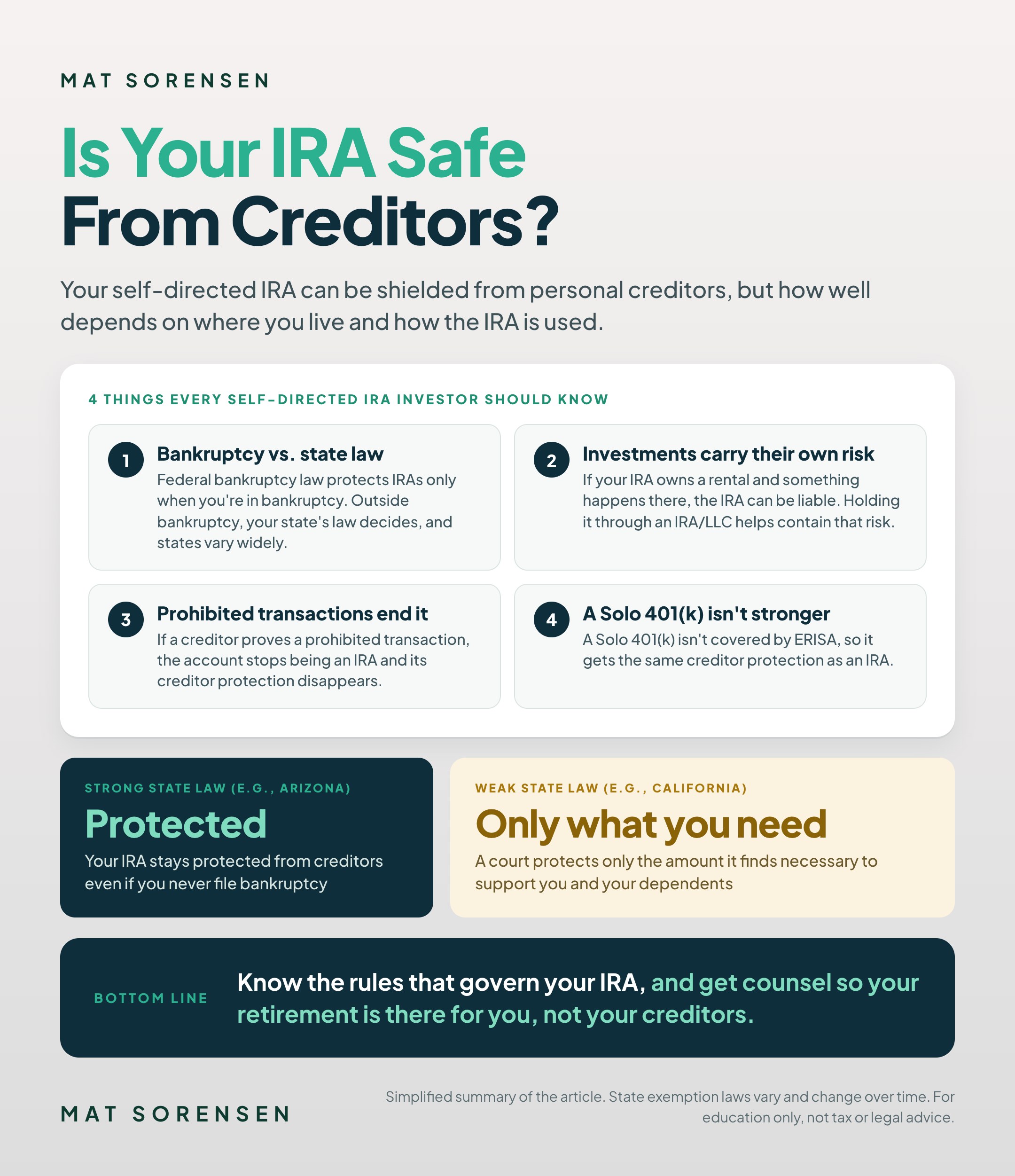
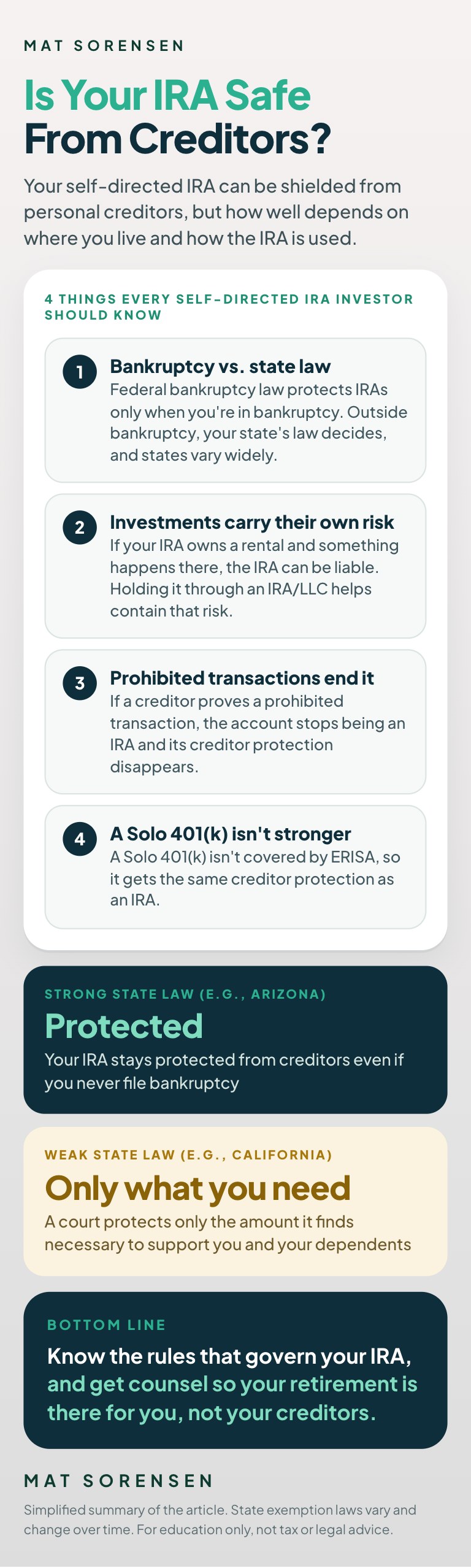
Infographic: four things every self-directed IRA investor should know about creditor protection. Bankruptcy vs. state law, liability inside IRA investments, prohibited transactions, and Solo 401(k)s

Bankruptcy Protection vs. State Law

First, your IRA is not always exempt from creditors up to $1Million. Many IRA owners believe that federal law protects their IRA from creditors up to $1M. While Section 522(n) of the federal bankruptcy code protects an IRA owner’s IRA from creditors up to $1M, this protection is only provided to IRAs when an account owner is in bankruptcy. If the IRA owner is not in bankruptcy then the creditor protections are determined by state law and the laws of each state vary. For example, if you are a resident of Arizona then your IRA is still protected from creditors up to $1M even without filing bankruptcy. The approach Arizona takes is the most common, however, many states protections for IRAs outside of bankruptcy are extremely weak. For example, if you are a resident of California then your IRA is only protected in an amount necessary to provide for the debtor and their dependents. That’s a pretty subjective test in California and one that makes IRAs vulnerable to creditors. If your California IRA is from a rollover of a company plan, you may have other protections. California residents should check out my prior article here.

Liabilities Inside Your IRA’s Investments

Second, while your IRA can be exempt from your personal creditors, as explained above, it is not exempt from liabilities that occur in the IRAs investments. For example, if your IRA owns a rental property and something happens on that rental property then the IRA is responsible for that liability (and possibly the IRA owner). As a result, many self directed IRA owners who own real estate or other liability producing assets utilize IRA/LLC’s which protect the IRA and the IRA owner from the liability of the property.

A Prohibited Transaction Removes the Protection

Third, if the IRA engages in a prohibited transaction under IRC Section 4975 then the IRA is no longer an IRA and is no longer exempt from creditors. Despite the bankruptcy and state law protections outlined in my first point above, if a creditor successfully proves that a prohibited transaction occurred within an IRA then account no longer is considered a valid IRA and therefore the protections from creditors vanish. There seems to have been an increase in creditors who are pursuing IRAs, particularly self directed IRAs, and I have been representing more and more self directed IRA owners in bankruptcy and other creditor collection actions in defending against prohibited transaction inquiries.

Solo 401(k)s Don’t Offer More Protection

Fourth, many proponents of solo 401(k)s have argued that investors are better off using a self-directed solo 401(k) plan instead of a self-directed IRA because solo 401(k)s receive ERISA creditor protection (federal law) that is better than most state law creditor protections afforded to IRAs. While it is true that ERISA plan protection is better than state law IRA creditor protection and courts have already held that while a Solo K plan is a qualified plan it is not subject to ERISA. Yates v. Hendon, 541 U.S. at 20-21. Since a Solo K plan is not subject to ERISA, its account holders cannot seek ERISA creditor protection and would instead be treated the same as IRA owners. In sum, there is no difference in creditor protection between a solo 401(k) account and a self-directed IRA. We love Solo 401(k) plans, we just aren’t setting them up instead of IRAs because of asset protection purposes.

In summary, the best way to protect your self directed IRA from creditors is to understand the rules that govern your self directed IRA and to seek counsel and guidance to ensure that your retirement is available for you and not just your creditors.

FREE CHECKBOOK IRA GUIDE

Learn how an IRA-owned LLC gives you checkbook control over your IRA investments.

Get the Free IRA/LLC Guide

Prefer to talk it through? Book a call with a Directed IRA specialist

What Not To Do With Your IRA/LLC or Checkbook Control IRA: Niemann v. Commissioner

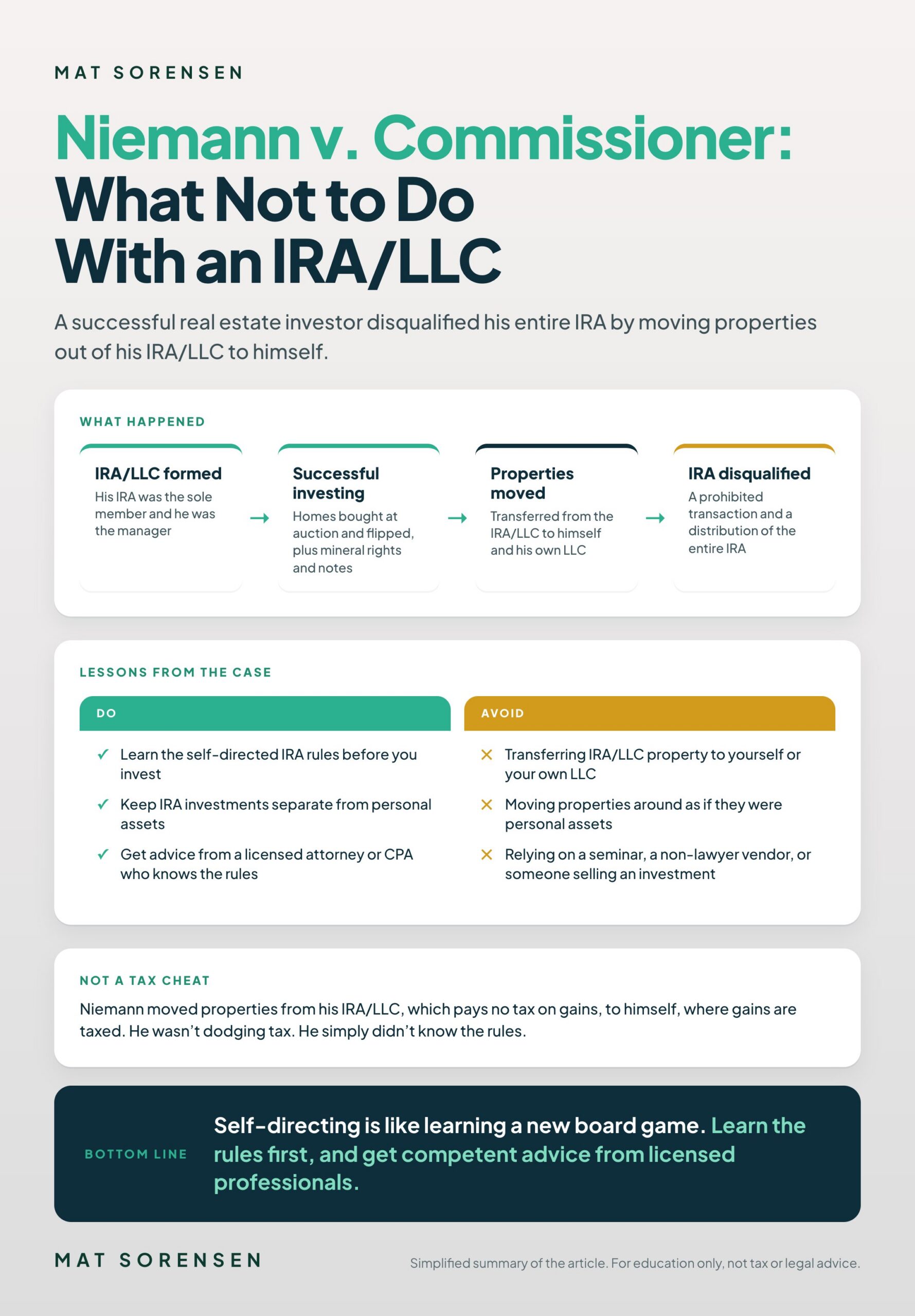
The recent case of Niemann v. Commissioner involves a successful real estate investor who unknowingly used his self-directed IRA owned LLC (aka, checkbook control IRA) in a way that caused a prohibited transaction under IRC § 4975. While the Tax Court’s holding and decision focused on other tax matters, the Court did outline the history of the case and the prohibited transactions that occurred and that disqualified Niemann’s IRA. Here are the pertinent facts regarding Niemann’s self directed IRA investments.

Infographic: how the investor in Niemann v. Commissioner disqualified his IRA/LLC, and lessons for checkbook control IRA investors

Case Facts

  • ✓Niemann formed Real Estate Rabbit, LLC with his IRA as the sole member and himself as manager.
  • ✓Niemann used Real Estate Rabbit, LLC for numerous real estate investments including buying homes at auction and flipping them for a profit. Real Estate Rabbit, LLC also bought mineral rights investments and held notes.
  • ✓Niemann personally engaged in real estate investments in his own name and in the name of an LLC he personally owned called Magic, LLC. Niemann intended for Magic, LLC to be a multi-member LLC to be owned by himself, his personal LLC, and his IRA/LLC. This LLC was not properly established nor was it properly operated. He learned about it from a seminar and engaged a non-lawyer (“vendor”) to set up the LLC.
  • ✓Niemann transferred properties from his Real Estate Rabbit, LLC (his IRA/LLC) to himself personally and to his personally owned LLC. These transfers caused a prohibited transaction and resulted in the entire distribution of Niemann’s self directed IRA.

It is quite clear from the case and from the Court’s analysis that Niemann was not intending to unfairly avoid tax nor was he attempting to improperly engage in a prohibited transaction. In fact, his real estate transactions were very successful. And if you were a successful real estate investor looking to illegally avoid taxes, you wouldn’t transfer properties from your IRA owned LLC (that pays no taxes on gains) to yourself personally (where you do pay taxes on the gains). If you were a tax cheat, you’d do the opposite and would transfer properties with gains from yourself personally to your IRA. It is quite clear instead, that Niemann was unaware of the rules and as a result he moved his real estate investments around between his LLCs and his personal name as he would with any property he owned. These transfers were made without regard to IRA rules which require IRA investments to be held separately from personal assets and which restrict transactions between the IRA (and IRA/LLC) and the IRA owner personally.

Niemann conceded with the Court and the IRS that he engaged in a prohibited transaction when his IRA owned LLC (Real Estate Rabbit, LLC) transferred property to himself personally and to his personally owned LLC.

Learn the Rules and Seek Out Qualified Licensed Professionals

This case illustrates a critical point that self-directed IRA investors must first become acquainted with the self-directed IRA rules before they enter into real estate, LLC, or other transactions with their IRA. Niemann was a successful investor and a former engineer but he either received poor advice or he sought no professional legal or tax advice in the process.

Learning how to self-direct your IRA is like learning a new board game. At first, it takes some time to learn what you can and cannot do but once you understand the rules for the investments you intend to make it becomes second nature and you can proceed without having to consult the “rulebook” or a lawyer, or CPA, or other licensed advisor. So, if you’re new to self directing your IRA, make sure you’ve received competent advice from licensed professionals. Don’t rely on something you’ve heard at a seminar or by someone trying to sell you an investment. Instead, seek a specific consult with a licensed attorney or CPA who is competent in the rules affecting your self-directed IRA.

FREE CHECKBOOK IRA GUIDE

Learn how an IRA-owned LLC gives you checkbook control over your IRA investments.

Get the Free IRA/LLC Guide

Prefer to talk it through? Book a call with a Directed IRA specialist

Correcting Your IRA’s RMD Failures and Avoiding the Penalty

If you failed to take required minimum distributions (RMD’s) from your IRA, then you are subject to a 25% penalty (10% if corrected within two years). The penalty is 25% on the amount you should have distributed from your IRA to yourself. It’s a steep penalty for simply failing to pay yourself from your own IRA and it’s something every IRA owner with RMD needs to understand. For my prior article explaining RMD rules for IRAs, please click here.

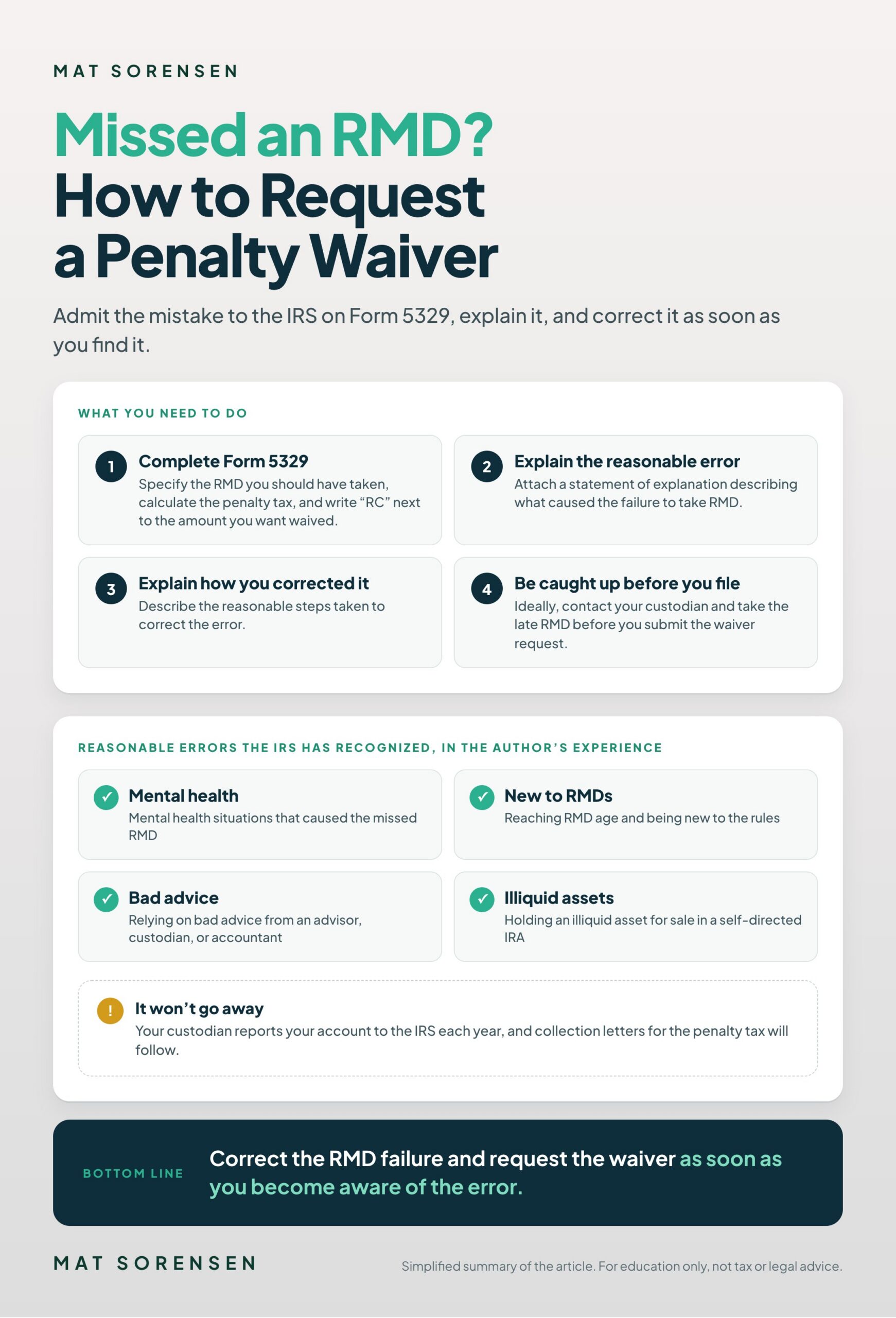
Infographic: the steps to request an IRS waiver of the missed RMD penalty on Form 5329, and examples of reasonable errors

Waiver of the Penalty Tax

UPDATE (NOV 2026)

The penalty for a missed RMD is now 25% of the amount not taken, or 10% if you correct it within two years. It was 50% when this article was written. (Source: IRS)

If you’ve failed to take RMD for your IRA, you have a chance at obtaining a waiver from the penalty but you must admit the mistake to the IRS by filing IRS form 5329. In the instructions to form 5329, the IRS outlines the waiver process to avoid the 50% penalty tax.

What You Need to Do

  1. 1Complete Section IX of Form 5329. You need to specify what you should have taken as RMD  and then you calculate the penalty tax due. You then write the letters “RC” next to the amount you want waived on line 52.
  2. 2Statement of Explanation. Attach a Statement of Explanation outlining two items.
    1. First, explain what was the “reasonable error” that caused a failure to take RMD. The IRS does not provide a definition or acceptable examples of “reasonable error”. See IRC 4974(d)(1). From my own experience and from examples I’ve heard from colleagues, the IRS does recognize reasonable errors and oversights in most situations where there is reason for the error. This would include situations such mental health, to turning 73 and being new to RMD, to relying on bad advice from an advisor, custodian or accountant, to holding an illiquid asset for sale in a self directed IRA.
    2. Second, explain the reasonable steps taken to correct the error. Ideally, by the time you’re filing the exemption request you would’ve already contacted your IRA custodian and would’ve taken the late RMD so that by the time you submit the RMD penalty tax waiver, you would be caught up and would have already remedied the error.  This makes for an easy and clean explanation of what steps you’re going to take as your explanation will be that you already corrected the RMD failure once you realized the error.

WATCH OUT

Keep in mind that RMD failures won’t go away as your IRA custodian will be updating your account each year with the IRS. Eventually, you’ll start getting collection letters from the IRS requesting the penalty tax. Consequently, IRA owners are well advised to correct the RMD failure and request the waiver as soon as they become aware of the error or oversight.

FREE SELF-DIRECTED IRA GUIDE

Learn how to invest your IRA in real estate, private companies, notes, precious metals, and more.

Get the Free Self-Directed IRA Guide

Prefer to talk it through? Book a call with a Directed IRA specialist

Who are Self Directed IRA Investors? An Essay

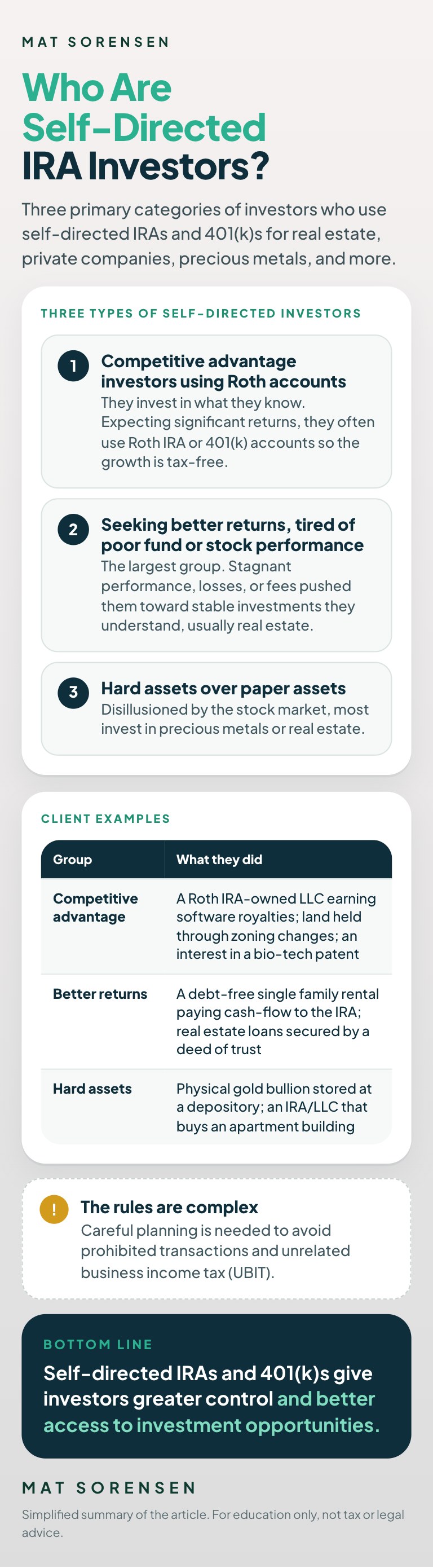
I was recently interviewed and asked, “what has caused so many investors to self-direct their retirement plan?” As many people know, self-directed retirement plan investors use their self-directed IRA and 401(k)s to invest into real estate, private companies, precious metals and other “non-wall street” investments. I’ve worked with thousands of self-directed IRA and 401(k) investors and as I reflected on the question, I realized that there are three primary categories of self-directed investors.

Infographic: the three primary categories of self-directed IRA and 401(k) investors, with client examples from the article

I. Competitive Advantage Investors Using Roth Accounts

These investors like to invest in what they know. They avoid mutual funds and the stock market because they have a competitive advantage over other investors and usually have a special expertise over other investors. Because they have a special expertise, they often expect to make significant returns and therefore will frequently use Roth IRA or 401(k) accounts for their investments. Let me offer a few examples from actual un-named clients of mine that all resulted in 7 figure returns.

CLIENT EXAMPLE

Software Engineer. Software Engineer who used Roth IRA funds along with some other technology savvy investors and funded an LLC. This LLC then engaged and paid some un-related developers to develop new programming that the Roth IRA investors knew would have value. The LLC owned by the Roth IRAs then in turn negotiated a royalty agreement with an unrelated company who wanted the technology to be used in a specific software program that it would sell commercially. The LLC receives royalties on the use/sales of the product. The income goes back to the Roth IRAs tax free.

CLIENT EXAMPLE

Real Estate Developer. Real estate developers and investors personally develop millions of dollars of real estate a year and decides to use his Roth IRA to fund a specific real estate investment. Real estate developer converted a couple hundred thousand dollars of traditional IRA funds to Roth IRA funds so that he could acquire a specific piece of real estate that was to be held and later sold. The developer knows the land would have significant value over the next few years as a result of zoning law changes and planned development from neighboring property. The Roth IRA paid for some paper development zoning changes upon acquisition and then held the property as an investment for a few years. The property later increased nearly 10 times in value as neighboring development took off.

CLIENT EXAMPLE

Bio-Tech Start-Up Entrepreneur. An experienced bio-tech investor had an opportunity to invest at early stages in a patent that was going to be the basis for a new bio-tech start-up. The investor used Roth IRA funds and funded additional research costs in exchange for an interest in the patent that was being developed by un-related researchers for commercial purposes. The patent was the basis of value for a start-up venture and the Roth IRA received a significant share of the company in exchange for the patent interest.

This group would also include former Republican Party Nominee, Mitt Romney, and famous Venture Capitalist, Peter Thiel, whose large self-directed IRAs have been reported on extensively.

Keep in mind, the rules for these investments are complex and careful planning must be taken to avoid prohibited transactions, as well as unrelated business income tax (UBIT). However, when properly executed with the right investment, this group can sock away significant returns in tax-free Roth accounts. There’s no better deal in the tax code than this!

II. Seeking Increased Returns and Tired of Poor Fund or Stock Performance

This is the largest group of self directed IRA investors. These investors have seen stagnant performance, losses, or ridiculous fees eat away at their retirement account. They are generally tired of the ups and downs of the stock market and want stable investments they can actually understand. This group usually invests in real estate, in its various forms, because it can offer more stable returns and because the investor can actually understand the investment (something they can’t do from a 100 page mutual fund prospectus). Here are a couple of actual client examples.

CLIENT EXAMPLE

Retired Corporate Manager Becomes a Real Estate Investor. A retired real estate investor client of mine rolled over former employer 401(k) funds to a traditional self-directed IRA. This investor is in their early 60’s and uses the income from her retirement account to live on. She invested her traditional IRA into a modest 3 bd 2 bth single family rental. The property has no debt and the cash-flow goes back into her IRA. She routinely takes distributions of the cash-flow to supplement her retirement income. Since this is a traditional IRA she is taxed on the distributions (as she would with any traditional IRA) but she is not reducing the actual investment value of the IRA as she only distributes the cash-flow. This client has had an increase in confidence as the rental income has proven to be consistent over time and she still knows that her IRA owns the property so she doesn’t feel like she’s depleting her retirement account when she takes distributions of the cash-flow. Frankly, I’ve talked to hundreds if not thousands of clients in a scenario similar to this.

CLIENT EXAMPLE

Real Estate Broker Loans Solo 401(k) Funds to Other Investors. This real estate broker uses his self-directed 401(k) to loan money to real estate investors buying investment properties. Some people refer to these loans as hard money loans or as trust deed loans. The 401(k) will loan funds to other real estate investors in situations where banks are typically un-willing to lend. The real estate broker lends to properties in markets that he knows and receives a first or second place deed of trust (mortgage) securing his loan. The typical loan terms are 10% annual interest with 2 points. This self-directed investor knows real estate and has been able to receive annual returns far in excess of the stock market.

III. Hard Assets Over Paper Assets

These investors value hard assets over paper assets. They are generally disillusioned by the stock market and feel that price to earnings ratios of publicly traded companies have sky-rocketed without regard to company performance. They tend to believe that stock prices have nothing to do with actual value but instead are propped up by the Wall Street money machine. They’ve usually had retirement accounts for years and have seen their account go through the dot-com bubble and the financial crisis. They have little faith in paper assets and desire to move to a self-directed account at a time when they believe the market is going to collapse. Most of these investors will invest in precious metals or real estate.

CLIENT EXAMPLE

Retired Corporate 401(k). A retired corporate employee rolls over a portion of his prior employer’s 401(k) to a self-directed IRA and buys actual precious metals that are stored at a depository for his IRA. The precious metals are not an ETF or a fund but are actual, physical, gold bullion that meets the retirement plan rules for ownership by an IRA. Common precious metals would be gold or silver bullion as well as specifically approved American Eagle coins.

CLIENT EXAMPLE

Working Corporate Employee with Prior Employer 401(k). A 50 year old corporate employee uses her present employer retirement plan for standard mutual fund investments based on risk factors and tolerances for investors her age. Her current employer’s plan cannot be self-directed but she rolls over a prior employer’s 401(k) to a self-directed IRA and uses that self-directed IRA to invest in real estate investments with other like-minded investors. The investors use their self directed IRAs and each invest into the newly created IRA/LLC (an LLC owned by IRAs). The LLC then uses the combined funds to purchase a multi-family property. In the end, her IRA owns a 20% interest in an LLC that owns an apartment building.

There are many other characteristics of self-directed investors and even more examples of these groups in the industry. However, the three groups above seem to capture 90% of the growing self-directed retirement plan market. Additionally, many investors have cross over and identify in two or all three of these groups. Because self-directed IRAs and 401(k)s give investors options for greater control and because they provide better access to investment opportunities, we will only continue to see growth in the self-directed retirement plan market.

FREE SELF-DIRECTED IRA GUIDE

Learn how to invest your IRA in real estate, private companies, notes, precious metals, and more.

Get the Free Self-Directed IRA Guide

Prefer to talk it through? Book a call with a Directed IRA specialist

By: Mat Sorensen, Attorney and best-selling Author of The Self Directed IRA Handbook

Mat Sorensen

Mat has been at the forefront of the self-directed IRA industry since 2006. He is the CEO of Directed IRA & Directed Trust Company where they handle all types of self-directed accounts (IRAs, Roth IRAs, HSAs, Coverdell ESA, Solo Ks, and Custodial Accounts) which are typically invested into real estate, private company/private equity, IRA/LLCs, notes, precious metals, and cryptocurrency. Mat is also a partner at KKOS Lawyers and serves clients nationwide from its Phoenix, AZ office.

He is published regularly on retirement, tax, and business topics, as well as a VIP Contributor at Entrepreneur.com. Mat is the best-selling author of the most widely used book in the self-directed IRA industry, The Self-Directed IRA Handbook: An Authoritative Guide for Self-Directed Retirement Plan Investors and Their Advisors.
California Rollover IRAs Can Receive ERISA-Style Creditor Protection

Have you rolled over your 401(K) plan or other employer based plan to a rollover IRA? Has someone told you that your rollover IRA in California isn’t protected from creditors. They’re wrong.

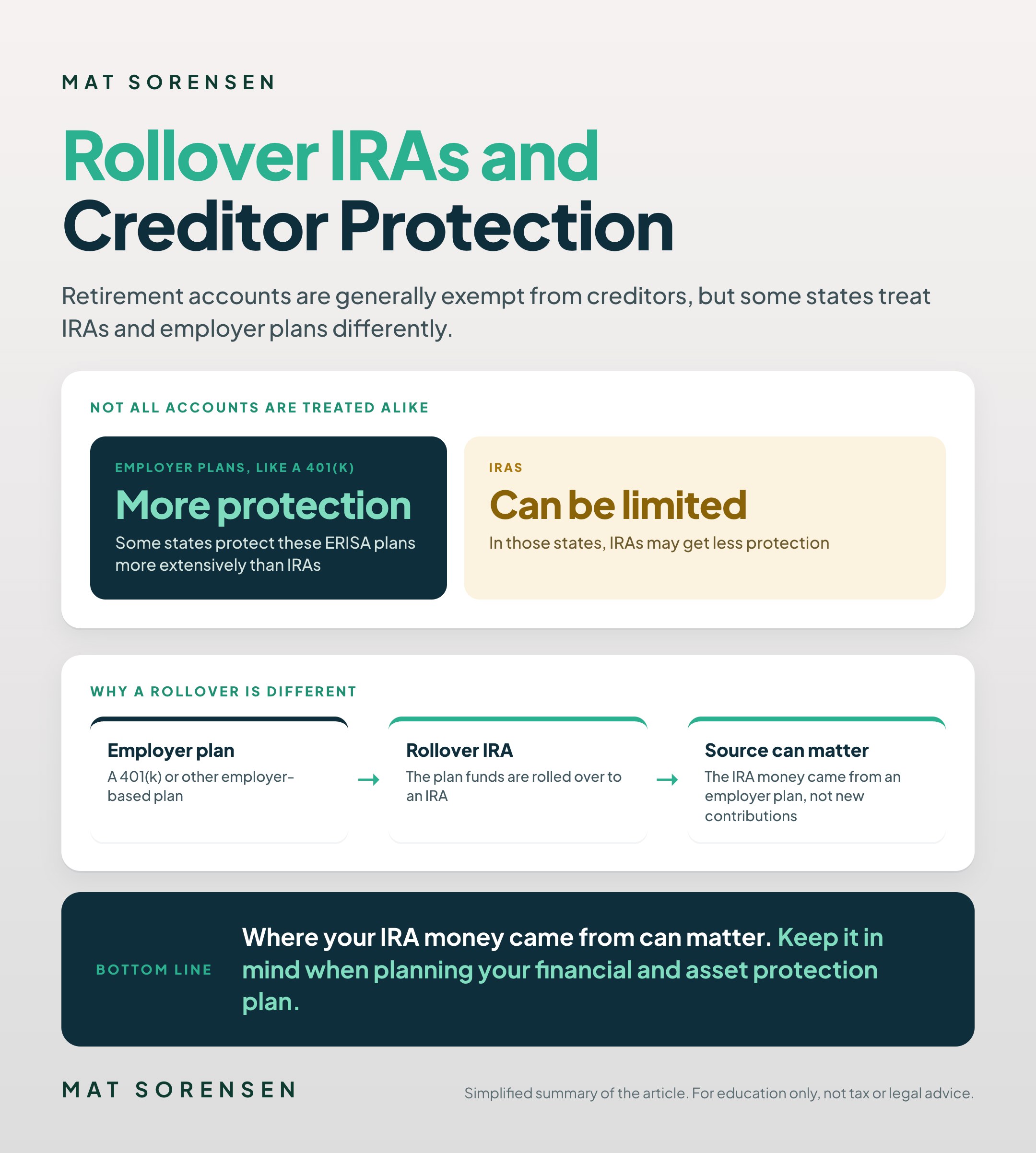
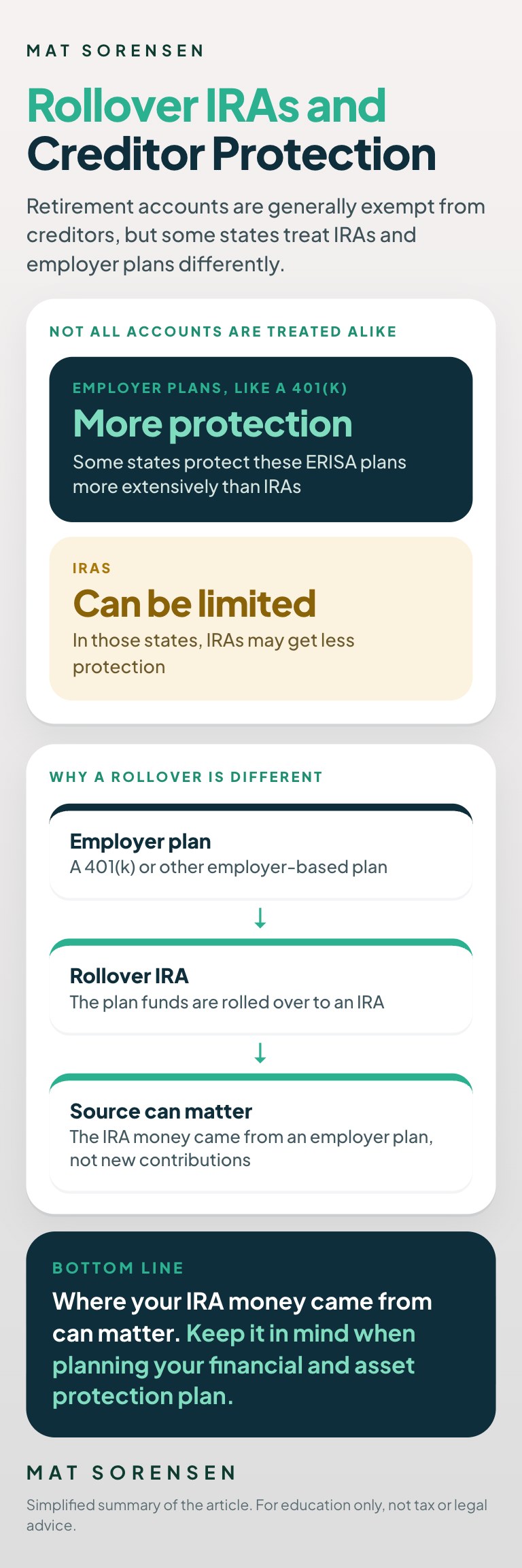
Infographic: retirement accounts are generally exempt from creditors, but some states protect employer plans like a 401(k) more than IRAs, and a rollover IRA holds money that came from an employer plan

California Exemptions

Retirement plans are known for being great places to build wealth and they have numerous tax and legal advantages. One of the key benefits of building wealth in a retirement account is that those funds are generally exempt from creditors. However, some states have laws that protect employer based retirement plans (aka, ERISA Plans) more extensively than IRAs. California is one of those states as their laws treat IRAs and ERISA based plans differently (the California Code refers to ERISA based plans, such 401(k)s, as private retirement plans) .

California Code of Civ. Proc., § 704.115, subds. (b),(d), treats funds held in a private retirement plan as fully exempt from collection by creditors. “Private retirement plans” include in their definition “profit-sharing” plans. The most common type of profit sharing plan is commonly known as a 401(k) plan.

IRAs, on the other hand, are only exempt from creditors up to an amount “necessary to provide for the support of the … [IRA owner, their spouse and dependents] … taking into account all resources that are likely to be available…” In other words, the exemption protection for IRAs is “limited”. California Code of Civ. Proc., § 704.115, subdivision (e).

McMullen v. Haycock

Notwithstanding the limited creditor protections for IRAs outlined above, the California Court of Appeal has ruled that rollover IRAs funded from “private retirement plans” receive full creditor protection as if they were a fully protected private retirement plan under California law. McMullen v. Haycock, 54 Cal.Rptr.3d 660 (2007). In McMullen v. Haycock, McMullen had a judgement against Haycock for over $500,000.  McMullen attempted to get a writ of execution against Haycock’s IRA at Charles Schwab. In defending against the writ of execution, Haycock claimed that the entire IRA was a rollover IRA funded and traceable to a private retirement plan and thus fully protected from collection as a private retirement plan. Haycock relied on California Code of Civ. Proc., § 703.80, which allows for the tracing of funds for purposes of applying exemptions.

Haycock lost at the trial court level but appealed and the appellate court found in his favor and ruled that his rollover IRA was fully protected from the collection of creditors as the funds in the rollover IRA were traceable to a fully exempt private retirement plan (e.g. former employer’s 401(k) plan).

As a result of McMullen v. Haycock, California IRA owners whose IRAs consist entirely of funds rolled over from a private retirement plan of an employer are fully protected from the collection efforts of creditors. IRAs that consist of individual contributions and are not funded from a prior employer plan rollover will only receive limited creditor protection. It is unclear so far how an IRA would be treated that consists of both private retirement plan rollover funds and new IRA contributions. Presumably, the Courts will trace the funds and separate out the private retirement plan rollover IRA portions from the regular IRA contributions and the regular IRA contributions would then receive the limited protection. Unfortunately, there is no case law or guidance yet as to rollover IRAs with mixed rollover and regular IRA contributions.

McMullen v. Haycock was a big win for IRA owners with funds rolled over from a private retirement plan and one that should be kept in mind when planning your financial and asset protection plan.

FREE ROLLOVER GUIDE

Learn how to move an old 401(k) or IRA into a self-directed IRA, tax-free.

Get the Free Transfers & Rollovers Guide

Prefer to talk it through? Book a call with a Directed IRA specialist