Distributions from Your Retirement Account: The Top Ten List

by Mat Sorensen | Aug 13, 2018 | Uncategorized

I’m routinely asked questions about what taxes and rules apply when a distribution occurs from a retirement account. Here are the top ten rules you should know about distributions from retirement accounts:

Infographic: key tax rules for taking distributions from traditional IRAs and 401(k)s and from Roth accounts

The first 5 facts apply to Traditional IRA and 401(k) accounts

1. Early Withdrawal Penalty

A distribution from a traditional IRA or 401(k) before the account owner reaches 59 1/2 causes a 10% early withdrawal penalty on the amount distributed. This is in addition to taxes owed on the amount distributed.

EXAMPLE

So, for example, if you take a $10,000 distribution from your traditional IRA at age 45 then you will be subject to a $1,000 penalty and you will also receive a 1099-R from your IRA custodian and will need to report $10,000 of income on your tax returns.

$1,000

early withdrawal penalty

$10,000

income to report

Once you reach age 59 1/2, the 10% early withdrawal penalty does not apply.

2. Required Minimum Distributions

Whether you need the money or not, at age 70 1/2, the IRS requires a traditional IRA or 401(k) owner (unless still employed by employer 401(k)) to begin taking distributions from their retirement account. These distributions are subject to tax and the account owner will receive a 1099-R of the amount distributed that will be included on their tax return. The amount of the distribution is based on the person’s age and the account’s value. For example, someone with a $100K IRA who has turned 70 1/2 and is taking their first RMD would take $3,639 (3.79%).

UPDATE (NOV 2026)

Required minimum distributions now start at age 73 (rising to 75 in 2033) under the SECURE 2.0 Act. This article was written when they started at 70½. (Source: IRS)

3. Avoid Taking Large Distributions In One-Year

Because distributions from traditional retirement accounts are subject to tax at the time of distribution, it is wise to avoid taking too much in one year as a large distribution can push your distribution income and your other income into a higher tax bracket.

EXAMPLE

For example, if you have employment and or rental/investment income of $50,000 annually then you are in a joint income tax bracket of 15% on additional income. However, if you take $100,000 as a lump-sum that year this will push your annual income to $150K and you will be in a 28% income tax bracket. If you could instead break up that $100K over two tax years then you could stay in 15% to 25% tax bracket and could reduce your overall tax liability.

In short, only pull out what you need when you need it to lessen the immediate year’s tax liability.

4. Distribution Withholding

Most distributions from an employer 401(k) or pension plan (including solo K), before the age of 59 1/2, will be subject to a 20% withholding that will be sent to the IRS in anticipation of tax and penalty that will be owed. In the case of an early distribution from an IRA, a 10% withholding for the penalty amount can be made but you can also elect out of this automatic withholding provided you make an estimated tax payment or that you will otherwise be current on your tax liability.

5. If You Have Tax Losses, Consider Converting to a Roth IRA or Roth 401(k)

When you have tax losses on your tax return you may want to consider using those losses to offset income that would arise when you convert a traditional IRA or 401(k) to a Roth account. Whenever you convert a traditional account to a Roth account, you must pay tax on the amount of the conversion. In the end though, you’ll have a Roth account that grows entirely tax-free and that you don’t pay taxes on when you distribute the money. Using the losses when they are available is a good way to get your Traditional retirement funds over to Roth.

The final 5 rules are for Roth IRAs and Roth 401(k)s

6. Roth IRAs Are Exempt from RMD

While traditional IRA owners must take required minimum distributions (“RMD”) when the account owner reaches age 73, Roth IRAs are exempt from RMD rules. That’s a great perk and allows you to keep your money invested as long as possible.

7. Roth 401(k)s Must Take RMD

UPDATE (NOV 2026)

Since 2024, Roth 401(k) and Roth 403(b) accounts no longer require RMDs during the owner’s lifetime (SECURE 2.0 Act). The section below describes the rules before that change. (Source: IRS)

Roth 401(k) designated accounts are subject to RMD. This is a confusing rule since Roth IRAs are NOT subject to RMD. Such is the tax code.

8. Distributions of Contributions Are Always Tax-Free

Distributions of contributions to a Roth IRA are always tax-free. Regardless of age, you can always take a distribution of your Roth IRA contributions without penalty or tax.

9. Distributions of Roth IRA Earnings

In order to take a tax-free distribution from a Roth IRA, you must be age 59 1/2 or older and you must have had a Roth IRA for five years or longer. As long as those two criteria are met, all amounts (contributions and earnings) may be distributed from a Roth IRA tax free. If your funds in the Roth IRA are from a conversion, the converted amount itself can be distributed tax-free (you paid the tax when you converted), but if you are under 59 1/2, you must have converted the funds at least 5 years ago to avoid the 10% early withdrawal penalty on that amount.

10. Delay Roth Distributions

Roth retirement accounts are the most tax efficient way to earn income in the U.S. As a result, it is best to distribute and use other funds and assets that are at your disposal before using the funds built up in your Roth account as those funds aren’t as tax efficient while invested.

FREE SELF-DIRECTED IRA GUIDE

Learn how to invest your IRA in real estate, private companies, notes, precious metals, and more.

Get the Free Self-Directed IRA Guide

Prefer to talk it through? Book a call with a Directed IRA specialist
RMDs and Solo 401(k)s: Three Quirky Rules to Know

by Mat Sorensen | Feb 27, 2018 | Retirement & IRAs, Uncategorized

All retirement account owners must be familiar with the required minimum distribution (“RMD”) rules applicable to their accounts. These rules require you, in most instances, to take partial distributions from your retirement account when you reach age 73. And, surprise, the rules for Traditional IRAs, Roth IRAs, and 401(k)s differ. In fact, even 401(k)s where you are a 5% or greater owner have different rules than 401(k)s where you aren’t an owner. Thanks, Congress.

UPDATE (NOV 2026)

Required minimum distributions now start at age 73 (rising to 75 in 2033) under the SECURE 2.0 Act, and the penalty for a missed RMD is now 25% of the amount not taken (10% if corrected within two years). This article was first written when RMDs started at 70½ and the penalty was 50%. (Source: IRS)

So what rules apply to Solo 401(k) owners? Well, generally speaking, you must begin taking distributions from your Solo K when you reach age 73. Despite what you may think or presume, there are three quirks to be aware of when it comes to RMD and Solo 401(k):

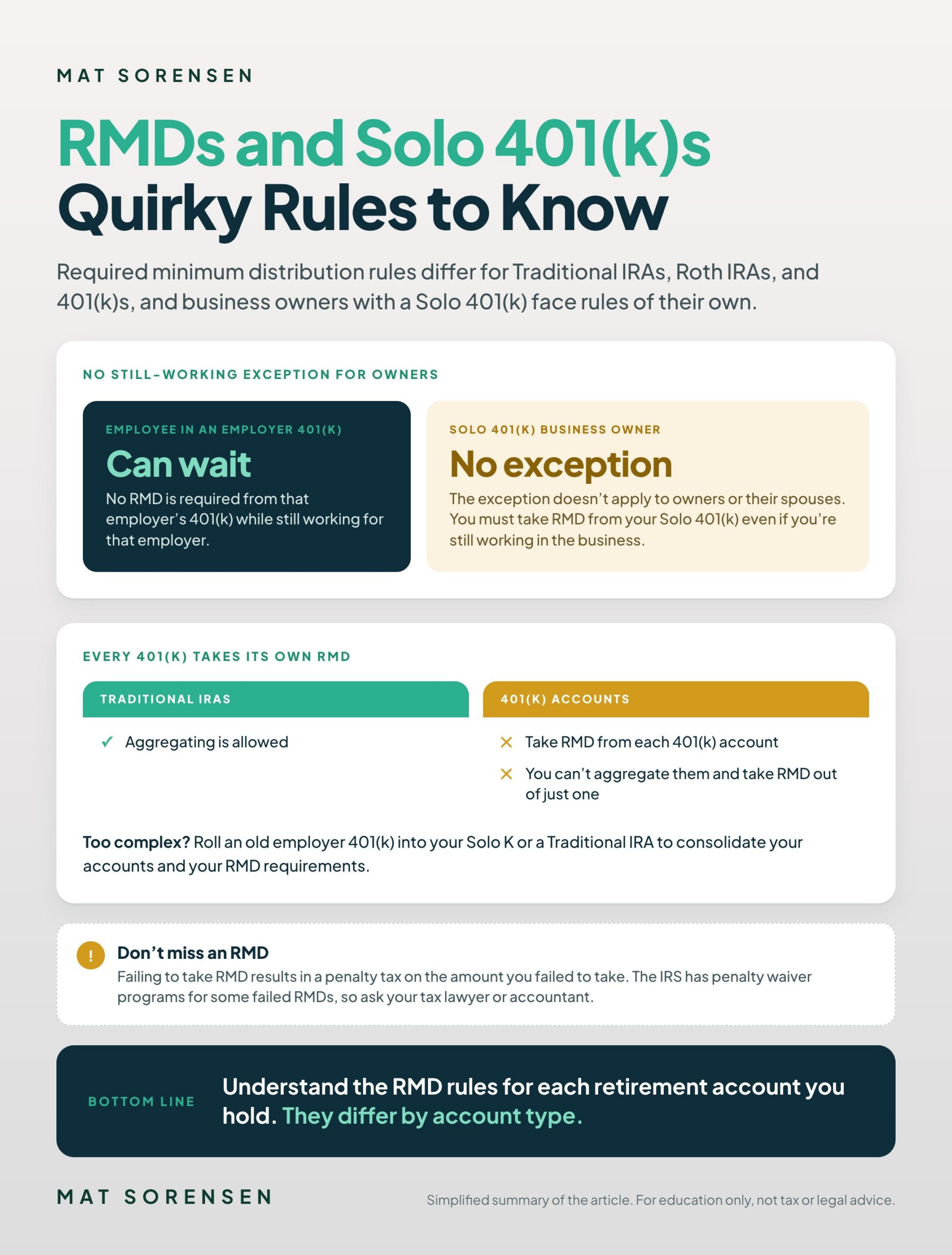
Infographic: Solo 401(k) required minimum distribution rules for business owners, including no still-working exception and no aggregating across 401(k)s

Still Working Exception Does Not Work on Solo Ks

There is a general RMD 401(k) rule which states that even after age 73, you are not required to take distributions from an employer 401(k) when you are still working for that employer. However, this exception does not apply to account holders or their spouses who own 5% or more of the company. In other words, business owners who use a Solo 401(k) will be forced to take RMD from their Solo 401(k) after age 73 even if they are still working in the business.

Roth 401(k) Funds are Subject to RMD

UPDATE (NOV 2026)

Since 2024, Roth 401(k) and Roth 403(b) accounts no longer require RMDs during the owner’s lifetime (SECURE 2.0 Act). The section below describes the rules before that change. (Source: IRS)

RMD applies to Roth 401(k)s. I know what you’re thinking, “Wait, but why would RMDs apply to Roth 401(k)s when Roth IRAs are exempt?” Because Congress said so. I know, it doesn’t make much sense, Roth 401(k) distributions at retirement will be tax-free, like Roth IRA distributions, and the IRS will not receive any revenue from the distribution so why treat Roth 401(k)s differently? There’s not a good answer, but you should write your Congressperson or Senator and ask.

Every 401(k) Must Have RMD Taken, No Aggregating

Every 401(k) account you have must take RMD.

EXAMPLE

So, for example, if you have a Solo 401(k) and a 401(k) account with an old employer then you need to take RMD from each 401(k) account. You cannot aggregate those accounts together and take RMD out of one to satisfy both RMD requirements.

This aggregating is allowed in Traditional IRAs but unfortunately does not work with different 401(k) plan accounts. If taking RMDs from multiple accounts is getting too complex, you can roll the old employer 401(k) to the Solo K or to a Traditional IRA (or Roth IRA if Roth 401(k) funds) to consolidate your accounts and your RMD requirements.

Make sure to take RMD when you are required to do so. Failure to take RMD results in a 25% penalty tax (10% if corrected within two years) on the amount you failed to take. As a result, it’s critical that you understand the RMD rules for each retirement account you hold. If you have made a mistake though, the IRS does have penalty waiver programs whereby you can correct some failed RMDs and request a waiver of the penalty due. This doesn’t work in every instance, but if you’ve failed to take RMD ask your tax lawyer or accountant on whether a penalty waiver could apply in your instance.

FREE SOLO 401(K) GUIDE

Self-employed? Learn how a self-directed Solo 401(k) works and how much you can contribute.

Get the Free Solo 401(k) Guide

Prefer to talk it through? Book a call with a Directed IRA specialist

Roth IRAs: Other Perks on Top of Tax-Free Growth

by Mat Sorensen | May 10, 2016 | Uncategorized

Many investors and financial professionals are familiar with the primary benefits of a Roth IRA: that the plan’s investments grow tax-free and come out tax-free. But if tax-free investing isn’t enough to get you excited, rest assured, there are more benefits to the Roth IRA. I’ll note just three more in this article.

Remember, Roth IRAs are for nearly everyone with earned income. They’re not restricted to high income earners. Check out my prior article here if you’re unfamiliar with the back-door Roth IRA. Okay, now let’s go over the other perks of Roth IRAs.

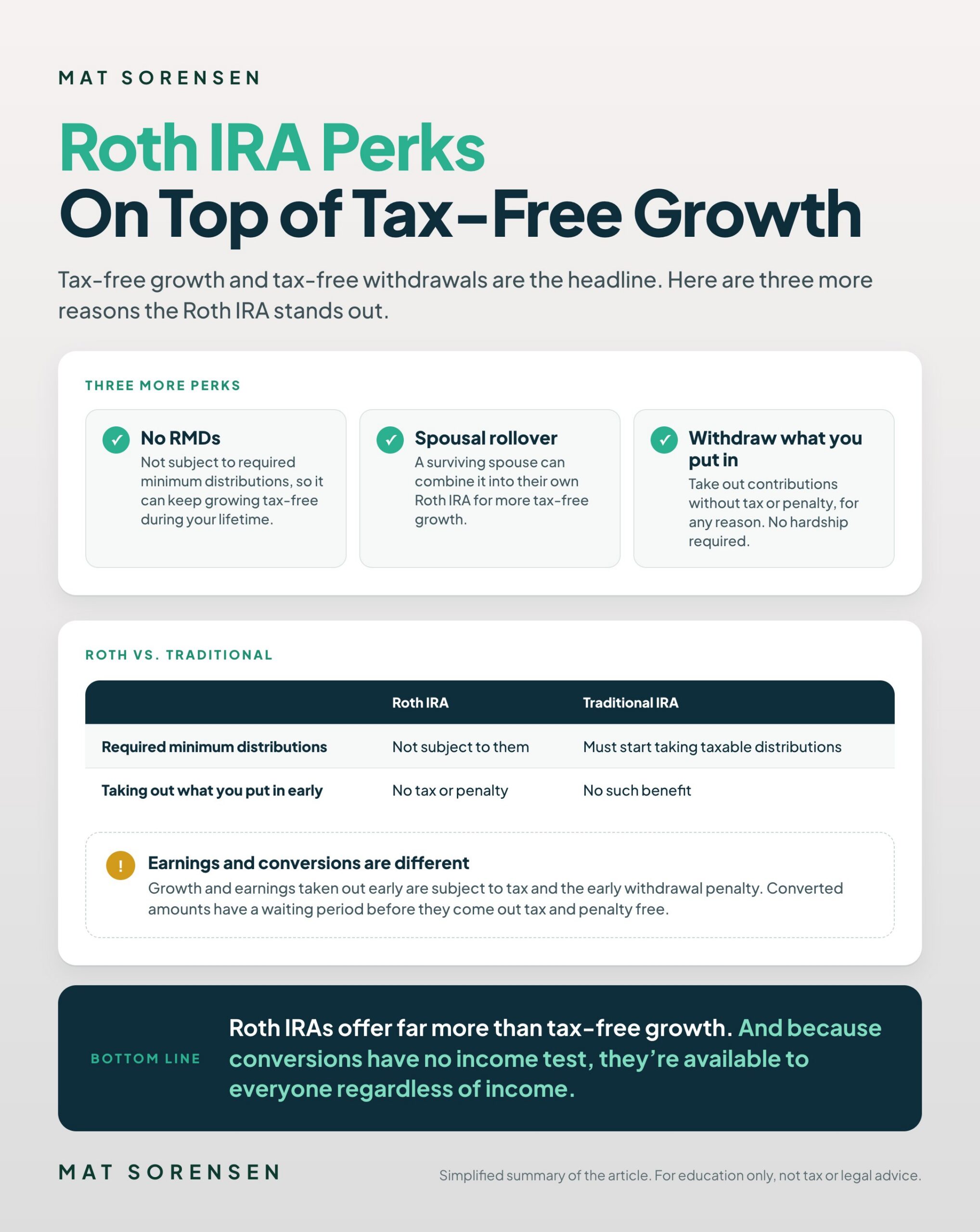
Infographic: three Roth IRA perks beyond tax-free growth, no RMDs, spousal rollover, and withdrawing contributions without tax or penalty

No Required Minimum Distributions

First, Roth IRAs are not subject to RMD. Traditional retirement plan owners are subject to rules known as Required Minimum Distribution rules which require the account owner to start taking distributions and paying tax on the distributions (since traditional plan) when the account owner reaches the age of 73. Not being subject to RMD rules allows the Roth IRA to keep accumulating tax free income (free of capital gain or other taxes on its investment returns) and allows the account to continue to accumulate tax free income during the account owner’s lifetime. Learn more about the facts and fiction about IRA RMDs here.

Spousal Rollover: The Best Asset to Leave to Your Spouse

Second, a surviving spouse who is the beneficiary of a Roth IRA can continue contributing to that Roth IRA or can combine that Roth IRA into their own Roth IRA. Allowing the spouse beneficiary to take over the account allows additional tax free growth on investments in the Roth IRA account. Non spouse beneficiaries (e.g. children of Roth IRA owner) cannot make additional contributions to the inherited Roth IRA and cannot combine it with their own Roth IRA account. The non-spouse beneficiary becomes subject to required minimum distribution rules but can delay out required distributions up to 5 years from the year of the Roth IRA account owner’s death and is able to continue to keep the tax free return treatment of the retirement account for 5 years after the death of the owner. The second option for non-spouse beneficiaries is to take withdrawals of the account over the lifetime expectancy of the beneficiary (the younger the beneficiary the longer they can delay taking money out of the Roth IRA). The lifetime expectancy option is usually the best option for a non-spouse beneficiary to keep as much money in the Roth IRA for tax free returns and growth.

UPDATE (NOV 2026)

For owners who died after 2019, the SECURE Act limits the lifetime “stretch” to eligible designated beneficiaries: a surviving spouse, the owner’s minor child (until 21), a disabled or chronically ill beneficiary, or someone not more than 10 years younger than the owner. Most other beneficiaries must empty the account within 10 years, and if the owner had already started RMDs, they also take yearly RMDs during those years (required from 2025). (Source: IRS final regulations, 2024)

Tax and Penalty Free Withdrawals Before Age 59 ½ On What You Put In

Third, Roth IRA owners are not subject to the 10% early withdrawal penalty for distributions they take before age 59 ½ on amounts that are comprised of contributions or conversions. Growth and earnings are subject to the early withdrawal penalty and taxes too, but you can always take out the amounts you contributed to your Roth IRA or the amounts that you converted without paying taxes or penalties (note that conversions have a 5 year wait period before you can take out funds penalty and tax free). This makes the Roth IRA the most powerful savings account out there because you can take out what you put in without penalty or tax for whatever reason you may have as hardship is not required. Traditional IRAs have no such benefits.

Roth IRAs are a great tool for many investors. Keep in mind that there are qualification rules to being eligible for a Roth IRA that leave out many high income individuals. However, you can convert your traditional retirement plan dollars to a Roth IRA (sometimes known as a backdoor Roth IRA) as the conversion rules do not have an income qualification level requirement on converted amounts to Roth IRAs. This conversion option has in essence made Roth IRAs available to everyone regardless of income.

FREE SELF-DIRECTED IRA GUIDE

Learn how a self-directed Roth IRA can invest in real estate, private companies, notes, and more, and keep the growth tax-free.

Get the Free Self-Directed IRA Guide

Prefer to talk it through? Book a call with a Directed IRA specialist

Search

Tom W. Anderson

The "Self Directed IRA Handbook" by attorney Mat Sorensen is the most comprehensive book ever written about one of the best investment and retirement savings tools ever created: the Self-Directed IRA. Mat has performed the impossible by effectively delivering complex information in an easily understandable manner for the layperson, while providing the necessary legal basis to suit the professional. Mat's book is a "must read" for investors, attorneys, CPAs, and other professionals and other interested individuals wanting to learn about all there is to know about Self-Directed IRAs.

Tom W. Anderson
President, RITA, and Founder and Vice Chairman / PENSCO Trust Company

Harry Veldkamp

Mat's books is a great reference guide for self-directed IRA investing – Best I’ve seen in 30 years of being in the business.

Harry Veldkamp
CEO, Polycomp Trust Company

Pamela Constantino

Mat's book is an excellent resource for self directed IRA owners and their advisors. It is the first of its kind in our industry. Mat has truly written an “Authoritative Guide” for self directed IRAs.

Pamela Constantino
President, Polycomp Trust Company

Mark J. Kohler

Mat is truly an expert on self directed IRAs, and his book is the one book that every self directed IRA investor should read.

Mark J. Kohler
CPA, Attorney, Author

Richard Davis

I was referred to Matt for help in setting up an IRA owned LLC. Matt and his team did an incredible job completing the work in a few short days. The process was professional, efficient and cost effective. I continue to rely on Matt for guidance running the LLC and related real estate matters. Not only is Matt a good lawyer, he runs a great office. It is easy for me to recommend Matt and his team.

Richard Davis

Christine Farkas

We have used Matt for many legal matters and he always comes through with shining colors. I highly recommend Matt for any legal or tax matter.

Christine Farkas
Real Estate Broker & Investor

Jennifer Cayton

Mathew is the legal partner for the majority of my clients. Matthew provides solid legal advice, precise strategic planning, appropriate corporate structure development, and is readily available to consult with his clients on all legal and business manners. Matthew is well respected and has an extremely large network in the successful real estate investor world. Matthew is reliable, professional and an all around great partner to have on your side

Jennifer Cayton
CFO Consultant / Premier Accounting and Financial, Inc.

Bill Sthay

I have retained Mathew Sorensen several times for multiple real estate deals and have been very pleased with his efforts and work product and will continue to use him in the future.

Bill Sthay
Real Estate Investor

Kade Creamer

My wife and I recently sought Mat's help with estate planning and couldn't have been more satisfied. Mat's professionalism, honesty, creativity and attention to detail is second to none. What impresses me the most about Mat can be summed up as "diverse". Mat's vast knowledge and experience in a plethora of differing areas of the law is astounding. I highly recommend Mat to my clients and friends seeking legal help.

Kade Creamer
Owner / Creamer Insurance Agency, Inc.

Bill Carlson

Mat's advice can be trusted. He is both knowledgeable about the impact of potential litigation and brings creativity to all that he does. It is enjoyable to work with him.

Bill Carlson
CFO / Authentic Property Investors

Valerie Griffin

Mat is a highly qualified...lawyer specializing in real estate. He's personable and professional, knows his stuff and is a nice guy. It doesn't get any better than that. I really liked the way he explained everything to me at my level so I got it. He also advised the best way for me to proceed with my RE investments. He handled my case in a timely manner with high integrity.

Valerie Griffin
Owner / Griffin Investment Properties

Kim Jacobs

I have had the opportunity to engage Mat's services on many occasions and have found him to be diligent and reliable. He has always been committed to delivering high-quality work and is very professional. He is well-liked and respected by his peers. He has my most sincere recommendation.

Kim Jacobs
Treasurer / Jacobs Construction, Inc.

Mathew Owens

Mathew Sorensen is a great resource and I use him consistently for real estate law questions. He is a wealth of information and will always give you a great knowledge base. I have been using KKOS for a while now and am very impressed and happy with their services.

Mathew Owens
CPA, Real Estate Investor

Kenneth P. Child

[Mat] is completely devoted to his clients and continually strives to stay abreast of changes and updates in the law. Mat is an unbelievably hard worker and...I don't hesitate to recommend Mat's services to anyone as I know he will take care of them and give them simple, concise, and straightforward solutions to any legal issue they may be facing.

Kenneth P. Child
Chief Legal Officer / Stake Center Locating

K.M

I am a partner in a law firm in Chicago and I have worked with Mat on my personal real estate and business ventures. Mat has given me practical and wise advice which has helped me make profitable decisions. I highly recommend Mat.

K.M.
Attorney & Real Estate Investor

Gary Shumm

Mathew is an excellent attorney, well versed in the Self-Directed IRA market…His ability to distil the complexities of the Self-Directed IRA so that the average person can understand them, and ensure that they don't get "tripped up" is second to none. Anyone interested in this Self-Directed IRA Market would do well to connect with Mathew and learn from the best.

Gary Shumm
Vice President / IRA Services Trust Company

Mat is truly an expert on self directed IRAs, and his book is the one book that every self directed IRA investor should read.

Mark J. Kohler
CPA, Attorney, Author / MarkJKohler.com

"A must-read for any self-directed IRA investor."

Kaaren Hall
President / uDirect IRA Services

"Mat's book is an excellent resource for self directed IRA owners and their advisors. It is the first of its kind in our industry.
Mat has truly written an“Authoritative Guide” for self directed IRAs."

Pamela Constantino
President / Polycomp Trust Company

"Mat is an excellent attorney, well versed in the Self-Directed IRA market...His ability to distill the complexities of the Self-Directed IRA
so that the average person can understand them, and ensure that they don't get "tripped up" is second to none.

Gary Shumm
Vice President / IRA Services Trust Company

"Mat’s book is the most practical and comprehensive self directed IRA guide in our industry. Reading this handbook should be the first step for any alternative asset investor, investment sponsor, or trusted advisor that seeks to become informed about how to maximize the value of IRAs."

J.P. Dahdah
CEO / Vantage Self Directed Retirement Plans

"Mat's books is a great reference guide for self-directed IRA investing – Best I’ve seen in 30 years of being in the business."

Harry Veldkamp
CEO / Polycomp Trust Company

"The Self Directed IRA Handbook by attorney Mat Sorensen is the most comprehensive book ever written about one of the
best investment and retirement savings tools ever created: the Self-Directed IRA."

Tom Anderson
Founder and Retired CEO, PENSCO Trust Company

J.P. Dahdah

Mat’s book is the most practical and comprehensive self directed IRA guide in our industry. Reading this handbook should be the first step for any alternative asset investor, investment sponsor, or trusted advisor that seeks to become informed about how to maximize the value of IRAs.

J.P. Dahdah
CEO, Vantage Self Directed Retirement Plans

View All Testimonials Here