The IRS Says That You Can Contribute More to Your IRA and 401(k) in 2019

Late last week, the IRS announced increased contribution limits for IRAs, 401(k)s and other retirement plans. IRAs have been stuck at $5,500 since 2013, but are finally moving up to $6,000 starting in 2019. If you save in a 401(k), including a Solo K, the good news is that your contribution limits were increased too, with employee contributions increasing from $18,500 to $19,000 and total 401(k) contributions (employee and employer) reaching $56,000. The IRS announcement and additional details can be found here.

Health savings account (HSA) owners also won a small victory with individual contribution maximums increasing by $50 to $3,500, and family contribution amounts increasing by $100 to $7,000.

Breakdown

Here’s a quick breakdown on the changes:

  • IRA contribution limitations (Roth and Traditional) increased from $5,500 to $6,000, and there is still the $1,000 catch-up amount for those 50 and older.
  • 401(k) contributions also increased for employees and employers: Employee contribution limitations increased from $18,500 to $19,000 for 2019. The additional catch-up contribution for those 50 and older stays the same at $6,000. The annual maximum 401(k) (defined contribution) total contribution amount increased from $55,000 to $56,000 ($62,000 for those 50 and older).
  • HSA contribution limits increased from $3,450 for individuals and $6,900 for families to $3,500 for individuals and $7,000 for families.

These accounts provide advantageous ways for an individual to either save for retirement or to pay for their medical expenses. If you’re looking for tax deductions, tax deferred growth, or tax-free income, you should be using one or all of these account types. Keep in mind there are qualifications and phase out rules that apply, so make sure you’re getting competent advice about which accounts should be set up in your specific situation. Lastly, remember, all of these accounts can be self-directed and invested into assets you know best.

What is a Foreign LLC or Corporation, and When Do I Need to Register My Company in Another State?

Business owners and investors doing business in multiple states often ask the question of whether their company, that is set up in one state needs to be registered into the other state(s) where they are doing business. This registration from your state of incorporation/organization into another state where you also do business is called a foreign registration. For example, let’s say I’m a real estate investor in Arizona and end up buying a rental property in Florida. Do I need to register my Arizona LLC that I use to hold my real estate investments into Florida to take ownership of this property? The answer is generally yes, but after reviewing a few states laws on the subject I decided to outline the details of when you need to register your LLC or Corporation into another state where you are not incorporated/organized. (Please note that the issue of whether state taxes are owed outside of your home state when doing business in multiple states is a different analysis).

In analyzing whether you need to register your out of state company into a state where you do business or own property it is helpful to understand two things: First, what does the state I’m looking to do business in require of out of state companies; and Second, what is the penalty for failure to comply.

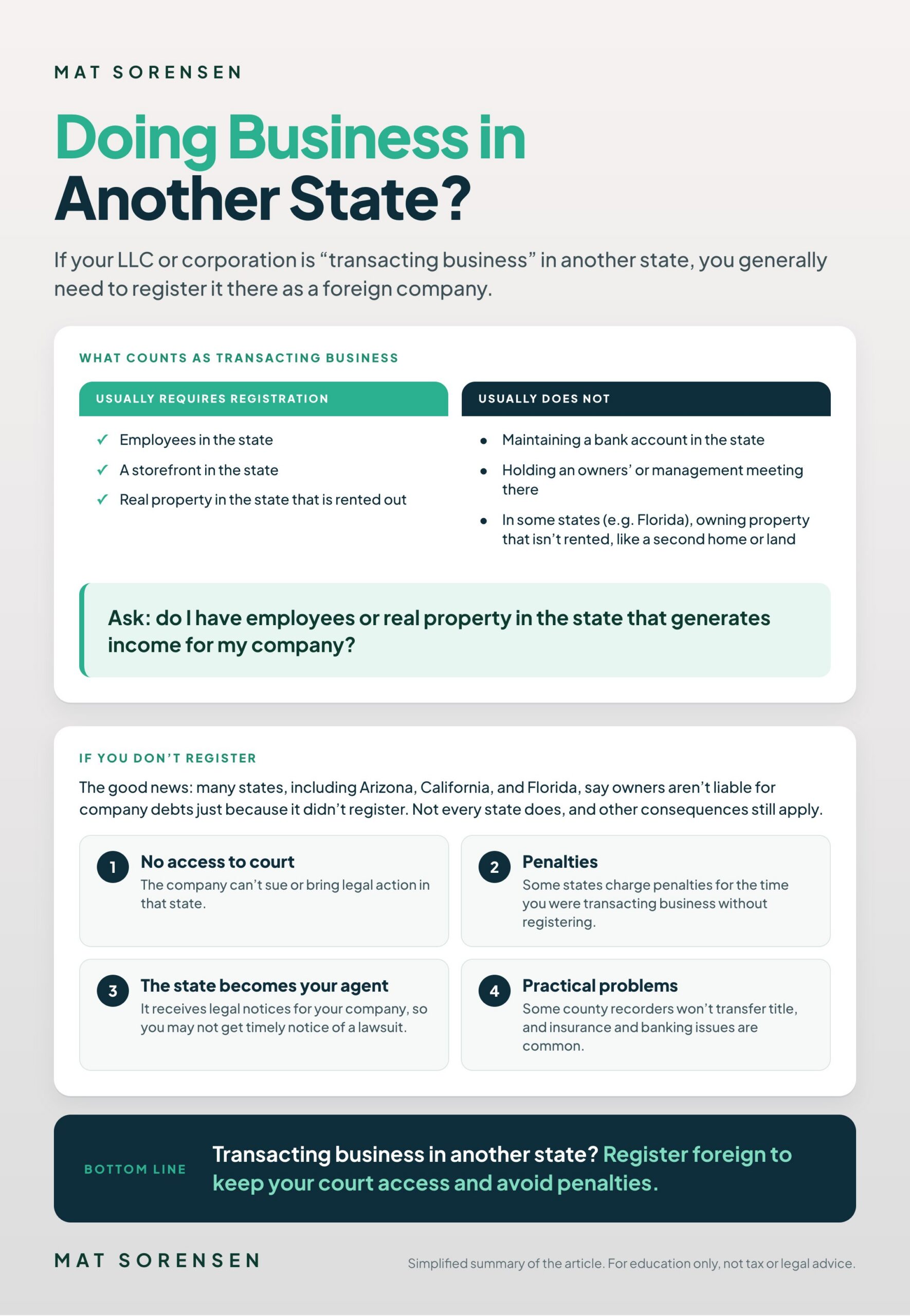
Infographic: what counts as transacting business in another state and what happens if an LLC or corporation fails to register as a foreign company

When Do I Need to Register Foreign?

First, a survey of a few state statutes on foreign registration of out of state companies shows that the typical requirement for when an out of state company must register foreign into another state is when the out of state company is deemed to be “transacting business” into the other state. So, the next question is what constitutes “transacting business”? The state laws vary on this but here are some examples of what constitutes “transacting business” for purposes of foreign registration filings.

  1. 1Employees or storefront located in the foreign registration state.
  2. 2Ownership of real property that is leased in the foreign registration state. Note that some states (e.g. Florida) state that ownership of property by an out of state LLC does not by itself require a foreign registration (e.g. a second home or maybe land) but if that property was rented then foreign registration is required.

Here is an example of what does not typically constitute “transacting business” for foreign registration requirements.

  1. 1Maintaining a bank account in the state in question.
  2. 2Holding a meeting of the owners or management in the state in question.

So, in summary, the general rule is that transacting business for foreign registration requirements occurs when you make a physical presence in the state that results in commerce. Ask, do I have employees or real property in the state in question that generates income for my company? If so, you probably need to register. If not, you probably don’t need to register foreign. Note that there are some nuances between states and I’ve tried to generalize what constitutes transacting business so check with your attorney or particular state laws when in question.

What is the Penalty if I Don’t Register Foreign?

Second, what is the penalty and consequence for failing to file a foreign registration when one was required? This issue had a few common characteristics among the states surveyed. Many company owners fear that they could lose the liability protection of the LLC or corporation for failing to file a foreign registration when they should have but most states have a provision in their laws that states something like the following, “A member [owner] of a foreign limited liability company is not liable for the debts and obligations of the foreign limited liability company solely by reason of its having transacted business in this state without registration.” A similar provision to this language was found in Arizona, California and Florida, but this provision is not found in all states that I surveyed. This language is good for business owners since it keeps the principal asset protection benefits of the company intact in the event that you fail to register foreign.  On the other hand, many states have some other negative consequences to companies that fail to register foreign. Here is a summary of some of those consequences.

  1. 1The out of state company won’t be recognized in courts to sue or bring legal action in the state where the business should be registered as a foreign company.
  2. 2Penalty of $20 per day that the company was “transacting business” in the state when it should have been registered foreign into the state but wasn’t. This penalty maxes out at $10,000 in California. Florida’s penalty is a minimum of $500 and a maximum of $1,000 per year of violation. Some states such as Arizona and Texas do not charge a penalty fee for failure to file.
  3. 3The State where you should have registered as a foreign company becomes the registered agent for your company and receives legal notices on behalf of your company. This is really problematic because it means you don’t get notice to legal actions or proceedings affecting your company and it allows Plaintiffs to sue your company and to send notice to the state without being required to send notice to your company. Now, presumably, the state will try to get notice to your company but what steps the state actually takes and how much time that takes is something I couldn’t find. With twenty to thirty day deadlines to respond in most legal actions I wouldn’t put much trust in a state government agency to get me legal notice in a timely manner nor am I even certain that they would even try.
  4. 4In addition to the statutory issues written into law there are some practical issues you will face if your out of state company is not registered into a state where you transact business. For example, some county recorders in certain states won’t allow title to transfer into your out of state company unless the LLC or corporation is registered foreign into the state where the property is located. It is also common to run into insurance and banking issues for your company until you register foreign into the state where the income generating property, employee, or storefront is located.

In summary, you should register your company as a foreign company in every state where you are “transacting business”. Generally speaking, transacting business occurs when you have a storefront in the foreign state, employees in the foreign state, or property that produces income in the foreign state. Failure to file varies among the states but can result in penalties from $1,000 to $10,000 a year and failure to receive legal notices and/or be recognized in court proceedings. Bottom line, if you are transacting business outside of your state of incorporation/organization you should register as a foreign entity in the other state(s) to ensure proper legal protections in court and to avoid costly penalties for non-compliance.

IRS Announces 2018 Retirement and HSA Contribution Amounts

Photo of woman standing with her fists raised above her head in front of a sunrise.The IRS announced new contribution amounts for retirement accounts in 2018, and there are some winners and losers in the bunch.

The biggest win goes to 401(k) owners, including Solo K owners, who saw employee contribution amounts go from $18,000 to $18,500. Health savings account (HSA) owners won a small victory with individual contribution maximums increasing $50 to $3,450 and family contribution amounts increasing by $150 to $6,900.


However, IRA owners lost with no increase in the maximum contribution amount for Traditional or Roth IRAs. The IRA maximum contribution amount remains at $5,500 and hasn’t increased since 2013.

Breakdown


Here’s a quick breakdown on the changes:

  • 401(k) contributions also increased for employees and employers: Employee contribution limitations increased from $18,000 to $18,500 for 2018. The additional catch-up contribution for those 50 and older stays the same at $6,000. The annual maximum 401(k) (defined contribution) total contribution amount increased from $54,000 to $55,000 ($61,000 for those 50 and older).
  • HSA contribution limits increased from $3,400 for individuals and $6,750 for families to $3,450 for individuals and $6,900 for families.
  • IRA contribution limitations (Roth and Traditional) stayed at $5,500, as did the $1,000 catch-up amount for those 50 and older.

There were additional modest increases to defined benefit plans and to certain income phase-out rules. Please refer to the IRS announcement for more details here.

These accounts provide tax advantageous ways for an individual to either save for retirement or to pay for their medical expenses. If you’re looking for tax deductions, you should determine which of these accounts is best for you. Keep in mind there are qualifications and phase out rules that apply, so make sure you’re getting competent advice about which accounts should be set up in your specific situation.