
When a retiree begins taking distributions from a traditional IRA, 401(k), or pension plan, those distributions are taxable to the retiree under federal income tax and any applicable state income tax rules. While federal taxation cannot be avoided, state taxation may be avoided depending on your state of residency. In general, there are some states that have zero income tax and therefore don’t tax retirement plan distributions, some states that have special exemptions for retirement plan distributions, and other states that do in fact tax retirement plan distributions. This article breaks down the basics and discusses some of the states where income taxes can be avoided.
The No State Income Tax States
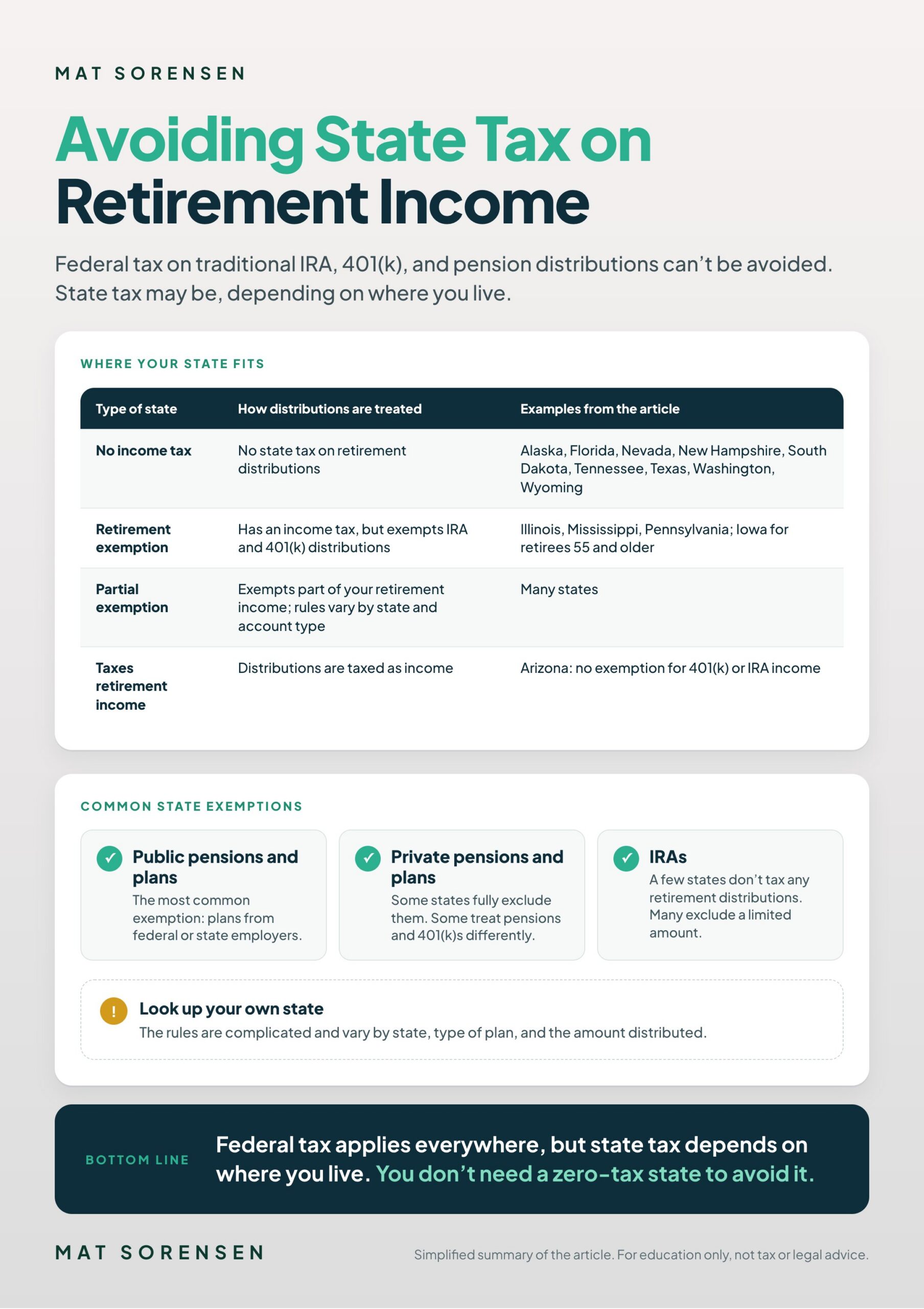
First, the easiest way to avoid state income tax on retirement plan distributions is to establish residency in a state that has no state income tax. It isn’t just the fun and sun of Florida that helps attract all of those retirees. It’s the tax-free state treatment of all that money stocked away in your retirement account. As of 2026, nine states have no income tax on wages or retirement distributions: Alaska, Florida, Nevada, New Hampshire, South Dakota, Tennessee, Texas, Washington, and Wyoming.
States with Retirement Income Exclusions
Second, some states have an income tax but exempt retirement plan distributions. In 2026, Illinois, Mississippi, and Pennsylvania exempt IRA and 401(k) distributions, and Iowa exempts them for retirees 55 and older. Many other states exempt part of your retirement income, and the rules vary by state and by type of account. Here’s a quick summary of the common exemptions found in the states.
- 1For Public Pensions and Retirement Plans. Distributions from federal or state employer plans are exempt from taxation in many states. This is the most common exemption amongst states that have an income tax but who exempt some types of retirement plan distributions from income. Most of the states that have an exemption for retirement plan income provide an exemption for public employee pensions and retirement plans.
- 2For Private Pensions and Retirement Plans. Some states offer a full exclusion for private pensions and retirement plans. Some of them differ between pension and contributory plans (e.g. 401(k)) and some of them make no distinction. Pennsylvania, for example, excludes all income distributions. Hawaii excludes certain distributions from state income tax for private retirement plans and for portions from company plans rolled over to a rollover IRA and then distributed from the rollover IRA.
- 3For IRAs. There are some states that do not tax any retirement plan distributions, including IRA distributions to retirees. Illinois for example does not tax distributions from retirement plans at all (pensions, IRAs, 401(k)s). There are also numerous states that exclude a certain limit of retirement plan income from taxation.
Know Your State’s Rules
In sum, the state tax rules for retirement plan distributions are complicated and vary significantly. Each state can be understood rather quickly though and everyone planning for retirement should understand how state income taxes may eat into their planned retirement plan distributions.
EXAMPLE
I, for example, looked into Arizona and found that there is no exemption for 401(k) or IRA income in the state of Arizona. While we do have a low state income tax rate, Arizona state income tax includes income from private retirement plans (pensions and 401(k)s) and IRAs and has a modest deduction for distributions from public retirement plans.
Each state is unique to the type of plan, and the amounts being distributed but don’t just think you need to be in a state with zero income tax to avoid taxes on retirement plan distributions. For example, you could be in Illinois, Tennessee, or New Hampshire and could realize state income tax-free distributions of your IRA or 401(k). The National Conference of State Legislators has an updated 2015 chart that is very useful and can be used to look up your state’s tax treatment of retirement plan distributions for retirees.
SELF-DIRECTED IRA
Invest your IRA in real estate, private companies, notes, precious metals, and more.