How I’d Build Wealth From Scratch in 2026 (If I Lost It All)

If I had to start over at zero—no assets, no investments, no portfolio—what’s the smartest path to building wealth again? The key is focusing on strategically building wealth that lasts. There’s no perfect investment or trendy shortcut. It starts with doing the right things, in the right order, and staying consistent.Ā 

Step 1: Focus on Cash Flow

Cash flow gives you options—and options create freedom. The first step is to invest in your ability to earn. Learn a valuable skill and put it to work in the marketplace to generate income whether it is a career or a business. That income should cover your living expenses, pay down debt, fund your savings, and build capital for future investments. To expand your margin in cash flow, consider developing a high-value skill, growing a side hustle, or taking on temporary work to increase your earning potential.


When I was a new attorney in my 20’s, I worked as assistant corporate counsel for a large health care company. I was making a good income but had debt, a family, and was impatient with my financial situation so I took on a side hustle. I worked on nights and weekends putting up advertising signs on top of gas station pumps. This gave me extra income to get out of high interest debt and to actually have cash flow to start deploying into savings to buy a home and acquire an asset. For many people, your cash flow situation may require more education, training, a side hustle, a career progression or some other action and achievement that will make you more valuable in the workforce or in your business.

Step 2: Protect the Gap Between Income and Spending

To build true wealth, your lifestyle must grow slower than your income. One of the biggest financial mistakes is letting your lifestyle expand as fast as your income. When your spending rises in step with what you earn, there’s no cash left to invest. Without consistent investing, you’ll always work for your lifestyle instead of letting your money work for you. Wealth is built in the gap between what you earn and what you spend.Those who retire early do so by maintaining a wide margin—living below their means, saving, and strategically turning that capital into income-producing assets.


I had a friend who retired in his 40’s. He was a physician and when he told me he retired I was shocked. He was always financially savvy and invested into real estate with his excess cash flow but his trick wasn’t to just earn more, instead he told me he didn’t increase his lifestyle and spending in line with his income growth. He said his lifestyle and spending always lagged about 5 years behind his income growth and his income and spending gap was wide enough that he could set more and more money aside. In other words, if he was making $250K, he lived like he made $150k. Once he was making $500K, he lived like he made $250k. Do that for a year or two and you start making progress. Do that for 10 to 15 years, and you have significant wealth accumulation.Ā 

Step 3: Get the Order of Operations Right

People don’t fail at investing because they pick bad investments—they fail because they don’t follow the right order. First, build an emergency savings fund. Second, pay off high-interest debt, such as credit cards with 20% rates. Lower-interest debt,Ā  like low interest student loans or a mortgage, can wait, but your goal is for your investments to outperform your debt costs. If your debt carries a higher interest rate than your expected investment return, focus on paying it down first.Ā 


For example, if you have credit card debt at 18% interest rates, you need to pay that debt down first before you start investing. It will be hard to find an investment that gets you a higher return than 18%. The only exception worth noting here is if you have a 401(k) at work where they offer a match. Many 401(k) plans offer a match of 50% to 100%. So for example, if you make $100K and you put in $3K to your 401(k), your employer puts in $3K and now you have a total of $6k but it only cost you $3K. That is a 100% return on investment on day one so even if you have high interest credit card debt it makes sense to at least put enough into your 401(k) if your employer offers a match of 100% or even 50%. After you’ve put in enough to your 401(k) to get the free money match, go back and focus on paying down high interest debt.Ā 

Step 4: Start Investing Early, Even If It Is Boring

Once your financial foundation is set, begin investing—even small amounts make a difference. Early investing is less about picking the perfect strategy and more about building consistent habits, learning how markets work, compounding returns over time, becoming comfortable with risk, and letting time do the heavy lifting. Avoid chasing complex strategies or hot trends. If you’re new to investing, focus on steady contributions to simple, broad-based investments like an S&P 500 index fund, which can be a mutual fund or, an ETF, or a target-date fund. Don’t overanalyze every option—just get started and let your money grow. You can always adjust your investments later; for now, the goal is to build momentum and benefit from compounding.

Step 5: Layer in Tax-Advantaged Accounts IntentionallyĀ 

As your income grows, your financial strategy becomes increasingly important. Start by taking full advantage of the tax-advantaged accounts available to you. An employer-sponsored 401(k) is one of the most effective tools for growing wealth—especially if your company offers a matching contribution, which is essentially free money. A Roth IRA or Roth 401(k) allows your investments to grow tax-free and gives you flexibility in retirement withdrawals. A Health Savings Account (HSA) offers a unique triple benefit: tax-deductible contributions, tax-free growth, and tax-free withdrawals for qualified medical expenses.

These accounts work together as powerful wealth-building tools that reward consistency, discipline, and time. By contributing regularly and letting compounding and tax advantages work in your favor, you can grow wealth efficiently and sustainably. And remember, your money isn’t completely locked away—options like a 401(k) participant loan provide some flexibility if you ever need access to funds. Invest with confidence, knowing you’re building a system that balances growth, efficiency, and accessibility.

Retirement accounts will grow and build wealth faster than standard brokerage or taxable account investments because retirement accounts are not taxed when you make money. This means that every penny of return gets re-invested and grow and when you think of investing overĀ  a 20 or 30 year window of time the difference between making 10% on your investments and keeping 10% (versus say 8% in a taxable account) means your money doubles and compounds over time.Ā 


When $100K turns into $1,600,000 from Investment Returns Only


Retirement accounts total return not affected by taxes, non-retirement accounts taxable so consider account value and growth only after tax is paid. $100K is an investment amount and growth is only from investment returns and not from making additional contributions or funds to invest.Ā 


$100k Investment Making 10% Annual Return Roth IRA or Roth 401(k) Taxable Account
10% Investment Return $1.6M in 28.8 Years X
8% Investment Return (same investment but because tax burden on investment income or gains being taxable total return is only 8%, example) X $1.6M in 36 Years


As the above example illustrates, saving in tax advantaged accounts like a Roth IRA or Roth 401(k) allows your wealth to accumulate faster which means you can reach your retirement goals faster. If you’re 40 with $100K to set aside you could end up with $1.6M by the time you’re 68 using a tax advantaged account or if you used a taxable account you could end up with $1.6M by the time you’re 76. Of course, investment returns and tax situations vary but in every instance funds invested in a Roth account that grows and comes out tax-free will beat funds invested from a taxable account.Ā 

Step 6: Build Wealth Through Engines You Understand

Focus on investments you genuinely understand—those where you can clearly see how they generate returns, what factors influence their success, and what risks could affect them. The best investments aren’t necessarily the most complex ones; they’re the ones you can explain with confidence and conviction. If you can’t describe how your investment works or why it should succeed, it’s probably not the right place for your money.Ā 


The goal is long-term asset accumulation—not frequent selling of appreciated assets. You want to own investments that work for you, generating cash flow and appreciating over time. That might be real estate, a business, or a stock portfolio—what matters is that you truly understand it and continue deepening your expertise. Concentrate your efforts where you have knowledge and conviction rather than spreading yourself thin across areas you don’t fully grasp. Wealth is created through focused conviction and concentration of what you know best and is preserved through thoughtful diversification to manage risk.

Step 7: Protect What You Build as It Grows

As your assets grow, your priorities evolve—protection becomes just as important as growth. Focus on building a solid foundation through proper legal and entity structures (e.g. an LLC for your rental property), adequate insurance, clean documentation, and full compliance. Protection doesn’t make you wealthier, but it prevents costly setbacks. A single lawsuit, poor partnership, or compliance mistake can erase years of progress.

This is also the stage where you begin to protect and strategically use your equity—whether it’s in your home, business, real estate, or investment portfolio. First, ensure your assets are well-protected. Then, learn how to access and leverage them to generate additional income or support your lifestyle without selling them outright. By using low-cost debt tied to strong assets, you can unlock capital for new investments or cash flow needs while your original assets continue to grow over time and this can all happen without selling the asset and causing capital gains tax. The alternative is selling the asset to receive the equity and then paying tax on the gains. By accessing equity in your asset via debt (e.g. cash out refinance of real estate or stock portfolio line of credit) you keep the asset and the future appreciation and also don’t have to pay tax on the gain from the sale because you still own the asset.

Step 8: Think Long-Term About Distribution

Think long-term and be intentional about where you’re heading. Take time to envision what your ideal financial future looks like—how much income you’ll need in retirement to sustain your lifestyle, how to structure your finances for tax efficiency, who are the beneficiaries to your wealth, and what kind of legacy or impact you hope to leave behind. These questions help you design a financial plan that aligns with your values, not just your numbers. You don’t need to have every detail mapped out from day one, but you should have a clear sense of direction. Wealth without purpose or planning eventually gets wasted. I keep a 10 year plan and update multiple times over the year. I think back in 5 years and then in 3 and 1 year phases. I make goals and stick to them. We underestimate what we can accomplish in 10 years and by taking the time to think through what your goals can be in 10 years you have more clarity about what you should be doing in 5 years, 3 years, and this year.Ā Ā 

The Big Picture: Consistency Beats Cleverness

Wealth is built through consistency, not luck. Success comes from steady habits, patience, and discipline—not quick wins or trends. Building wealth from scratch isn’t about chasing the perfect investment; it’s about following a sound plan, taking deliberate steps in the right order, and staying the course long enough for your efforts to produce lasting results.


If you’d like to learn more, I’ve created a guide called The Ideal Order of Investing, available through the link below. In it, I break down the key steps to take in the right sequence—helping you focus on what matters most right now and what to prioritize next in your wealth-building journey.

Building Wealth Guide: The Ideal Order of Investing | Mat Sorensen


Ā 

Disclaimer

This article is for educational purposes only and does not constitute legal, tax, or investment advice. Tax results depend on individual circumstances, future legislation, and proper implementation. Consult qualified advisors before implementing any strategy. Investment outcomes depend on investment performance, contribution discipline, future tax law, and proper execution. No specific result is guaranteed.

Trump Accounts Explained: How the New Child Retirement Account Can Become a Roth IRA

Trump Accounts are a newly created type of tax-advantaged retirement account for children under age 18. Established under the One Big Beautiful Bill Act and codified in Internal Revenue Code §530A, these accounts introduce a planning opportunity that did not previously exist in retirement law. The most significant planning opportunity around Trump Accounts is not to keep the account as a Trump Account or as a Traditional IRA, as the Trump Account automatically turns into at age 18, but to convert that Trump Account to a Roth IRA. 

On the surface, Trump Accounts appear limited. But with simple planning, Trump Accounts are the most powerful account you can establish for your kids. Why? Because they are flexible and at age 18 can be converted to a Roth IRA, which is widely regarded as the best tax-advantaged account any American can own.Ā 

You can contribute up to $5,000 per year per child to a Trump Account, and these contributions are made with after-tax dollars and do not generate a tax deduction for the contributor or the child. While funds inside the account grow tax-deferred, the account ultimately converts to a traditional IRA when the child reaches age 18. At that point, distributions are taxable, and early withdrawals before age 59½ are generally subject to penalties. The account functions like a traditional IRA, and turns into one at age 18, but you don’t get a tax deduction on the contributions.

In that sense, early Trump Account analysis focused on what seemed like the least favorable aspects of both traditional and Roth IRAs: no deduction on the way in (Roth IRA downside), and taxation on the way out (Traditional IRA downside). As a result, much of the early commentary emphasized the novelty of the account rather than its long-term planning potential. The ability to convert the Trump Account to a Roth transforms Trump Accounts from a simple savings vehicle into a powerful early-stage Roth planning tool, even when the child does not have earned income.

What Is a Trump Account?

A Trump Account is a statutorily created retirement account that is treated as a traditional IRA once the beneficiary reaches age 18. The account must be designated as a Trump Account at the time it is established and is governed by IRC §530A.

Important characteristics:

  • Maximum contribution limit of $5,000 from individual contributors
  • Contributions do not require earned income
  • Contributions are not tax-deductible
  • Distributions are taxable
  • At age 18, the account follows Traditional IRA rules and turns into a Traditional IRA

To understand where Trump Accounts fit into a broader retirement strategy, it helps to compare them directly to Traditional and Roth IRAs. While all three accounts offer tax-advantaged growth, they differ significantly in contribution limits, earned income requirements, funding deadlines, and how distributions are ultimately taxed.


Trump Account

Traditional IRA

Roth IRA

Contribution Amt

$5,000

$7,500

$7,500

Earned Income Req

No

Yes

Yes

Contribution Deadline

12/31/2026 (last day of the year)

4/15/2027 (tax return deadline)

4/15/2027 (tax return deadline)

Tax Deduction for Contribution

No

Yes

No

No Tax on Investment Growth

Yes

Yes

Yes

Distributions Taxed

Yes, except basis (Amounts contributed)Ā  is exempt

Yes

No


Why Trump Accounts Matter

No Earned Income Requirement

Unlike Traditional or Roth IRAs, Trump Accounts allow contributions even when the child has no earned income. This makes it possible to begin retirement saving earlier than previously allowed under tax law.

Early Access to Roth Conversion Planning

Once the child reaches age 18, the account automatically becomes a Traditional IRA, and the account becomes eligible for Roth conversions. This creates a legal pathway into a Roth IRA that does not rely on earned income contributions.

The Growth Period: Rules Before Age 18

The Trump Account operates under a defined ā€œgrowth period,ā€ which ends on January 1 of the calendar year in which the beneficiary turns 18. During this period, special rules apply.

Contributions During the Growth Period

The first year for Trump Accounts is 2026, and in that year, contributions cannot be made before July 4, 2026, and must be made by December 31 of the applicable calendar year. Unlike IRAs, you cannot make prior-year contributions up to the tax return deadline.Ā 

Qualified contribution types include:

  • Pilot program contributions funded by the U.S. Treasury (This is the $1K free contribution from the U.S. government for any U.S. child born between 2025-2028)


  • Qualified general contributions from states or qualifying charities (For example, the amounts donated by Michael and Susan Dell donated to children in lower-income zip codes).


  • Employer contributions under IRC §128 up to $2,500 (Many U.S. Employers have already pledged to contribute to their employee children accounts including Blackrock, Visa, and these employer contributions are not taxable to the employee or child).


  • Qualified rollovers between Trump Accounts


  • Standard contributions made by family members or other third parties (this is the $5,000 annual contribution a parent, grandparent or other person can make).


Standard contributions combined with employer contributions are subject to a $5,000 annual limit, indexed for inflation after 2027. Employer contributions are separately capped at $2,500 per year.

Investment Restrictions During the Growth Period (age 0-17)

Investment options during the growth period are limited and Trump Accounts cannot be invested into a single stock nor can they be self-directed into real estate, crypto, or private companies like many self-directed IRA clients do at Directed IRA.Ā 

During the growth period (age 0-17), Trump Account assets may be invested only in eligible mutual funds or ETFs that:

  • Track qualifying U.S. equity indexes


  • Do not use leverage


  • Have total annual fees of 0.10% or less


Cash and money market funds are not permitted investments, except for brief administrative holding necessary to process contributions, dividends, or sales before reinvestment.

Distribution Restrictions

Distributions are generally prohibited during the growth period. Limited exceptions include:

  • Trustee-to-Trustee rollovers between Trump Accounts (e.g. moving your Trump Account from one custodian provider to another).


  • Qualified ABLE rollovers during the year the child turns 17


  • Distribution of excess contributions


  • Distribution upon the death of the beneficiary


Hardship distributions are not permitted.

The Transition at Age 18

On January 1 of the year the beneficiary turns 18, the growth period ends. At that point:

  • Contributions must stop
  • The account becomes subject to Traditional IRA rules under IRC §408

  • Distributions, rollovers, and Roth conversions are permitted

IRS Notice 2025-68 explicitly confirms this transition.

Everything that follows hinges on one planning opportunity: Roth conversions after age 18.

Roth Conversions: The Core Planning Opportunity

The year the child reaches age 18, the Trump Account turns into a Traditional IRA and all Traditional IRA rules apply. This is significant in two instances. First, you can convert the Traditional IRA into a Roth IRA. And second, you now have more investment options on how to invest the Roth IRA (that first started as a Trump Account) as Roth IRAs can be self-directed and invested into any assets allowed by law including a single stock, real estate, private companies, small businesses, rental properties, and even crypto.Ā 

The Roth conversion strategy is central to the importance of Trump Accounts as it allows the nest egg that has been set aside while the child was age 0-17 to move from a tax-deferred traditional IRA to a tax-free Roth account. And, if we strategic about how we convert the Traditional IRA (formerly a Trump Account) when the child reaches age 18 there will be no tax on the Roth conversion.Ā 

How the Strategy Works:

  1. Fund Early
    Trump Accounts allow funding years before earned income exists, extending the compounding timeline.


  2. Traditional IRA Treatment After Age 18
    At age 18, the account will consist of two buckets of funds


    • After-tax basis from standard contributions (e.g. you put money in and didn’t take a deduction as that is the Trump Account rules so these funds are after-tax dollars). This is sometimes referred to as ā€œBasisā€ under the rules.


    • Pre-tax earnings from investment growth (e.g. the contributions were invested and grew and the earnings have not been taxed).Ā 

The distinction here between after-tax and pre-tax funds is important as you only pay tax on the Roth conversion for pre-tax dollars. In other words, when you convert the Trump Account from a Traditional IRA to a Roth IRA you do not pay tax on the contributions you put into the Trump Account. You are only taxed on the pre-tax earnings and investment growth that came from the contributions.

Ā Pro-Rata Rule and Basis Allocation

Once a Trump Account turns into a Traditional IRA the pro-rata rule for Roth conversions applies. What the means is that you have to determine what amounts you contributed after tax (which you won’t pay tax on) and what funds are the earnings and the growth in the account which have not been taxed but will be when you do a Roth conversion.Ā Ā 

Example:

  • $60,000 – Your contributions to the Trump Account over 12 years in the amount of $5,000 each year (no deduction allowed and taken). This is after tax dollars and also sometimes called basis.


  • $40,000 – The earnings and growth as the contributions were invested over that 12 years which have not been taxed and are called pre-tax dollars.


  • $100,000 – Total Account Value after 12 Years of investingĀ 

In this scenario, 40% of any conversion is taxable, and 60% is non-taxable. So, if I wanted to convert $50,000 to a Roth IRA I would only have tax on 40% of the conversion which would be $20,000. The other $30,000 would not be subject to tax.Ā 

How to ConvertĀ  Trump Account to Roth and Pay Zero Tax

When your child reaches age 18 you are able to convert their Trump Account to a Roth IRA and age 18, 19, and 20 are optimal years to convert your child’s Trump Account to a Roth IRA. When you convert Trump Accounts, which turn into Traditional IRAs at age 18, to Roth IRAs the child who owns the account takes the amount converted into their taxable income. This is one of the downsides of Roth Conversions. However, when a child is age 18 they may be finishing high school and they may have no other taxable income so if the taxable portion of the Roth conversion is under the standard deduction ($16,100 in 2026) they will pay no tax on the amounts converted as they will be in a zero federal income tax bracket. And if your child has a large Trump Account at age 18, you could also do multiple Roth conversions over different tax years so that they stay under the standard deduction each year and are able to get all their Trump Account funds over to a Roth IRA. This could be when they are 18, 19, or even in their 20’s if they are in low or no income years. And even if they do have a job, they will likely be at the lowest tax rate of their working years and converting the funds now will pay huge dividends later as the funds in the Roth IRA grow and come out tax-free later in retirement.Ā 

Special Rule: No Aggregation With Other IRAs

A critical clarification in Notice 2025-68 is that Trump Accounts are not aggregated with other IRAs for basis allocation purposes.

This means:

  • Trump Account basis is calculated separately


  • Other Traditional IRAs do not affect conversion taxation


  • Existing IRA balances do not dilute the strategy


This is a rare and favorable exception in retirement tax law.

Long-Term Impact

Once assets are held in a Roth IRA, future qualified distributions at age 59 ½ are tax-free. The difference between executing this correctly and not can be measured not just in tax savings, but in the financial flexibility available to your child decades later.

To understand why this strategy matters, it helps to zoom out.

Assume a child reaches age 18 with $100,000 in a Trump Account that has been fully converted to a Roth IRA using the strategy described above. No additional contributions are ever made by the child and they simply keep the $100,000 invested.Ā Ā 

If that $100,000 remains invested for 45 years and earns a 10% annual return (e.g. an S&P 500 index fund), it will grow to approximately $8.8 million by age 65.This is the value of compounding and is what we wished our parents or grandparents did for us.Ā 

One key strategy here though is the Roth conversion and ability to receive all of the compounding and investment gains entirely tax free. Remember, the Trump Account will turn into a Traditional IRA at age 18 and if it is not converted and stays invested it will be worth $8.8M as well but millions will go to the IRS and to the state (as applicable) when distributions are made from the Traditional IRA later on.


Disclaimer

This article is for educational purposes only and does not constitute legal, tax, or investment advice. Tax results depend on individual circumstances, future legislation, and proper implementation. Consult qualified advisors before implementing any strategy. Investment outcomes depend on investment performance, contribution discipline, future tax law, and proper execution. No specific result is guaranteed.

LLC Masterclass Part 2: How to Set Up an LLC the Right Way

You need to make sure your LLC is set up the right way—otherwise, all those benefits you thought you were getting? Asset protection, tax savings, legitimacy… you might not be getting any of it.

This is where a lot of people mess up. After 20+ years and thousands of LLCs formed for clients nationwide, I’ve seen how small mistakes at the start can turn into expensive problems later.

In this article—I’ll walk you through the four steps to properly set up your LLC and the key decisions you don’t want to get wrong.

Step 1: File Your Articles of Organization

The articles or organization is the official document filed with your state that forms the LLC. It includes:

  • Your business name
  • Registered agent (who gets served lawsuits and legal notices
  • Management structure (manager vs. member-managed) – Member is LLC lingo for ā€œownerā€
  • Principal address

What state should you file in?
File in the state where you’re actually doing business. If you live in California and own a rental in Ohio, file in Ohio. Don’t fall for the ā€œDelaware or Wyomingā€ structure unless you’re in an advanced situation and you’re intentionally layering for privacy, capital raising, or charging order protection (more on that in another video). Otherwise, filing in the wrong state means double fees and extra registrations.

Tip: Choose manager-managed. It gives you more privacy and flexibility—you list yourself as the manager, not as the owner, which keeps your name as owner off public records in many states. It’s also easier to change ownership as the member owner isn’t listed and doesn’t need to change if say your revocable trust becomes owner of the LLC – or if you add a partner.

Tip: Choose a registered agent company to serve as your registered agent to keep your name and address off the public filing and to avoid getting a lawsuit or served at your home. If you’re setting up an LLC in a state where you do not reside you must use a registered agent company as every state requires a physical address (no PO Box) and a person or company AT that address be listed. This can cost you from $125/yr to $350/year depending on the company. My clients use our registered agent company, Main Street Business Services who serves as Registered Agent for $125/yr in all 50 states.

Step 2: Get an EIN (Tax ID) from the IRS

An EIN (Employer Identification Number) is like a Social Security number for your business. It’s how the IRS identifies the company for tax purposes. It is also called a tax ID. You’ll need it to:

  • Open a business bank account
  • Receive 1099s
  • File taxes for the business

You can get this directly from the IRS. Our law firm includes this in our LLC setup service.

Step 3: Create Your Operating Agreement & Initial Minutes

The operating agreement is a much more detailed document than the articles. It documents:

  • The Limited Liability protection.
  • Who owns the LLC
  • How much each person owns
  • Rights and responsibilities of members and managers
  • Profit splits and dispute resolution

If you have partners or investors, this is critical. Your operating agreement is your partnership agreement. It’s your roadmap—and skipping it leads to confusion and legal chaos down the line.

Step 4: Choose the Right Tax Status

LLCs don’t save taxes by default. The savings come from how your LLC is structured for tax planning.

By default:

  • A single-member LLC is taxed as a sole proprietorship
  • A multi-member LLC is taxed as a partnership

But you can elect to be taxed as an S corporation, and that’s where real tax strategy comes into play—especially if you’re earning more than $50,000 in net income and running a service-based business.

Here’s how it works:

S Corporation Tax Strategy

If you make $100,000 as a sole prop or default LLC, you pay 15.3% self-employment tax to the IRS on the full amount—$15,300 just in SE tax.

With an S corporation, you can split that $100K into:

  • $40K salary (subject to self-employment tax)
  • $60K distribution (not subject to SE tax)
Portion Treated As Tax Impact
$40,000 W-2 Salary 15.3% self-employment tax = $6,120
$60,000 Net Profit āŒ No SE tax
  • Annual savings: ~$9,000

You still pay regular income tax based on your tax bracket on both, but avoiding SE tax on the net profit portion is a significant win.

Important: Only elect S corp if you’re operating a business and clearing $50K+ net profit. If you own rentals or only make a few thousand (cost of s-corp return not worth not worth saving), the S election doesn’t help and might hurt.

You can make the election later if needed—just don’t wait too long and miss your opportunity to save on taxes.

BONUS: Skip the BOI Filing (For Now)

You may have heard about the Beneficial Ownership Information (BOI) filing with FinCEN. It was set to apply to most LLCs in 2024—but due to federal court rulings and guidance from the U.S. Treasury Department, you do not need to file a BOI report in 2025 if you’re a U.S. LLC or corporation. The Treasury Department states that they will not enforce the BOI rule.

That could change in future administrations, but for now—skip it.

Recap: The Right Way to Set Up Your LLC

To do it right, make sure you check all these boxes:

  • Articles of Organization in the correct state
  • Manager-managed structure for ownership privacy and ease of use
  • EIN from the IRS
  • Operating Agreement & Minutes (even if it’s just you)
  • S Corp election (if you’re earning over $50K from services)
  • No BOI filing required (for now)

Need Help?

Our law firm, KKOS Lawyers, can handle all of this for you—proper filing, EIN, operating agreement, S election, and more. We’ve set up thousands of LLCs and know how to tailor the setup for your unique situation.

šŸ‘‰ Get Started with KKOS Lawyers

Key Takeaways

  • File in the state where you do business – Not where influencers say. Avoid double fees.
  • Go manager-managed – Gives you privacy and keeps your ownership off public record.
  • EIN and bank account are essential – You need both to operate cleanly and separate business from personal finances.
  • Operating agreement matters – Especially with partners. Don’t skip this documentation.
  • Elect S Corp if you’re earning $50K+ in net income – It can save you $9,000/year in self-employment tax.
  • Skip the BOI filing for now – It’s not required in 2025 due to U.S. Treasury guidance.
  • Choose a Registered Agent company to keep your name and address off the state filing and to avoid getting served lawsuits or legal notices at your home or business. It’s also required to use a R.A. company if you don’t live in the state of the LLC.

LLC Masterclass, Part 1: Do You Really NEED an LLC for Your Business or Real Estate Investment?

Do you need an LLC for your business or your real estate investments?

This is the most common question we get from entrepreneurs, side hustlers, and real estate investors—and for good reason. LLCs are one of the powerful tools for protecting assets, building legitimacy, and structuring ownership the right way.

But not everyone needs one.

After setting up over 10,000 LLCs nationwide through my law firm, KKOS Lawyers here are the four key scenarios where you absolutely should have an LLC—and what you’re risking if you don’t.

1. You Need Asset Protection

The #1 reason to form an LLC is to protect yourself from liability. LLC stands for Limited Liability Company—and the ā€œlimitedā€ part is the whole point.

If something goes wrong in the business—whether it’s a tenant slip-and-fall, a customer lawsuit, or a product dispute—the lawsuit is forced to stop at the LLC. The suing plaintiff can only go after the LLC and its assets. That means your personal assets (home, savings, retirement accounts) are shielded.

Without an LLC, everything you own is at risk. And if you’re running a business or managing real estate, it’s not a matter of if liabilities arise—it’s when.

2. You’re Starting a Business and Want to Be Taken Seriously

If you’re working with customers, contractors, or vendors—or you want to hire employees—you need a real business structure. A DBA (ā€œdoing business asā€) isn’t enough.

People take you more seriously when you have an LLC. It adds credibility and gives your business a professional structure for:

  • Opening a business bank account
  • Establishing a company name and brand
  • Tracking business income and expenses- separate from your personal life
  • Establishing business credit
  • Applying for financing
  • Contracting with potential customers
  • Hiring Employees or Contractors

You want to build a legit business? Act like one. Set up an LLC. That being said, if you’re driving Door Dash on the weekends, you’re self-employed, but don’t necessarily need an LLC

3. You Have Business Partners or Investors

Anytime there’s another party involved—whether it’s a service-based partnership or a financial investor—you need clear documentation.

That’s where the operating agreement for your LLC comes in. It spells out:

  • Who owns what
  • What everyone’s responsibilities are
  • How profits (and losses) are split
  • What happens if someone leaves or needs to invest more capital

If you skip this step, you’re begging for a future dispute. This is your company’s prenup—don’t run a partnership without one.

4. You Own (or Plan to Own) Rental Properties

Rental properties come with liability risk—tenants, contractors, injuries, and more. That’s why real estate investors should use an LLC to hold their properties. If there’s ever a legal issue, the lawsuit hits the LLC, not you.

But be careful: you don’t want to put every property in an LLC.

  • Primary residence? No—your name should be put into your revocable living trust for estate planning.
  • Second home that’s also an Airbnb? Yes—consider an LLC for asset protection.If it generates income and has legal risk (e.g. tenants), it probably belongs in an LLC.

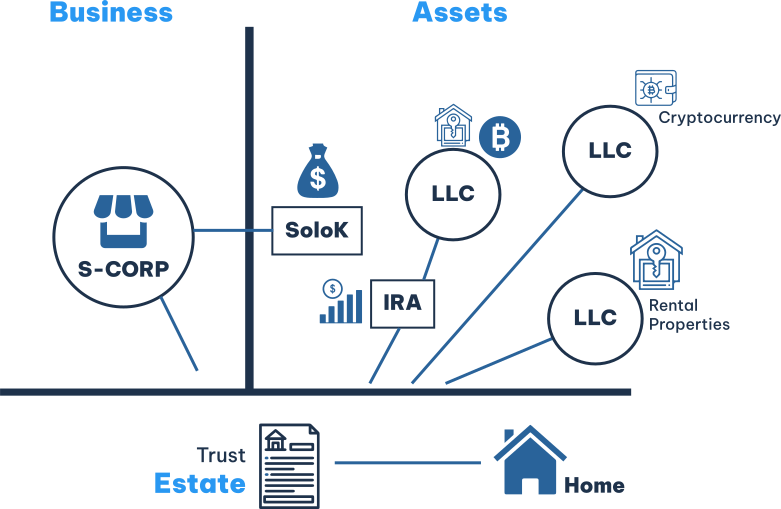
    *See diagram below from KKOS Lawyers where we illustrate a strategic diagram organizing the three major areas of an entrepreneur’s tax and legal world.


Ask Yourself These 4 Questions

Still unsure whether you really need an LLC? Ask yourself these four questions:

  1. Do I need asset protection?
    If there’s risk involved in what you’re doing—customers, clients, employees, tenants—you probably do.
  2. Am I starting a company?
    You’ll need an LLC to open a business account, to keep finances clean, to establish your company name and brand, and build legitimacy.
  3. Do I have partners or investors?
    Then you absolutely need an operating agreement (aka partnership agreement) to define roles and protect everyone involved.
  4. Do I own rental property or other risk-based assets?
    If it has liability exposure (e.g. tenants), it needs to be in an LLC.

If you answered yes to any of these, it’s time to consider forming an LLC.

Tax Considerations


When you set up an LLC you need to make tax elections. Doing this incorrectly will cost you greatly with the IRS. In general you should make the following S-Corp elections:

  • Operating Businesses: If you sell goods or services at less than $50K per year – choose to be taxed as an S-Corp – See vid above for why
  • Partnership: If you have a partner or more than 1 owner you’ll typically opt partnership
  • Sole Proprietorship: If you have a rental or an operating business making less than $50K per year

Final Thoughts

LLCs aren’t one-size-fits-all—but they’re a smart move in the right situations.

At KKOS Lawyers, we’ve helped thousands of clients form, fix, and optimize their LLCs in all 50 states. Whether you’re starting something new or need to clean up an existing structure, we can help.

Contact KKOS Lawyers to Get Started


Key Takeaways

  • LLCs protect your personal assets – If something goes wrong in the business, lawsuits stop at the LLC.
  • A real company needs a real structure – An LLC adds legitimacy, helps you get financing, and separates business from personal finances.
  • Partners and investors = operating agreement – Don’t run a business with others unless you have the terms spelled out.
  • Rental properties should be in an LLC – It protects your other assets and keeps your real estate investments legally insulated.
  • Ask the right questions – If you’re dealing with liability, growth, partnerships, or rental income, an LLC is likely the right call.
  • LLC’s can be taxed differently – Choose the right tax election for your situation to minimize your tax liability


New House Tax Bill Drops: Expanded Deductions & Credits in 2025

The House Ways and Means Committee released its sweeping tax bill with tax provisions for small businesses and individuals. From QSBS Small Business 199A Deduction of 22% (made permanent) to individual reduced rates and increased standard deductions, there are plenty of breaks and benefits for every taxpayer.

šŸ“„ Download the Full Explanation from the Joint Committee on Taxation
šŸ‘‰ View the Full Explanation PDF

šŸ“˜ Read the House Summary of the Tax Bill
šŸ‘‰ View the Summary (JCX-18-25)

Key Proposed Changes:

  • Increased Qualified Business Income Deduction (above the current 20%).
  • Expanded Child Tax Credit and higher individual tax credits.
  • Permanent extension of several key tax cuts from the prior tax reform.
  • Enhanced standard deduction and additional temporary increases.