Maxed Out Your 401(k), What’s Next?

Photo of graffiti on the ground reading as "What's Next?"For most American workers and business owners, the first vehicle to save and invest in is your 401(k). The tax benefits and the typical company matching that offers free company money make a 401(k) a great place to save and invest for the long-haul. But what if you’ve maxed out your 401(k) contributions? What else can you do?

Here are the three options you should consider that provide significant tax and financial benefits:
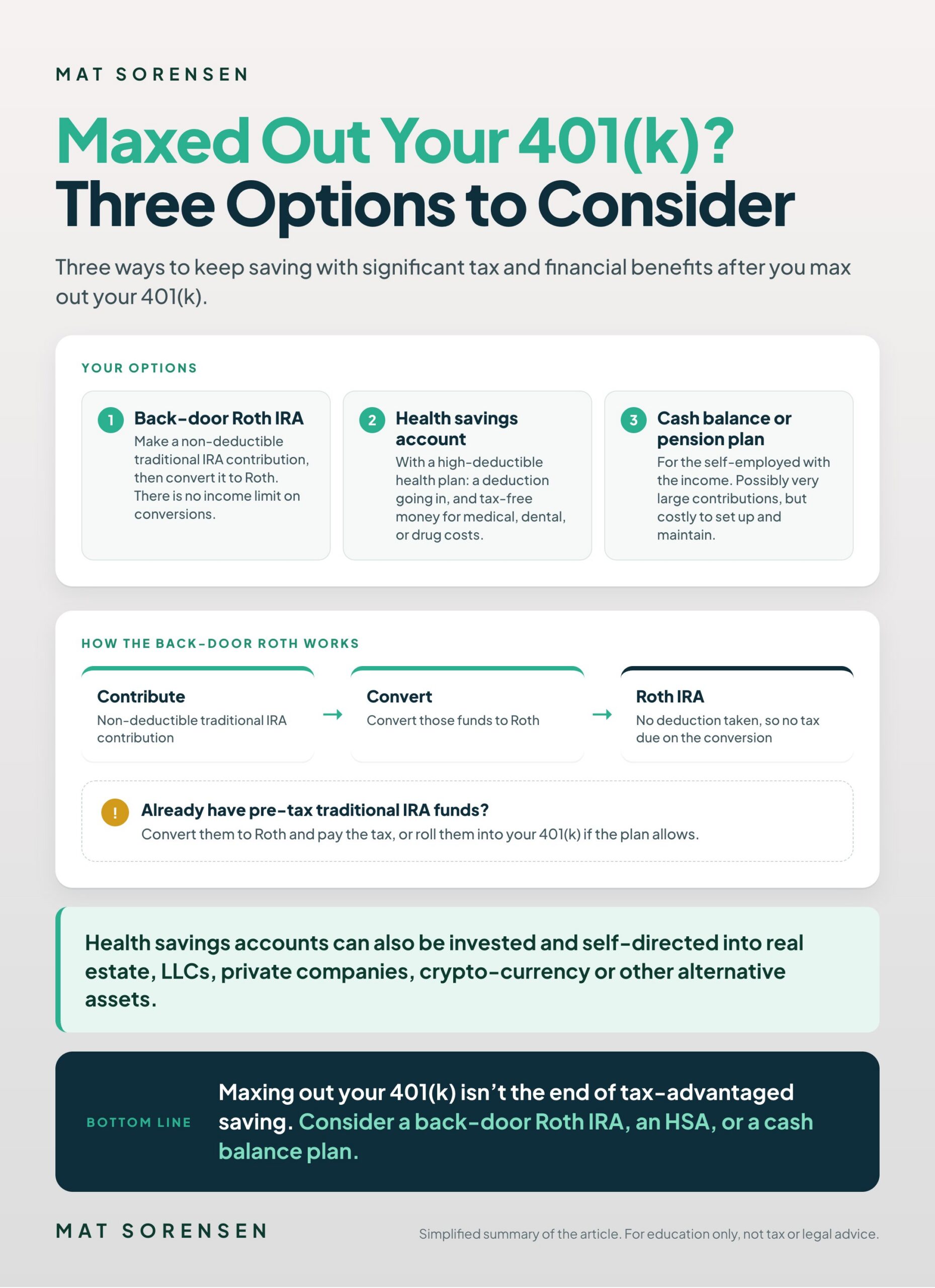
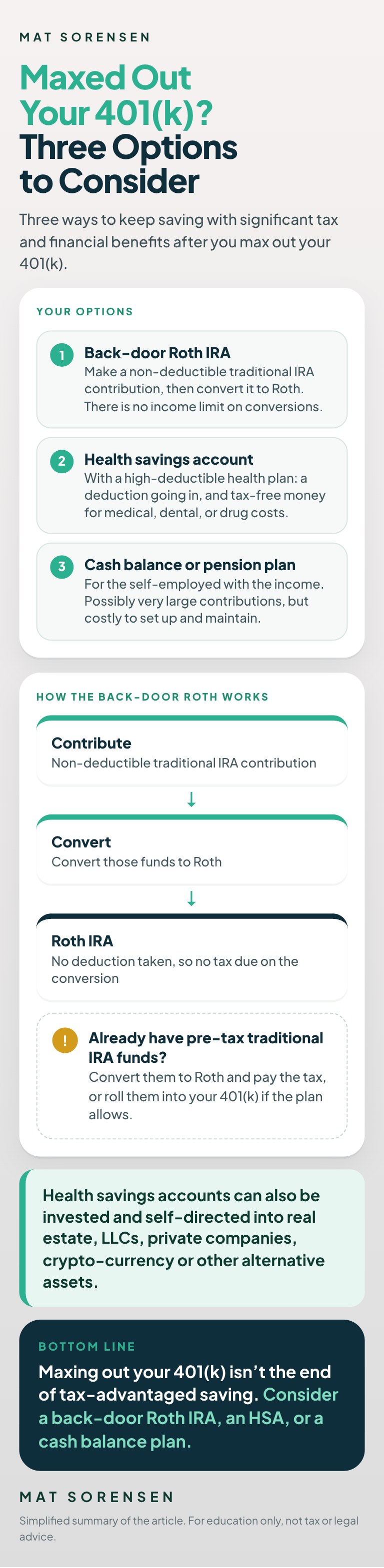
Infographic: three options after maxing out your 401(k), the back-door Roth IRA, a health savings account, and a cash balance or defined benefit plan

1. Back-Door Roth IRA

This is a really cool option that many clients utilize every year. (I do too.) First, you may be thinking that you can’t do a Roth IRA because your income is too high or because you already maxed out your 401(k). WRONG: It is still possible to do a Roth IRA, but you just have to know the back-door route. The reason it’s called a back-door Roth IRA is because you make a non-deductible traditional IRA contribution (up to $5,500 annual limit, $6,500 if 50 or older). Then, after the non-deductible traditional IRA contribution is made, you then convert the funds to Roth. There is no income limit on Roth conversions, and since you didn’t take a deduction on the non-deductible traditional IRA contribution, there is no tax due on the conversion to Roth. And now, voila, you have $5,500 in your Roth IRA. That’s the back-door route.

UPDATE (NOV 2026)

This section uses the IRA limits from when this article was written. For 2026, the IRA contribution limit is $7,500 ($8,600 if you’re 50 or older). (Source: IRS)

There is a road block though for some who already have funds already in traditional IRAs. The Roth conversion pro-rata rule states that you can’t convert only your non-deductible traditional IRA funds. Each conversion is treated as coming proportionally from all of your traditional IRA funds, including your pre-tax traditional IRA funds, which you got a deduction for and now pay tax on when you convert (this is figured on Form 8606 using the year-end value of all your traditional IRAs). So, if you have pre-tax traditional IRA funds and you want to do the back-door Roth IRA, you have two options:

  1. 1First, convert those pre-tax traditional IRA dollars to Roth and pay the taxes on the conversion.
  2. 2Second, if your 401(k) allows, you can roll those pre-tax traditional IRA dollars into your 401(k).

If you don’t have a traditional IRA, you’re on easy street and only need to do the two-step process of making the non-deductible traditional IRA contribution and then convert it to Roth.

You have until April 15th of each year to do this for the prior tax year. Additionally, while the GOP tax-reform restricted Roth re-characterizations, Roth conversions and the back-door Roth IRA route were unaffected. For more detail on the back-door Roth IRA, check out my prior article here.

2. Health Savings Account (HSA)

If you have a high-deductible health insurance plan, you can make contributions to your HSA up until April 15th of each year for the prior tax year. Why make an HSA contribution? Because you get a tax deduction for doing it, and because that money comes out of your HSA tax-free for your medical, dental, or drug costs. You can contribute and get a deduction, above the line, of up to $4,400 if you’re single or for up to $8,750 for family (2026). We all have these out-of-pocket costs, and this is the most efficient way to spend those dollars (from an account you got a tax deduction for putting money into). If you didn’t have a high deductible HSA-qualifying plan by December 1st of the prior year, then the HSA won’t work.

Any amounts you don’t spend on medical can be invested in the account and grow tax-free for your future medical or long-term care. Health savings accounts can also be invested and self-directed into real estate, LLCs, private companies, crypto-currency or other alternative assets. We’ve helped many clients invest these tax-favored funds using a self-directed HSA.

For more details on health savings accounts, check out my partner Mark’s article here.

3. Cash Balance Plan or Defined Benefit Plan

If you’re self-employed you may consider establishing a cash balance plan or a defined benefit plan (aka “pension”), where you can possibly contribute hundreds of thousands of dollars each year. The amount of your contribution depends on your income, age, and the age and number of employees you may have. A cash balance plan or defined benefit plan/pension will cost you ten thousand dollars or more in fees to establish, and is far more expensive to maintain and administer. But, if you have the income, it’s a valuable option to consider. For more details on cash balance plans, check out Randy Luebke’s article here.

FREE SELF-DIRECTED IRA GUIDE

Learn how a self-directed Roth IRA can invest in real estate, private companies, notes, and more, and keep the growth tax-free.

Get the Free Self-Directed IRA Guide

Prefer to talk it through? Book a call with a Directed IRA specialist

IRS Announces 2018 Retirement and HSA Contribution Amounts

Photo of woman standing with her fists raised above her head in front of a sunrise.The IRS announced new contribution amounts for retirement accounts in 2018, and there are some winners and losers in the bunch.

The biggest win goes to 401(k) owners, including Solo K owners, who saw employee contribution amounts go from $18,000 to $18,500. Health savings account (HSA) owners won a small victory with individual contribution maximums increasing $50 to $3,450 and family contribution amounts increasing by $150 to $6,900.


However, IRA owners lost with no increase in the maximum contribution amount for Traditional or Roth IRAs. The IRA maximum contribution amount remains at $5,500 and hasn’t increased since 2013.

Breakdown


Here’s a quick breakdown on the changes:

  • 401(k) contributions also increased for employees and employers: Employee contribution limitations increased from $18,000 to $18,500 for 2018. The additional catch-up contribution for those 50 and older stays the same at $6,000. The annual maximum 401(k) (defined contribution) total contribution amount increased from $54,000 to $55,000 ($61,000 for those 50 and older).
  • HSA contribution limits increased from $3,400 for individuals and $6,750 for families to $3,450 for individuals and $6,900 for families.
  • IRA contribution limitations (Roth and Traditional) stayed at $5,500, as did the $1,000 catch-up amount for those 50 and older.

There were additional modest increases to defined benefit plans and to certain income phase-out rules. Please refer to the IRS announcement for more details here.

These accounts provide tax advantageous ways for an individual to either save for retirement or to pay for their medical expenses. If you’re looking for tax deductions, you should determine which of these accounts is best for you. Keep in mind there are qualifications and phase out rules that apply, so make sure you’re getting competent advice about which accounts should be set up in your specific situation.

California Rollover IRAs Can Receive ERISA-Style Creditor Protection

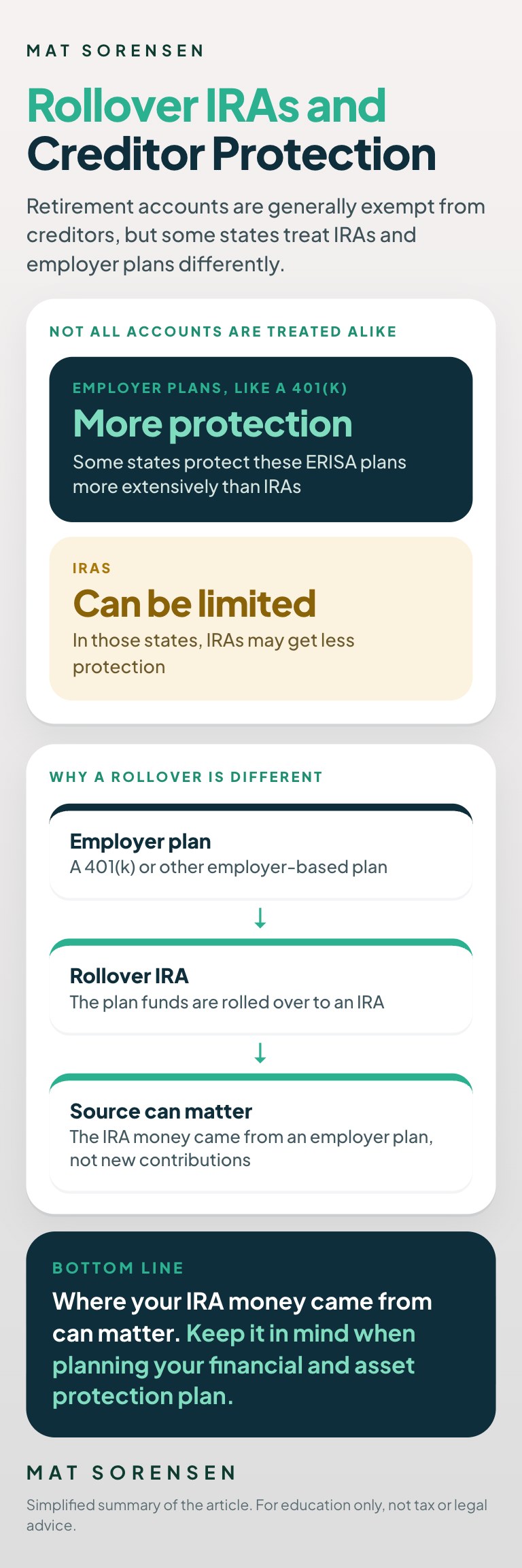
Have you rolled over your 401(K) plan or other employer based plan to a rollover IRA? Has someone told you that your rollover IRA in California isn’t protected from creditors. They’re wrong.

Infographic: retirement accounts are generally exempt from creditors, but some states protect employer plans like a 401(k) more than IRAs, and a rollover IRA holds money that came from an employer plan

California Exemptions

Retirement plans are known for being great places to build wealth and they have numerous tax and legal advantages. One of the key benefits of building wealth in a retirement account is that those funds are generally exempt from creditors. However, some states have laws that protect employer based retirement plans (aka, ERISA Plans) more extensively than IRAs. California is one of those states as their laws treat IRAs and ERISA based plans differently (the California Code refers to ERISA based plans, such 401(k)s, as private retirement plans) .

California Code of Civ. Proc., § 704.115, subds. (b),(d), treats funds held in a private retirement plan as fully exempt from collection by creditors. “Private retirement plans” include in their definition “profit-sharing” plans. The most common type of profit sharing plan is commonly known as a 401(k) plan.

IRAs, on the other hand, are only exempt from creditors up to an amount “necessary to provide for the support of the … [IRA owner, their spouse and dependents] … taking into account all resources that are likely to be available…” In other words, the exemption protection for IRAs is “limited”. California Code of Civ. Proc., § 704.115, subdivision (e).

McMullen v. Haycock

Notwithstanding the limited creditor protections for IRAs outlined above, the California Court of Appeal has ruled that rollover IRAs funded from “private retirement plans” receive full creditor protection as if they were a fully protected private retirement plan under California law. McMullen v. Haycock, 54 Cal.Rptr.3d 660 (2007). In McMullen v. Haycock, McMullen had a judgement against Haycock for over $500,000.  McMullen attempted to get a writ of execution against Haycock’s IRA at Charles Schwab. In defending against the writ of execution, Haycock claimed that the entire IRA was a rollover IRA funded and traceable to a private retirement plan and thus fully protected from collection as a private retirement plan. Haycock relied on California Code of Civ. Proc., § 703.80, which allows for the tracing of funds for purposes of applying exemptions.

Haycock lost at the trial court level but appealed and the appellate court found in his favor and ruled that his rollover IRA was fully protected from the collection of creditors as the funds in the rollover IRA were traceable to a fully exempt private retirement plan (e.g. former employer’s 401(k) plan).

As a result of McMullen v. Haycock, California IRA owners whose IRAs consist entirely of funds rolled over from a private retirement plan of an employer are fully protected from the collection efforts of creditors. IRAs that consist of individual contributions and are not funded from a prior employer plan rollover will only receive limited creditor protection. It is unclear so far how an IRA would be treated that consists of both private retirement plan rollover funds and new IRA contributions. Presumably, the Courts will trace the funds and separate out the private retirement plan rollover IRA portions from the regular IRA contributions and the regular IRA contributions would then receive the limited protection. Unfortunately, there is no case law or guidance yet as to rollover IRAs with mixed rollover and regular IRA contributions.

McMullen v. Haycock was a big win for IRA owners with funds rolled over from a private retirement plan and one that should be kept in mind when planning your financial and asset protection plan.

FREE ROLLOVER GUIDE

Learn how to move an old 401(k) or IRA into a self-directed IRA, tax-free.

Get the Free Transfers & Rollovers Guide

Prefer to talk it through? Book a call with a Directed IRA specialist

Avoiding State Income Tax on Retirement Plan Distributions

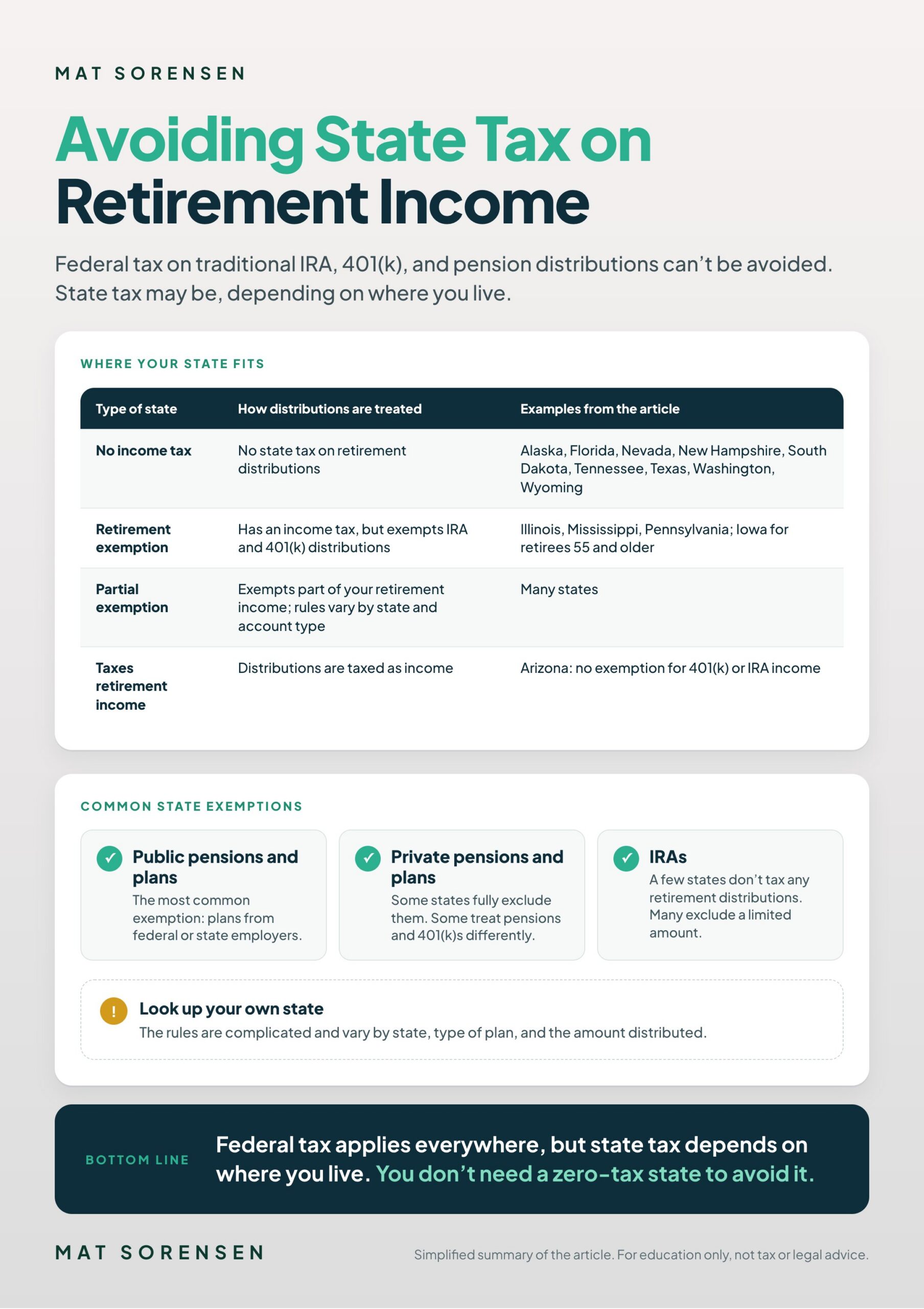
When a retiree begins taking distributions from a traditional IRA, 401(k), or pension plan, those distributions are taxable to the retiree under federal income tax and any applicable state income tax rules. While federal taxation cannot be avoided, state taxation may be avoided depending on your state of residency. In general, there are some states that have zero income tax and therefore don’t tax retirement plan distributions, some states that have special exemptions for retirement plan distributions, and other states that do in fact tax retirement plan distributions. This article breaks down the basics and discusses some of the states where income taxes can be avoided.

Infographic: how no-income-tax states, retirement exemption states, and taxing states treat IRA, 401(k), and pension distributions, plus common state exemptions

The No State Income Tax States

First, the easiest way to avoid state income tax on retirement plan distributions is to establish residency in a state that has no state income tax. It isn’t just the fun and sun of Florida that helps attract all of those retirees. It’s the tax-free state treatment of all that money stocked away in your retirement account. As of 2026, nine states have no income tax on wages or retirement distributions: Alaska, Florida, Nevada, New Hampshire, South Dakota, Tennessee, Texas, Washington, and Wyoming.

States with Retirement Income Exclusions

Second, some states have an income tax but exempt retirement plan distributions. In 2026, Illinois, Mississippi, and Pennsylvania exempt IRA and 401(k) distributions, and Iowa exempts them for retirees 55 and older. Many other states exempt part of your retirement income, and the rules vary by state and by type of account. Here’s a quick summary of the common exemptions found in the states.

  1. 1For Public Pensions and Retirement Plans. Distributions from federal or state employer plans are exempt from taxation in many states. This is the most common exemption amongst states that have an income tax but who exempt some types of retirement plan distributions from income. Most of the states that have an exemption for retirement plan income provide an exemption for public employee pensions and retirement plans.
  2. 2For Private Pensions and Retirement Plans. Some states offer a full exclusion for private pensions and retirement plans. Some of them differ between pension and contributory plans (e.g. 401(k)) and some of them make no distinction. Pennsylvania, for example, excludes all income distributions. Hawaii excludes certain distributions from state income tax for private retirement plans and for portions from company plans rolled over to a rollover IRA and then distributed from the rollover IRA.
  3. 3For IRAs. There are some states that do not tax any retirement plan distributions, including IRA distributions to retirees. Illinois for example does not tax distributions from retirement plans at all (pensions, IRAs, 401(k)s). There are also numerous states that exclude a certain limit of retirement plan income from taxation.

Know Your State’s Rules

In sum, the state tax rules for retirement plan distributions are complicated and vary significantly. Each state can be understood rather quickly though and everyone planning for retirement should understand how state income taxes may eat into their planned retirement plan distributions.

EXAMPLE

I, for example, looked into Arizona and found that there is no exemption for 401(k) or IRA income in the state of Arizona. While we do have a low state income tax rate, Arizona state income tax includes income from private retirement plans (pensions and 401(k)s) and IRAs and has a modest deduction for distributions from public retirement plans.

Each state is unique to the type of plan, and the amounts being distributed but don’t just think you need to be in a state with zero income tax to avoid taxes on retirement plan distributions. For example, you could be in Illinois, Tennessee, or New Hampshire and could realize state income tax-free distributions of your IRA or 401(k).  The National Conference of State Legislators has an updated 2015 chart that is very useful and can be used to look up your state’s tax treatment of retirement plan distributions for retirees.

FREE SELF-DIRECTED IRA GUIDE

Learn how to invest your IRA in real estate, private companies, notes, precious metals, and more.

Get the Free Self-Directed IRA Guide

Prefer to talk it through? Book a call with a Directed IRA specialist
Who Should I List as Trustee of My Trust?

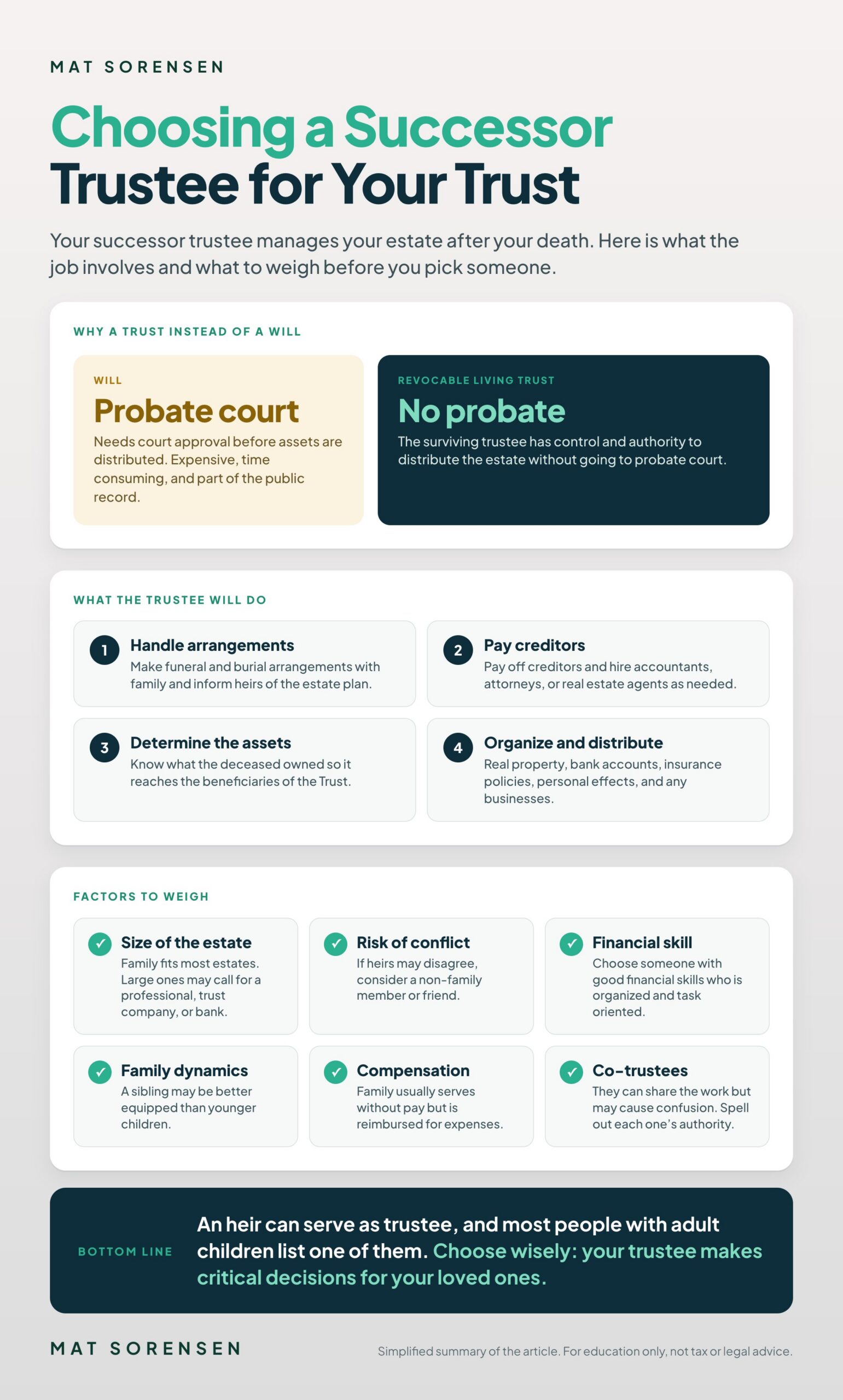
If you are establishing an estate plan, it is likely that you will have a Revocable Living Trust (“Trust”) as the primary document that outlines who will receive your assets upon your death and what conditions, if any, will be placed on those assets. As many persons are aware, a Trust has numerous advantages over a will because upon the death of the owner(s) of the Trust, the surviving trustee of the Trust will have control and authority to distribute the estate of the deceased person without having to go to probate court. A will, by contrast, typically must receive Court approval and distribution of the assets occurs only after going through probate court and getting orders from the Court. The probate process of a will is expensive, time consuming, and is part of the public record.

When establishing a revocable trust you will be outlining your assets and who will receive those assets upon your death. You will also outline certain conditions that may be placed on your assets. For example, you may state that your children will receive an equal share of your estate upon your death and the death of your spouse but your children shall not receive a distribution if they have a drug or alcohol addiction or if they have a creditor who would seize the funds. The trust may also restrict distributions to minor children so that they don’t receive a large inheritance when they are 18.

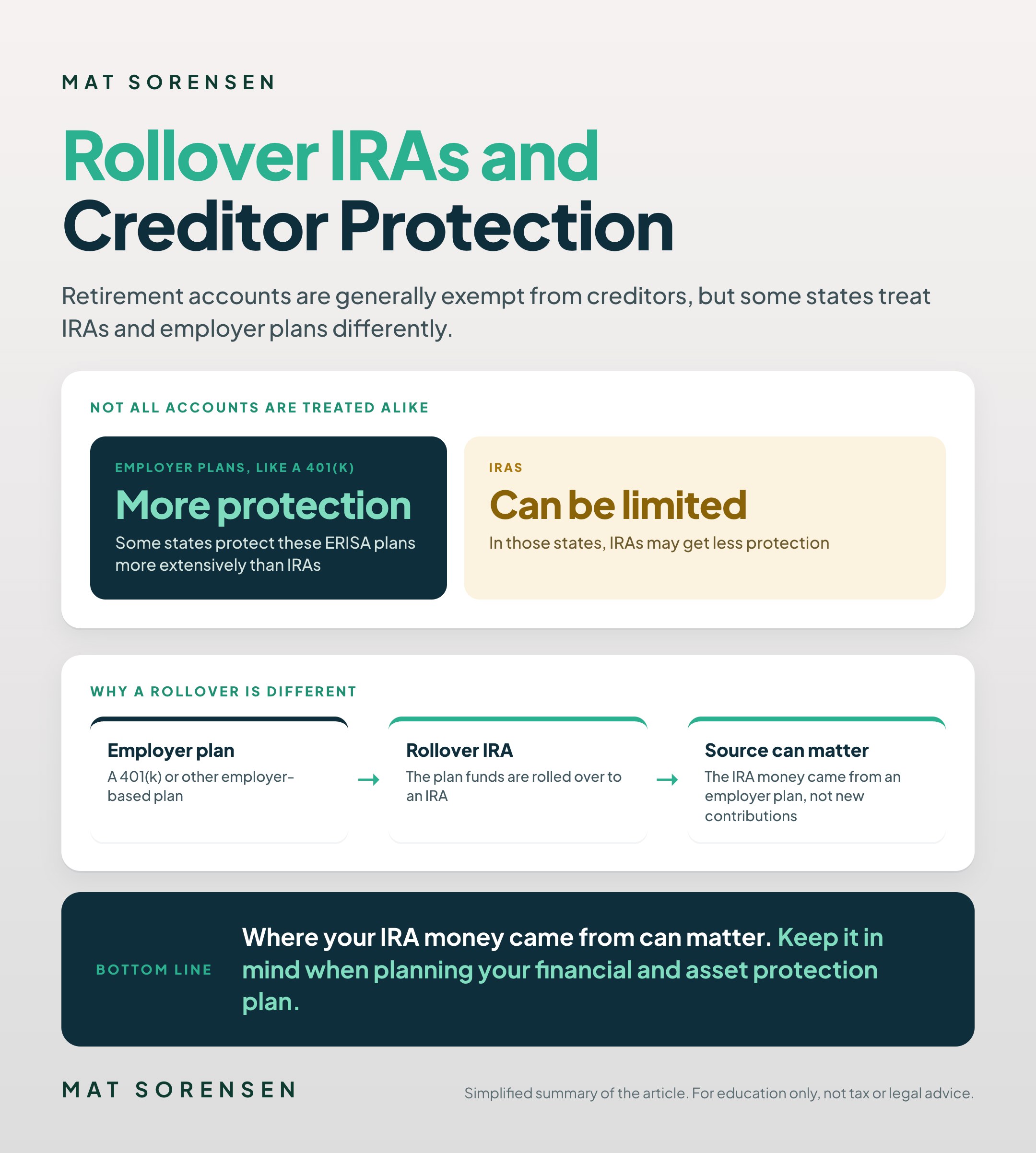
Infographic: why a trust avoids probate, what a successor trustee does, and the factors to weigh when choosing one

Trustee Selection

One of the most significant decisions you will make when you establish your Trust is who will be the Trustee of your Trust upon your death. In most situations, you will be the trustee during your lifetime and if you have a spouse your spouse will be trustee if they survive you. However, you will need to select a successor Trustee of your Trust who will manage your estate following your death (and the death of your spouse, as applicable). This successor Trustee may be a family member, friend, bank or trust company, or an attorney or other professional. When determining who should be your Trustee, you should consider the following issues and factors.

What Will the Trustee Do?

The Trustee will need to undertake the following tasks.

  1. 1Typically will make funeral and burial arrangements along with family members (generally the Trust pays for these things).
  2. 2Inform family members and heirs of the estate plans of the deceased.
  3. 3Will pay off creditors and hire professionals as needed to assist with the estate (accountants, attorneys, real estate agents, etc.).
  4. 4Determine assets. They will need to know the assets of the deceased in order to ensure that they are distributed to the heirs/beneficiaries of the Trust.
  5. 5Organize assets for distribution. This may include listing and selling real property. It will likely include coordinating the distribution of bank accounts and insurance policies. It will also include organizing and distributing personal effects (e.g. jewelry, furniture, art, personal effects). And finally, it may include the winding down, sale, or transfer of businesses.

Size of the Estate

Most Trusts will list a family member as the Trustee of the estate and for estates of a couple million dollars or less this is generally a good fit. However, for estates over $3M you may want to consider listing a professional (attorney or law firm) as the successor trustee of your estate and for estates over $10M you may want to consider listing a trust company or bank as the trustee of your estate. Large estates can overwhelm a family member who has never handled such matters before and having a professional with experience can go a long way. The Trust will need to pay for these services (generally in the tens of thousands of dollars) so it isn’t typically advisable for smaller estates unless there is no other adequate family member or friend available.

When to List Non-Family?

If you have heirs/beneficiaries who are likely to disagree and cause contention, you may want to list a non-family member or a friend as the Trustee so that a third party can make decisions and so that you can avoid potential contention and litigation over your estate.

Financial Expertise of the Trustee

If you are selecting a family member, choose one who has shown good financial skills over their life. If you’re selecting a child over another, consider their financial expertise, work background, location, and family dynamics in selecting one child as Trustee over another. Also, choose someone who is well organized and who is task oriented. The Trustee will have many things to accomplish and you want someone who will take care and responsibility for these things.

Family Dynamics

All families are different and all situations are unique. As a result, you may select a brother or sister as your successor Trustee instead of choosing a child or other family member. This may be because your children are younger or because a sibling is better equipped to handle the administration of your estate.

Trustee Compensation

If you are listing a family member as Trustee, they typically will serve without compensation but will be reimbursed for any expenses they incur while serving as Trustee. You may compensate them or give them something extra from the estate for taking on the responsibility but generally family members are listed to serve without compensation.

Can an Heir/Beneficiary be a Trustee?

Yes, you may have a beneficiary/heir serve as Trustee and this is very common. In fact, most persons who have adult children will list a child as the successor Trustee and this person will also typically be a beneficiary/heir. While there is some conflict of interest in this arrangement, the Trustee is bound to the terms of the Trust and can’t abuse that discretion for their own personal benefit.

Should I Appoint Co-Trustees?

Some persons will consider listing co-beneficiaries as successor Trustees. Typically, this is done as a way to involve more than one family member in the distribution of the estate so that one person doesn’t feel left out. While there can be some benefits to involving another person as Trustee (e.g. sharing the workload, combining skills of persons listed) it can cause contention and confusion as to who is doing what so be specific about their authority and responsibility if you are listing multiple trustees.

Who is Most Commonly Listed as Trustee?

Most persons with adult children will list one of their children as successor Trustee. Most persons with younger children will list a sibling or close friend as their successor Trustee.

Your Trustee has an important and critical task in managing your estate following your death. Choose wisely as they will need to make critical decisions that will affect your loved ones.