Maximize Roth 401(k) Dollars: What Can You Roll-Over or Convert to Roth in Your Solo 401(k)?
Many savvy investors have come to find Roth retirement accounts as a great tool to building long-term tax-free wealth. Roth IRAs were first introduced in 1997. Roth 401(k)s came around in 2006 but had many restrictions and were not widely offered. Under current 401(k) rules, you can contribute $17,500 a year to your Roth 401(k) account as an employee contribution. You can contribute up to an additional $34,500 to your 401(k) for the year, depending on your income, up to a total amount of $52,000 but the $34,500 would be employer contributions and must be Traditional dollars. So, if you’re self-employed and have a solo 401(k) and want to max-out your 401(k) contributions you could contribute $17,500 as Roth 401(k) dollars and $34,500 of Traditional 401(k) dollars. But what if you want all of the funds to be Roth 401(k) dollars? Well, have no fear; all you have to do is convert the Traditional 401(k) dollars to Roth. Also, what if you want to roll-over existing retirement accounts to your Roth 401(k)? This is also possible, you just have to roll the funds over and convert. This article outlines the brief history and details on how you can maximize your Roth 401(k) account.
UPDATE (NOV 2026)
The limits above are from when this article was written. For 2026, the employee deferral limit is $24,500 ($32,500 at age 50+) and the total limit is $72,000. Since the SECURE 2.0 Act (2022), a 401(k) plan can also let employees choose Roth treatment for employer matching and profit-sharing contributions (if fully vested); those contributions are taxable in the year they’re made. (Source: IRS; IRS Notice 2024-2)
Converting Traditional 401(k) Dollars to Roth
The American Taxpayer Relief Act of 2012 (“ATRA”) totally changed the game for Roth 401(k)s. Following ATRA, Roth 401(k)s became significantly more beneficial to investors for one simple reason: you could more easily put your existing retirement plan dollars into it. Since 2012, any 401(k) account owner, whose plan offers a Roth 401(k) account (and most now do), is eligible to convert any and all of their existing Traditional 401(k) dollars to Roth 401(k) dollars. This includes Traditional IRA rollovers to the 401(k), 401(k) employee contributions, and vested 401(k) employer contributions. Keep in mind that when you convert any Traditional retirement plan dollars to Roth 401(k) dollars that you will be taxed on the amount converted. That’s what Roth retirement account dollars are. They are post-tax retirement plan funds (you’ve paid taxes on them already) that grow tax-free and are withdrawn at retirement tax-free (age 59 ½).
Transfer and Rollover Rules
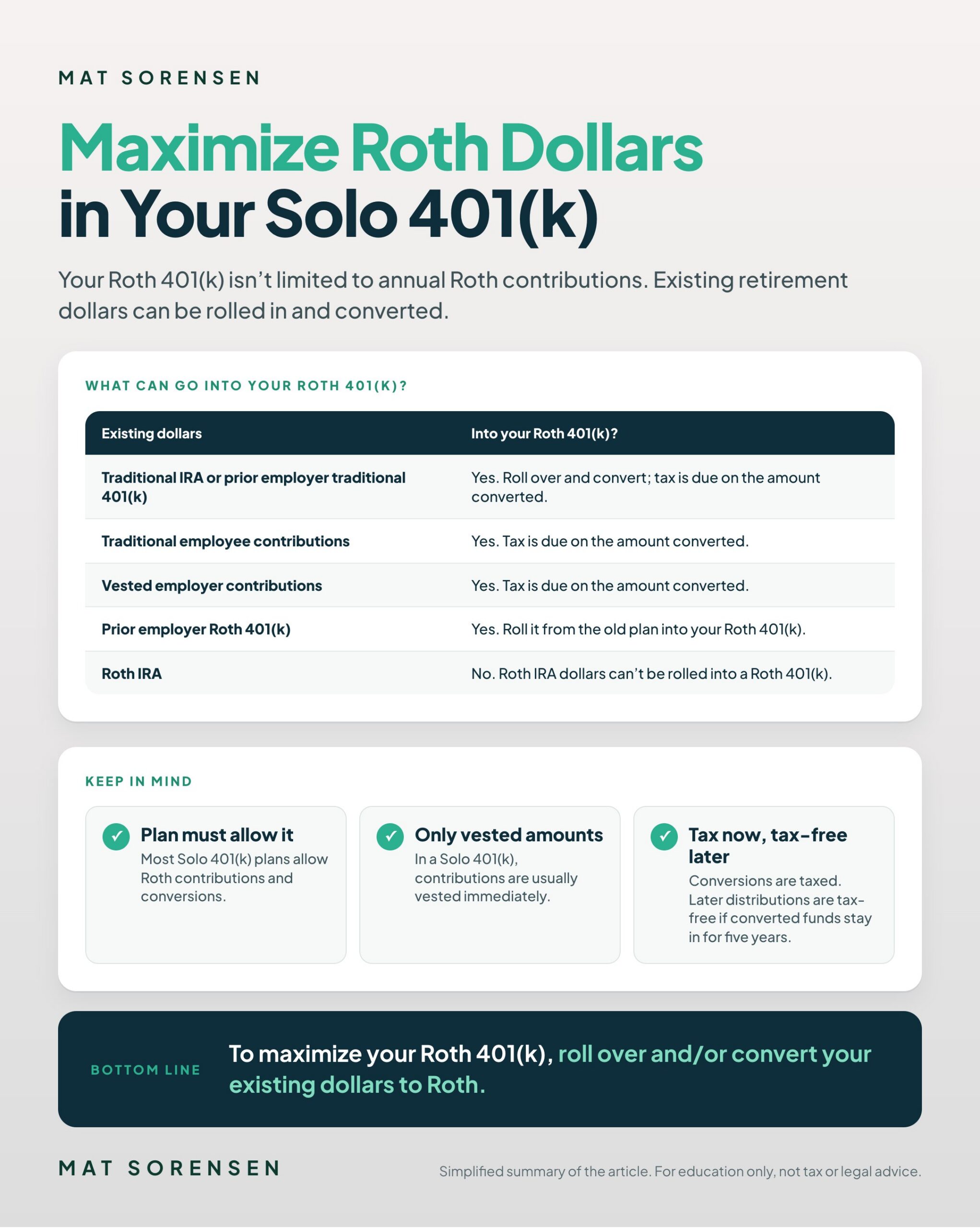
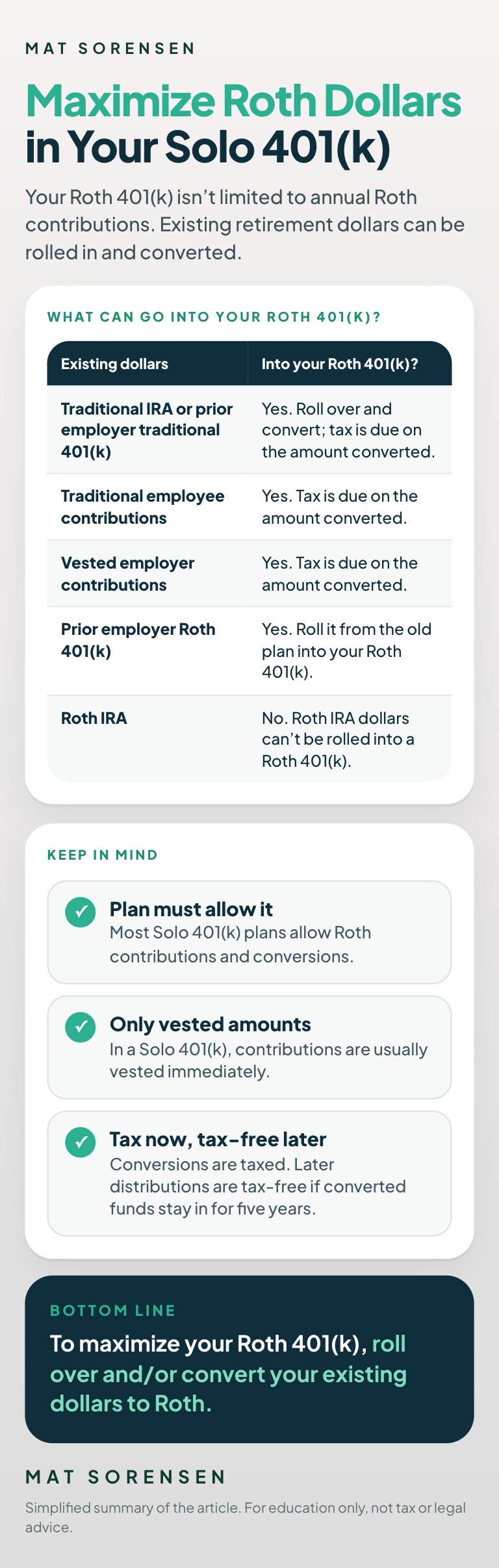
Additionally, funds in prior employer Roth 401(k)’s may be rolled into your existing Roth 401(k). Unfortunately, one source of funds that cannot be rolled, transferred, or converted into a Roth 401(k) are Roth IRAs. Here’s a quick chart breaking down the rules.
| Existing Retirement Plan Dollars | Can These Retirement Plan Dollars Go Into My Roth 401(k)? |
|---|---|
| Transfer/Rollover from a Traditional IRA or Prior Employer Traditional 401(k). | Yes, but tax will be due at the time of conversion on the amount converted to Roth. |
| Traditional Employee Contribution Made to Your Traditional 401(k) Account. | Yes, but tax will be due at the time of conversion on the amount converted to Roth. |
| Employer Contribution Made to Your 401(k). These Are Always Contributed as Traditional Dollars. | Yes, but tax will be due at the time of conversion on the amount converted. |
| Prior Employer Roth 401(k). | Yes, these are rolled from the old Roth 401(k) plan to the existing Roth 401(k). |
| Roth IRA | No, right now you cannot roll Roth IRA dollars into a Roth 401(k). We expect this law to change over time but not anytime soon. |
UPDATE (NOV 2026)
Employer contributions no longer have to be Traditional dollars: under the SECURE 2.0 Act, a plan can let employees choose Roth treatment for them (if fully vested), as noted above. (Source: IRS Notice 2024-2)
In addition to the chart above, here’s a link to IRS Notice 2013-74 which discusses Roth 401(k) conversions and rollovers.
KEEP IN MIND
Keep in mind that conversions to Roth dollars are only permitted if your 401(k) plan allows it. Most Solo or Owner Only 401(k) plans allow for Roth contributions and conversions. Also, only vested amounts are available for conversion, which in a Solo 401(k) plan, all amounts contributed are usually immediately vested. Finally, keep in mind that any amounts converted are still subject to tax based on your personal tax rate liability. However, once converted, later distributions will be tax-free if they are qualified distributions: generally, you must be 59 ½ or older (or disabled, or the distribution is made after your death), and five years must have passed since the start of the year you first made Roth contributions to the plan.
In summary, Roth 401(k) sums can be accumulated from many different sources. They can be accumulated from conversions of traditional IRAs, old employer Traditional 401(k)s, and from existing Traditional 401(k) contributions (employee or employer). You aren’t just limited to putting in your annual $24,500 (2026) of Roth 401(k) dollars each year. So, if you want to maximize your Roth 401(k) account, all you need to do is rollover and/or convert your existing dollars to Roth.
FREE SOLO 401(K) GUIDE
Self-employed? Learn how a self-directed Solo 401(k) works and how much you can contribute.
Get the Free Solo 401(k) Guide
Prefer to talk it through? Book a call with a Directed IRA specialist
