How the “Buy, Borrow, Die” Strategy Builds Wealth and Avoids Taxes

How the “Buy, Borrow, Die” Strategy Builds Wealth and Avoids Taxes

What if you could access millions in wealth without selling your assets—or paying a dime in taxes? That’s exactly what the wealthiest Americans have been doing for decades using a strategy called Buy, Borrow, Die.

While it may sound like a clickbait slogan, this approach is a time-tested way to build and preserve wealth. And despite what you may think, it’s not just for billionaires. Everyday investors use the same strategy with brokerage accounts, real estate, and small businesses.

In this article, we’ll break down how Buy, Borrow, Die works, why it’s so effective, and how you can start using it to grow your wealth while minimizing taxes—legally.

Step 1: Buy Appreciating, Income-Producing Assets

The first step is buying assets you understand—those that generate income and have the potential to appreciate over time.

Think:

  • Investment real estate (rental properties)
  • Stock Portfolios (stocks, ETFs, mutual funds)
  • Privately held businesses (your own company or private equity)

These assets grow over time and, in many cases, generate cash flow along the way via rental income or dividends. That means they not only increase your net worth, they also create ongoing income—which sets the stage for the “borrow” part of the strategy.

Key Rule: Don’t buy and sell. Buy and hold. That’s where real wealth is built.

Step 2: Borrow Against the Assets (Without Selling)

This is where most of the tax planning magic happens.

Rather than selling your appreciated assets—and triggering capital gains tax—you borrow against them. Equity in assets accessed via a loan isn’t taxable income. That means you can unlock your wealth selling assets or owing the IRS.

Two Common Borrowing Scenarios for Building Wealth

  1. Brokerage Account
    Let’s say you’ve built a $1M stock portfolio. You need $200K for a large expense—could be taxes, a business opportunity, or even a major life event.
  • Option A: Sell investments → You trigger capital gains tax. Depending on your bracket and state, you could lose $50K or more just in taxes.
  • Option B: Borrow against your portfolio → You pay no tax. Your portfolio stays fully invested and continues to grow.

This strategy is called securities-based lending. With a securities-backed line of credit, firms like JP Morgan, Wells Fargo, or your private bank will lend you 70–90% of your portfolio’s value, using your stocks, bonds, or mutual funds as collateral.

  • Stay invested
  • Access low-interest liquidity
  • Avoid triggering capital gains tax

Bottom line: You get the cash you need—without dismantling your long-term investment plan.
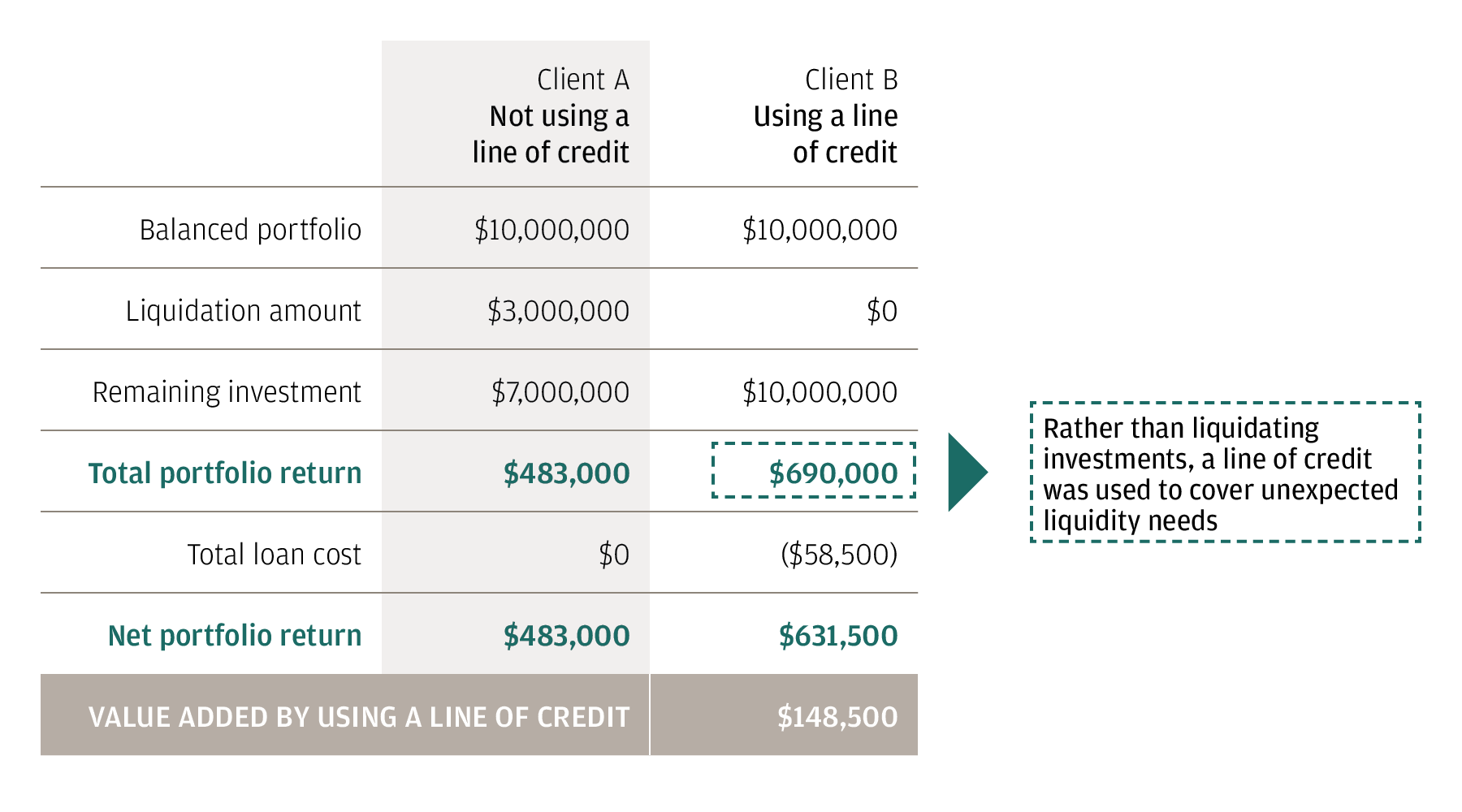
📉 See chart above: Client B uses a line of credit instead of liquidating assets. They keep their portfolio fully invested, pay minimal loan interest, and walk away with $148,500 more in net returns.

  1. Investment Real Estate (Cash-Out Refi)
    Own a $1M rental property with equity? Use a cash-out refinance to pull $700K without selling. You still own the asset, still collect rent, and you pay no tax on the money you borrowed.


Step 3: Die (and Pass It on Tax-Free)

Let’s be honest—this is the least fun part of the strategy. But it’s one of the most powerful.

When you die, your heirs receive a step-up in basis. That means all of the appreciation during your lifetime—stocks, real estate, businesses—is wiped clean from a tax standpoint.

Let’s say:

  • You bought a stock for $100K
  • It’s worth $1M when you pass away
  • You borrowed $700K against it during your lifetime

Your heirs inherit the asset at a $1M stepped up basis – which means they can sell it the next day for $1M and pay zero capital gains tax. The $700K loan is paid off, and the rest goes to them tax-free. In the end neither you nor your heirs paid capital gains tax.

Why This Strategy Works (Even If You’re Not a Billionaire)

You don’t need a $10M portfolio to use this. In fact, many investors use this strategy with:

  • $250K brokerage accounts
  • A single rental property
  • Business equity

Here’s why it works:

  • Loans are not taxable
  • Assets keep appreciating
  • You avoid selling (and shrinking) your net worth
  • Your heirs benefit from a tax-free step-up in basis

Congress has taken notice and bills have been introduced to limit or eliminate the step-up in basis. There have even been bills intended to tax you when you access equity in an asset via a loan. Those bills have all failed. For now, Buy, Borrow, Die remains one of the most powerful—and legal—wealth-building and tax-saving strategies available.

Key Takeaways

  • Buy assets that appreciate and produce income
  • Don’t sell—borrow
  • Loans are not taxable income
  • Borrowing allows you to enjoy your wealth without shrinking your net worth
  • Your heirs can inherit assets tax-free with a step-up in basis
  • This strategy works for real estate, stock portfolios, and even businesses

Ready to Build Your Wealth—Step by Step?

The Buy, Borrow, Die strategy is just one piece of a bigger picture. If you want to know where to start and what to do next, download Mat’s guide on the Ideal Order of Investing.

Whether you’re just getting started or ready to expand into real estate, Roth IRAs, or alternative assets—this is the roadmap.

👉 Download the Free Guide: The Ideal Order of Investing

Take control of your financial future—one smart move at a time.

What to Do with a 401(k) When You Leave Your Employer

What to Do with a 401(k) When You Leave Your Employer


For many Americans, their 401(k) is their largest investment account—and the main source of income they’re counting on for retirement. But when you leave your job, what happens to that money? What’s the best move to keep your savings protected and growing?

The wrong decision could cost you thousands in taxes, penalties, or missed investment opportunities. In this guide, we’ll break down everything you need to know about your 401(k) after leaving an employer—including vesting rules, rollover options, and tax implications—so you can make the best choice for your financial future.

Let’s go over your options, the pros and cons of each, and how to roll over your 401(k) the right way—without triggering unnecessary taxes or penalties.

Step 1: Check Your Vested Balance

Before making a move, the first thing you need to do is determine how much of your 401(k) actually belongs to you.

Understanding Vesting

Your 401(k) balance is split into two parts:

1. Your Contributions – The money you contributed from your paycheck. This is 100% yours, no matter what.

2. Employer Contributions (Match or Profit-Sharing) – This money may be subject to a vesting schedule. If you leave before you’re fully vested, you lose part (or all) of the employer contributions.

How to Check Your Vested Balance:


  • Get your latest 401(k) statement – It will show vested vs. unvested balance.
  • Review your company’s vesting schedule – This is outlined in your Summary Plan Description (SPD).

Know what you’re walking away with – Unvested employer contributions do NOT transfer when you leave.

Example: If your employer has a three-year vesting schedule and you leave after two years, you may only keep 66% of the employer match. If you leave too soon, you could be walking away from thousands of dollars in unvested money.

Once you know your true balance, you’re ready to decide where to move your funds.


Step 2: Weigh Your 401(k) Rollover Options

When you leave your employer, you have four main choices for handling your 401(k). Let’s go through each one.

Option 1: Leave Your 401(k) with Your Old Employer

Some people leave their 401(k) behind at their old job because it seems like the easiest choice. But in most cases, this is a mistake.


Cons of Keeping Your 401(k) at Your Old Job:

  • High fees – The average small business 401(k) charges 1.5% in fees, which could cost you thousands over time.
  • Limited investment options – Most plans restrict you to mutual funds and target-date funds—often with subpar performance.
  • Lack of control – You can’t make quick investment decisions, and accessing funds requires employer approval.

Bottom Line: If you no longer work there, why should your money stay there?


Option 2: Roll It Into Your New Employer’s 401(k)

If your new job offers a 401(k) plan, you may have the option to roll over your old 401(k) into the new one.


Cons of Moving to a New 401(k):

  • No financial benefit – Rolling over doesn’t give you extra employer matching.
  • Still limited investment options – You’re typically stuck with mutual funds or target-date funds.
  • More restrictive withdrawal rules – 401(k) plans often have tighter restrictions than IRAs.

Key Insight: Just because your new job has a 401(k) does NOT mean you should roll your old one into it.


Option 3: Cash Out Your 401(k)

You can withdraw your 401(k) as a lump sum when you leave—but this is one of the worst financial mistakes you can make.

Why Cashing Out Is a Disaster:

  • 10% Early Withdrawal Penalty – If you’re under 59½, you automatically lose 10% to the IRS.
  • Massive Taxes – Your withdrawal is treated as ordinary income, which could push you into a higher tax bracket. For traditional 401(k)s the entire distribution is taxable. For Roth 401(k) balances, only the earnings are taxable if distributed early.

Example: If you cash out a $100,000 401(k):

10% Penalty  -$10,000
30% in Taxes  -$30,000 (depends on your state/federal tax bracket)
Final Amount Received   $60,000


That’s 40% gone instantly.


When Cashing Out Might Make Sense:

  • You’re 59½ or older and ready for retirement.
  • You have no other financial options in an emergency.

For most people, this is the worst choice.

Option 4: Roll Over to an IRA

Rolling your 401(k) into an IRA gives you more control, lower fees, and better investment choices.

Why an IRA Is the Best Move for Most People:

  • Lower fees – No employer plan fees eating into your returns.
  • More investment choices – Could be a brokerage IRA for stocks/ETFs (like Schwab or Fidelity), or a Self-Directed IRA for real estate, private companies, and funds (like at Directed IRA).
  • Greater control – No employer restrictions.
  • Easier Roth conversions – Convert to a Roth IRA for future tax-free growth.

How to Rollover to an IRA Without Taxes or Penalties:

Use a direct rollover – This is critical to avoiding taxes. Your 401(k) provider should send the funds directly to your new IRA provider.

Do NOT take a check in your name – If the check is made out to you, it’s a distribution. You have 60 days to redeposit it into an IRA—or the IRS treats it as taxable income.

Some providers still mail checks – If they do, make sure it’s made out to your IRA provider, not to you personally.


Example: A 401(k) account owner requested a rollover, but the provider sent the check to the account owner. He didn’t redeposit it into an IRA and is now subject to taxes and penalties—and those funds can’t go back into a tax-advantaged account like an IRA.


Best Practice: Always request a direct rollover to the IRA provider to avoid a distribution, penalties, and taxes.


Key Takeaways

  • Check your vested balance first. Make sure you know how much of your 401(k) you actually own.
  • Leaving your 401(k) at your old employer is usually a bad idea – High fees and limited investment options make it less appealing.
  • Rolling your 401(k) into your new employer’s plan may not be the best move – You’ll still be stuck with high fees and limited investment options.
  • Cashing out your 401(k) is a terrible idea for most people under 59½ – Taxes and penalties could take 40% or more of your money.
  • Rolling over to an IRA is the best option for most people – It gives you lower fees, more investment options, and complete control over your retirement funds.
  • Use a direct rollover to avoid taxes and penalties – Never take a check in your name unless it’s your only option, and if you do, you must redeposit the same amount into an IRA within 60 days.


Are you interested in self-directing your IRA? Visit DirectedIRA.com and book a call with our team today!