

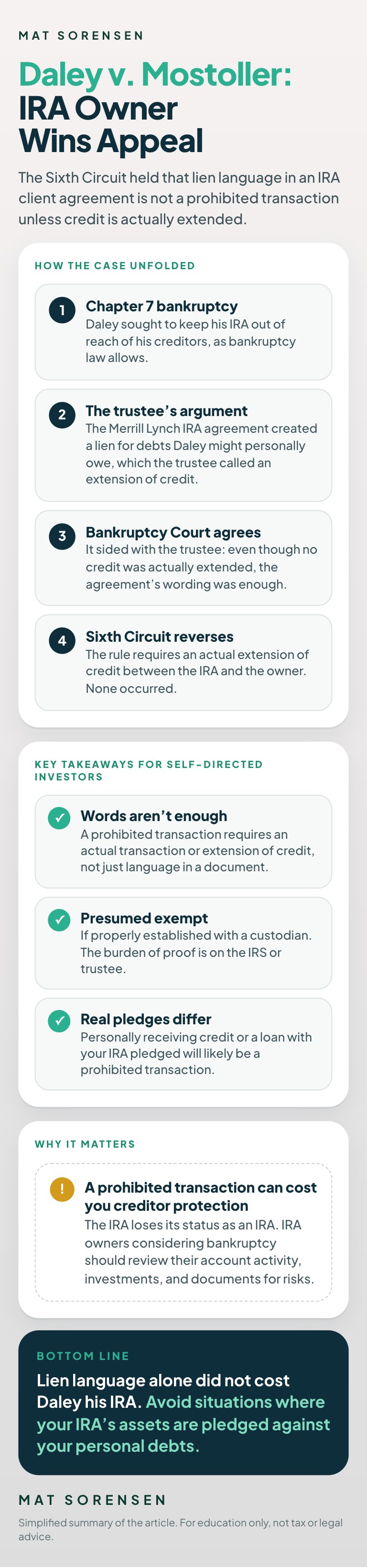
In Daley v. Mostoller, the U.S. Court of Appeals for the Sixth Circuit ruled that an IRA client account agreement which contains a “cross collateralization” or lien against the personal debts of the IRA owner does not constitute a prohibited transaction unless there is an actual execution or extension of credit based on the “cross collateralization” or lien against the IRA. Daley v. Mostoller (In re Daley), No. 12-6130 (6th Cir. June 17, 2013).

How the Case Arose
The case arose when Daley, the IRA account owner, filed Chapter 7 bankruptcy in Tennessee. Under the bankruptcy rules, Daley sought to exclude his IRA from the collection of the creditors as is typical and permissible under bankruptcy laws. The bankruptcy Trustee in the case sought to disqualify the IRA as an exempt asset of Daley by arguing that the Merrill Lynch IRA client agreement violated IRC § 4975(c)(1)(B) of the prohibited transaction rules because it contained language which created a lien in favor of Merrill Lynch for amounts which the IRA owner may personally owe to Merrill Lynch. The argument made by the Trustee was that by agreeing to offer the IRA as collateral to Merrill Lynch for personal accounts the IRA owner was thereby making an extension of credit between his IRA and debts he may personally owe. The result of prevailing on a prohibited transaction claim is that the IRA loses its status as an IRA which results in a loss of the creditor protections which typically allow IRA owners to keep their IRA outside the reach of creditors.
The Sixth Circuit Reverses
Following argument in the bankruptcy case, the Bankruptcy Court agreed with the Trustee in the case and ruled that even though no actual extension of credit or execution on the IRA assets occurred, the actual verbiage in the Merrill Lynch client agreement nonetheless was an extension of credit. Fortunately, the 6th Circuit disagreed and reversed the Bankruptcy Court by ruling that despite the language in the client agreement regarding a lien in favor of Merrill Lynch and the “cross collateralization” of the IRA, the 6th Circuit held that a prohibited transaction had not occurred because the actual language of the rule requires an actual extension of credit between the IRA and the IRA owner personally. The 6th Circuit held that the language in the client agreement did not in and of itself result in a prohibited transaction as no extension of credit actually occurred. While the case at first glance may not seem that applicable to self directed IRA investors it does make a number of important conclusions.
Takeaways for Self-Directed Investors
The important “take aways” from the case for self directed investors are as follows.
- 1The case held that a prohibited transaction only occurs when there is an actual transaction or actual extension of credit that violates the rule not just when there is language in a document allowing for such.
- 2The case reiterated that there is a presumption that an IRA is exempt, if properly established with a custodian, until proven otherwise. In other words, the burden of proving a prohibited transaction is on the agency or person (e.g. IRS or Bankruptcy Trustee) making the allegation. 11 U.S.C. § 522(b)(4)(A).
- 3The Court distinguished this case from cases where an actual extension of credit was made to the IRA owner personally based entirely or in part on a lien given against the IRA. All IRA owners need to be aware that they cannot personally receive an actual extension of credit nor should they actually obtain a loan whereby their IRA is pledged as an asset as those instances will likely result in a prohibited transaction.
WATCH OUT
IRA owners need to be careful to avoid situations where the IRAs assets are being pledged against the debts of an IRA owner. Additionally, IRA owners who have significant IRA accounts and whom are considering entering bankruptcy should carefully analyze their account activity, investments, and investment documents to determine whether there are potential prohibited transaction risks which could result in a bankruptcy trustee obtaining the assets of an IRA for the purpose of paying creditors.
THE SELF-DIRECTED IRA HANDBOOK
Mat’s best-selling guide to the rules: prohibited transactions, UBIT, IRA/LLCs, and the mistakes to avoid.
Prefer to talk it through? Book a call with a Directed IRA specialist

Mat has been at the forefront of the self-directed IRA industry since 2006. He is the CEO of Directed IRA & Directed Trust Company where they handle all types of self-directed accounts (IRAs, Roth IRAs, HSAs, Coverdell ESA, Solo Ks, and Custodial Accounts) which are typically invested into real estate, private company/private equity, IRA/LLCs, notes, precious metals, and cryptocurrency. Mat is also a partner at KKOS Lawyers and serves clients nationwide from its Phoenix, AZ office.
He is published regularly on retirement, tax, and business topics, and is a VIP Contributor at Entrepreneur.com. Mat is the best-selling author of the most widely used book in the self-directed IRA industry, The Self-Directed IRA Handbook: An Authoritative Guide for Self-Directed Retirement Plan Investors and Their Advisors.