Crowdfunding is the newest form of raising capital for small businesses and start-ups and it will eventually dominate as a primary method of raising capital in amounts under $1,000,000. In essence, Crowdfunding relaxes the current securities law restrictions, which make it nearly impossible for a small business or budding entrepreneur to raise capital from others. The basic premise of the Crowdfunding exemption to the securities laws is that the laws are loosened so long as the total amounts being raised are capped ($1M) and so long as each investor is only allowed to invest only a small portion of their income or net worth. For a breakdown on the details of the Crowdfunding rules, check out my prior article here. Keep in mind; the final rules still haven’t been put in effect so Crowdfunding hasn’t started yet. But we’re getting close.
UPDATE (NOV 2026)
Since this article was written, the SEC’s crowdfunding rules took effect (in 2016), and the cap is now $5 million per 12 months (raised from $1.07 million in March 2021). The UBIT figures below have also changed: UBIT is figured at trust tax rates, and for 2026 the top rate of 37% applies above $16,000 of taxable income. (Source: SEC; AAII; IRC 511(b))
Why Self-Directed IRAs Fit Crowdfunding
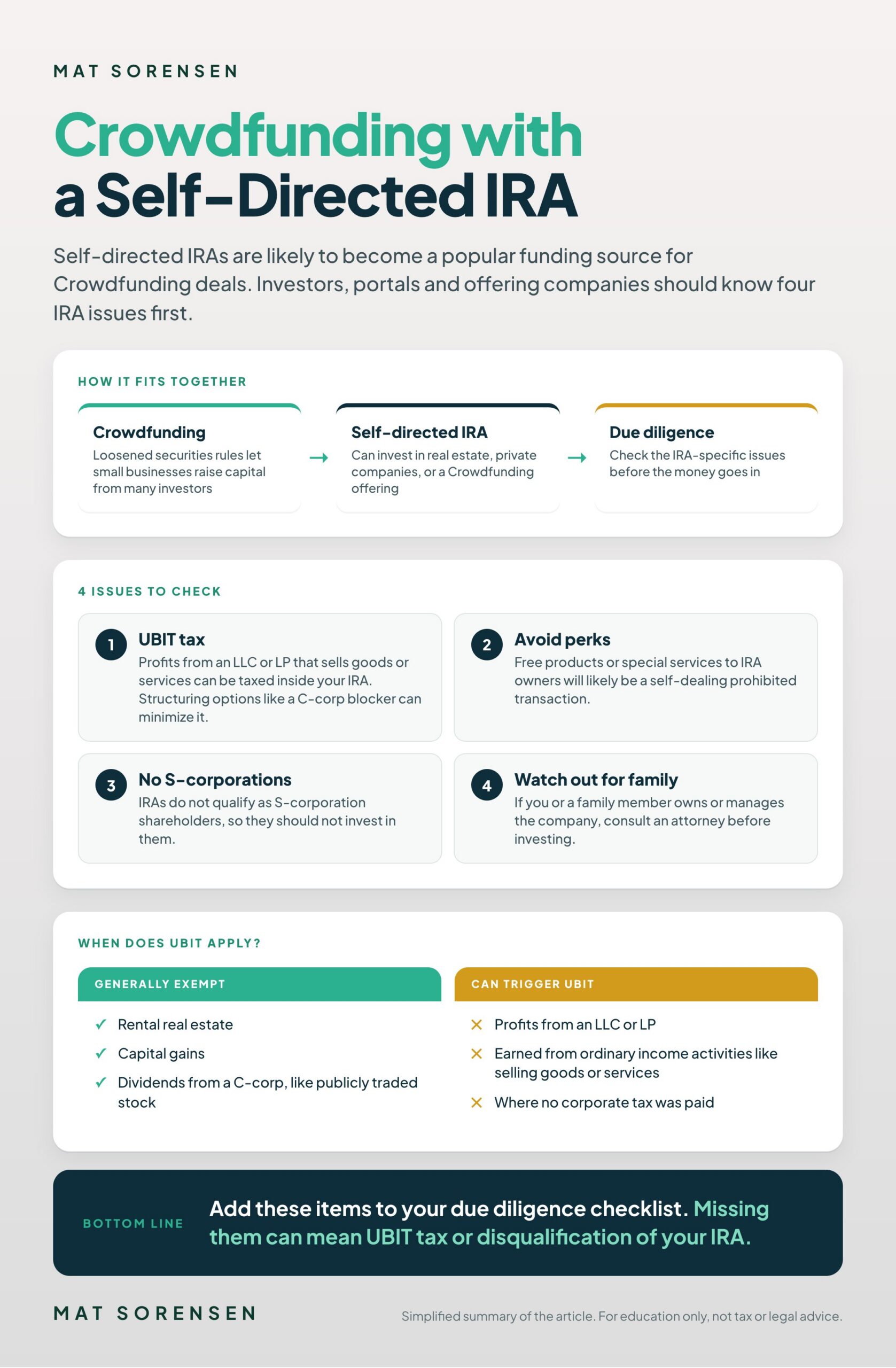
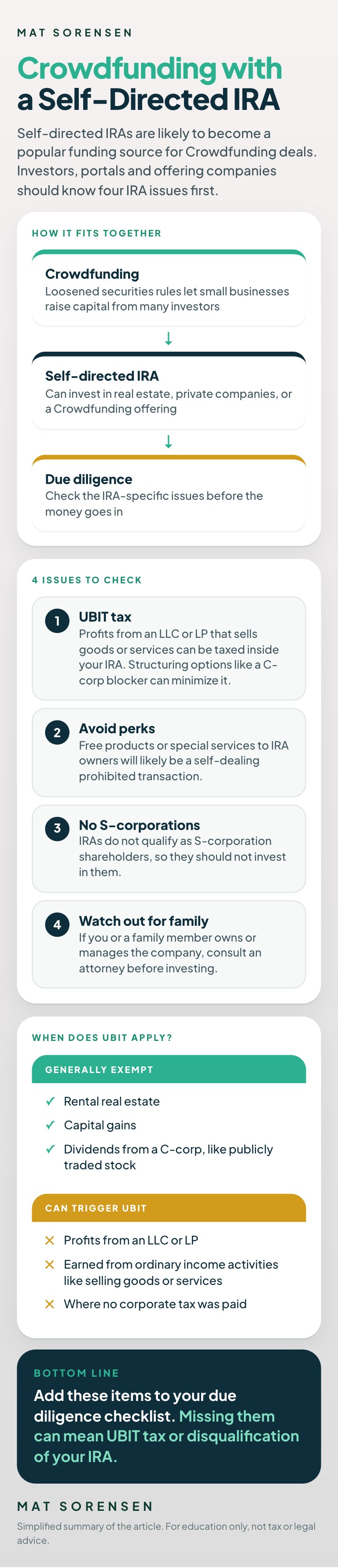
Because the typical investor of a Crowdfunding company is likely to have more investible funds in their retirement account than in their personal account, it is my prediction, and this is shared by many, that self-directed IRAs will become a very popular investment vehicle and funding source for Crowdfunding deals. A self directed IRA is an IRA with a custodian or administrator whereby the IRA can invest into any investment allowed by law. The IRA is not restricted into only investing into publicly traded stocks, bonds, or mutual funds but can instead invest into real estate, private companies, or in a company via a Crowdfunding offering. The companies who offer these types of IRAs are referred to as self-directed custodians.
IRA Issues Unique to Crowdfunding
Before IRA money is invested in a Crowdfunding offering, the parties involved (investor, offering company, portal) should be aware of the following issues that are unique to Crowdfunding where an IRA is involved.
- 1UBIT Tax. There is a tax that can apply to an IRA called unrelated business income tax (“UBIT”). IRC 512. This tax doesn’t apply to IRAs in passive investments like rental real estate, capital gains, or on dividend profits from a C-Corp (e.g. what you get from publicly traded stock owned by your IRA) as those types of income are specifically exempt from UBIT tax. However, one situation when an IRA is subject to UBIT tax is on profits from an LLC or LP where the profits are derived from ordinary income activities like the selling of goods or services. So, for example, if my IRA bought LLC units in a company that manufactured and sold a new yard tool then the profits that are returned to my IRA is ordinary income (where no corporate tax was paid) and will be subject to UBIT tax. The UBIT tax rate is 39.6% once you have $12,000 of annual net profits. Being subject to UBIT tax isn’t the end of the world and there are some structuring options to minimize the tax such as a c-corp blocker company which can cut the tax rate in half in many instances.
- 2Avoid Perks. Many Crowdfunding offerings promise free products or special services to the shareholders/owners that invest through the Crowdfunding offering. Unfortunately, these perks to self-directed IRA owners will likely constitute a self-dealing prohibited transaction and will result in disqualification of the IRA. A self-dealing prohibited transaction occurs when an IRA owner receives personal compensation or otherwise personally benefits from an IRA’s investment. IRC 4975 (c)(1)(F). As a result, perks to self-directed IRA owners should be provided only when it has been determined that they would not result in a self-dealing prohibited transaction.
- 3No S-Corporations. An IRA cannot become a shareholder in an s-corporation because IRAs do not qualify as an s-corporation shareholder under the tax laws. IRC 1361 (b)(1)(B). Consequently, IRAs should not invest in companies that are s-corporations.
- 4Watch Out for Companies Owned or Managed by Family. The tax laws restrict your IRA from investing into companies where you or a family member (e.g., spouse, children, parents) are owners or members of management. IRC 4975(c). As a result, if the Crowdfunding offering is offered by a family member or if a family member is involved in management, make sure you consult with an attorney prior to investing your IRA into the Crowdfunding offering as it could result in a prohibited transaction for your IRA.
The rules regarding self-directed IRAs can be a little tricky at first, but once learned they can be easily applied to common Crowdfunding scenarios. In summary, before investing your self-directed IRA into a Crowdfunding offering, make sure you add the above items to your due diligence check-list. Failure to properly understand these rules can result in taxes (e.g. UBIT tax) or disqualification of your IRA (e.g. prohibited transaction).
FREE PRIVATE FUNDS GUIDE
Learn how self-directed IRA investors put retirement money into private funds and offerings.
Get the Free Private Funds Guide
Prefer to talk it through? Book a call with a Directed IRA specialist
By: Mat Sorensen, Attorney and Author of The Self Directed IRA Handbook.